

















If you run a workshop off Banbury Road, a café in Jericho or a lab on the Science Park, you hear the same thing: a good supplier makes your year; a bad one quietly eats margin, time and goodwill.
The cheapest quote on a spreadsheet isn’t the full story. Choosing well is one of the most critical decisions for any business and has a direct impact on product quality, delivery speed and profitability. It’s vital that you know how to select the best supplier, but supplier selection is often an overlooked area. Which means owners don’t always know what to look for or what to avoid.
Here’s a practical, Oxford-focused way to choose partners you can trust — with a simple scoring method, a total cost of ownership (TCO) formula and a one-page checklist you can print and take on site visits.
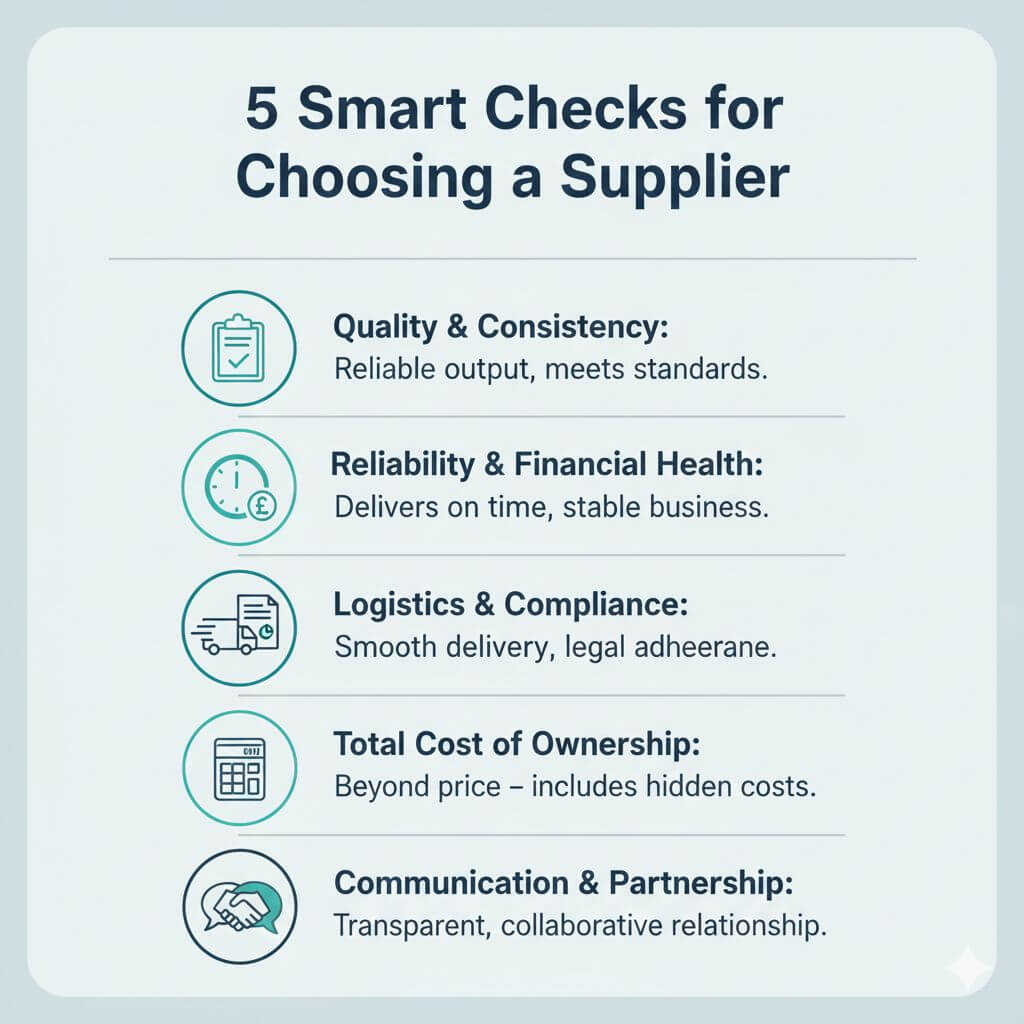
Quality and consistency – define “good” in numbers
Start with what you can measure.
- Agree metrics: defect rate (parts per million), first-pass yield, tolerance bands, on-arrival damage %, packaging spec.
- Ask for hard evidence: recent certificates of analysis/conformity, in-process QC records, sample reports, and a copy of the quality manual.
Check they run a recognised system such as ISO 9001 for quality management, plus sector approvals where relevant:
- ISO 9001:2015
- IATF 16949 for automotive
- BRCGS for food
If you can’t get to the factory, insist on a remote walk-through — look at rework areas, calibration records and non-conformance logs. Quality should be a habit, not a poster.
Reliability, capacity and financial health
Past behaviour predicts future delivery.
- Ask for on-time-in-full (OTIF) data for 12–24 months, typical and peak lead times, and how they cope when demand spikes.
- Check solvency before you fall in love with the price: pull filings on Companies House, scan for positive cash flow and any CCJs, or run an independent credit check (Experian, Dun & Bradstreet or Creditsafe)
Payment terms tell a story:
- Prompt Payment Code signatories are a good sign.
- Big prepayments with no escrow are not.
For critical inputs, ask for:
- a business-continuity plan
- surge capacity
- insurance (public/product liability, employers’ liability)

Logistics and compliance – don’t guess the boring bits
Be precise about who carries risk and cost.
- Clarify Incoterms (FOB, CIF, DDP): who owns the goods and who pays at each leg. See the ICC guide: https://iccwbo.org/resources/for-business/incoterms-rules
- Confirm EORI numbers, tariff codes and rules of origin.
- Keep an eye on sanctions/export controls if you buy beyond the UK/EU.
If you’re sourcing globally, address the complexities of cross-border transactions and payment up front to avoid cost overruns and delays. For an international supplier, confirm their expertise in shipping (Incoterms like FOB or CIF), customs clearance and acceptable payment methods such as letter of credit, bank wire, or specialised international payment systems. Modern payment systems are often faster and cheaper than traditional banking, and agreeing fair payment terms (e.g. Net 30) is vital for managing your cash flow.
Expect tidy documentation:
- packing lists
- MSDS/COSHH for hazardous goods
- UKCA/CE where required (UKCA guidance)
If a supplier touches your data or systems:
- require Cyber Essentials as a minimum: https://www.ncsc.gov.uk/cyberessentials/overview
- for higher-risk categories, ask for ISO 27001: https://www.iso.org/isoiec-27001-information-security.html
- add a GDPR data-processing schedule to the contract.
Price versus total cost of ownership (TCO)
Sticker price is line one. Over 12–24 months, the real cost also includes:
- shipping, duties, brokerage and insurance
- defects and rework
- the cost of holding extra stock
- expediting and downtime
- internal support time
A simple model:
TCO =
unit price
+ shipping + duties + brokerage + insurance
+ (return rate × rework cost)
+ (stock days × cost of capital)
+ expediting & downtime risk
+ service/support effort
− rebates/value-add
Local example
A Bicester manufacturer paid ~6% more for critical fasteners but saw defects fall from 2.8% to 0.2% and OTIF rise to 99.1%. Across 10,000 units they saved ~£18k in scrap and expedites and freed 120 production hours — the “more expensive” supplier delivered the lower total cost.
Communication and fit – buy a relationship, not just a part
The first 90 days tell you everything. A good supplier behaves like a partner, not a purely transactional vendor, offering transparency and collaborative problem-solving.
- Insist on a single point of contact with named deputies and a clear escalation ladder.
- Bake SLAs and KPIs into the contract (OTIF %, defect ppm, response times, corrective-action turnaround — e.g. 24-hour containment, five-day root cause, 10-day verified fix).
- Run 30/60/90-day reviews with a simple red-amber-green dashboard and agreed actions.
Above all, watch the mindset: do they flag problems early, offer fixes and bring ideas to cut waste, lead time or carbon?
Two cross-cutters to build in
Sustainability and social value
- ask for ISO 14001 or an emissions plan (include Scope 3 where material)
- request waste and energy data
- if turnover is £36m+, check for a Modern Slavery Act s54 statement: https://www.gov.uk/government/collections/modern-slavery-bill
Contracts and IP
Pin down:
- scope of work
- liability caps
- service credits
- confidentiality and data protection
- audit/traceability
- a workable exit plan for critical supply
Score it, don’t guess (print this if you like)
Score each area 1–5 (poor to excellent), multiply by the weighting, compare like-for-like.
- Quality & consistency — weight 30%
Defect ppm, first-pass yield, ISO 9001, sample CoA/CoC, on-arrival damage, process control. - Reliability & capacity — weight 20%
OTIF history, lead times, surge capacity, business continuity, geographic risk. - Financial stability — weight 15%
Companies House accounts, cash flow, CCJs, credit rating, insurance, payment practices. - Compliance & risk — weight 20%
H&S record, GDPR/Cyber Essentials or ISO 27001, ISO 14001, Modern Slavery s54, sanctions. - Partnership & fit — weight 15%
Governance, comms/escalation, responsiveness, innovation, UK client references.
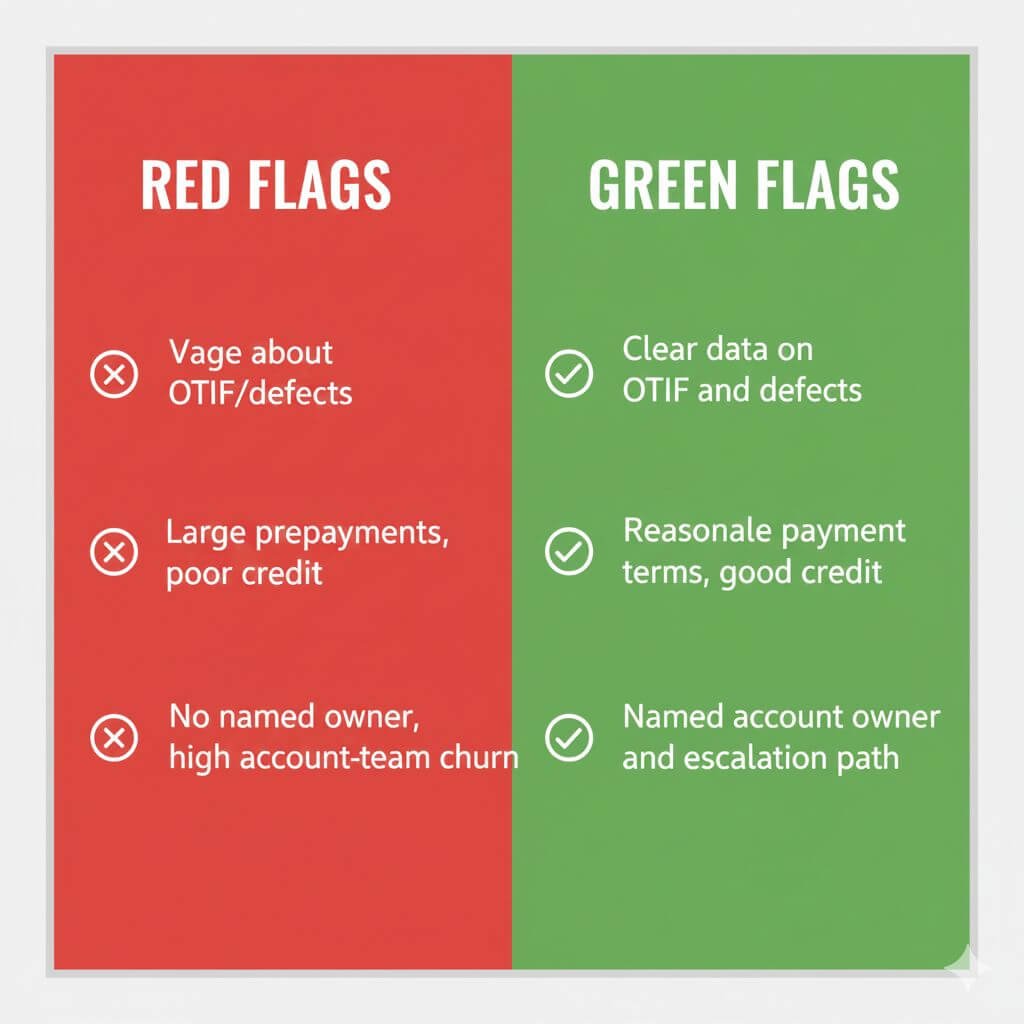
Red flags worth heeding
- Vague about OTIF/defects or unwilling to provide real references
- Requests large prepayments with no escrow; adverse credit or CCJs
- No named owner or escalation route; constant churn in your account team
Due-diligence checklist (take it to site visits)
Use this as a tick-box list when you visit, or for remote audits.
□ Samples tested; QA plan reviewed; site visit or remote audit complete
□ Contracts: scope of work, SLAs/KPIs, service credits, liability caps, IP/confidentiality, exit plan
□ GDPR data-processing addendum; Cyber Essentials or ISO 27001 (as appropriate)
□ Modern Slavery statement (if ≥ £36m); environmental plan or ISO 14001 where material
□ Insurance certificates; H&S policy and incident stats reviewed
□ Payment terms aligned; invoice/PO process clear
□ References taken; pilot order and ramp-up plan agreed
FAQs – quick answers for UK buyers
When are we on the hook legally?
You must:
- protect people “so far as reasonably practicable” (Health and Safety at Work etc. Act 1974)
- carry out suitable and sufficient risk assessments (HSE “5 steps to risk assessment”) https://www.hse.gov.uk/simple-health-safety/risk
- comply with UK GDPR/Data Protection Act 2018 if personal data is processed
Larger firms also have Modern Slavery Act s54 transparency duties.
How do I sanity-check a supplier’s finances?
- Search Companies House.
- Look at profit and cash-flow trends and any CCJs.
- Get an independent credit score (Experian, D&B, Creditsafe).
- Ask for insurance certificates and two trade references.
What’s the fairest way to compare quotes?
- Normalise everything: Incoterms, lead times, defect assumptions, warranty and service.
- Then run the TCO calculation.
- Where possible, place a small pilot order to validate quality and delivery before you commit.
What to do this week
- Score your top ten suppliers with the weighting model; book review calls with the two lowest scorers.
- Introduce SLAs and a 30/60/90-day review with one key supplier.
- Create a one-page supplier brief (spec, volumes, service levels, compliance asks) and use it on every new RFQ.
- Book a site visit or remote walk-through. Ask to see real quality and maintenance records, not just the brochure.
- Download and print the one-page supplier selection scorecard & checklist (PDF) to take on visits.
Useful links
- HSE “5 steps to risk assessment”: https://www.hse.gov.uk/simple-health-safety/risk
- HSE RIDDOR guidance: https://www.hse.gov.uk/riddor
- Companies House search: https://find-and-update.company-information.service.gov.uk
- Prompt Payment Code: https://www.smallbusiness-commissioner.gov.uk/ppc/
- ISO 9001/14001/27001: https://www.iso.org
- NCSC Cyber Essentials: https://www.ncsc.gov.uk/cyberessentials/overview
- Modern Slavery Act s54: https://www.gov.uk/government/collections/modern-slavery-bill














