An AI chat assistant can reduce customer support costs by answering straightforward questions or helping staff respond faster. Whether it saves money depends on how reliably it solves problems, what it costs to run and whether the time released reduces actual spending.
For a small business, that distinction matters. Freeing an employee to deal with a complicated complaint can be valuable even when the wage bill stays the same. But a bot that gives an unhelpful answer and sends the customer back to the phone queue may simply create extra work.
Where AI support can save time
Start with questions that have clear, verifiable answers: opening hours, delivery options, booking instructions and published returns policies. These are sensible candidates for a limited trial, provided the information is current.
Answering a question about an individual order is more demanding. The assistant needs an appropriate connection to order records, checks to prevent disclosure to the wrong person and a reliable way to pass the enquiry to staff.
There are also two different approaches to consider. A customer-facing chatbot answers customers directly. An assistant used by support staff suggests responses for a person to check and send.
Research by Erik Brynjolfsson, Danielle Li and Lindsey Raymond, using data from 5,172 customer support agents, found that access to AI assistance increased issues resolved per hour by 15% on average. Benefits varied across workers. The study concerned AI helping human agents, so it does not establish how much a small business would save by introducing an autonomous chatbot. Read the Generative AI at Work research summary.
Calculate the saving before buying
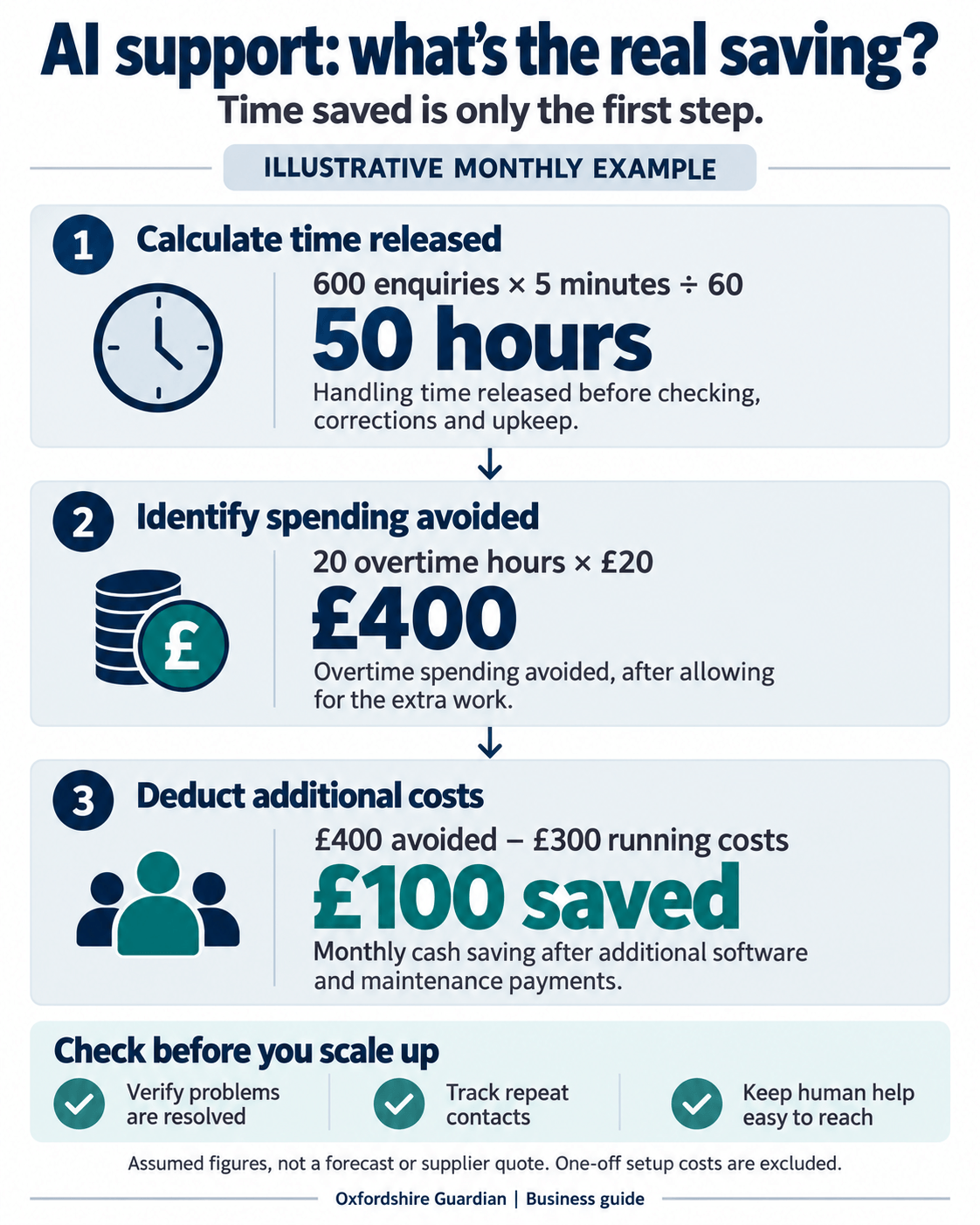
Consider a hypothetical business receiving 2,000 enquiries a month. Suppose a trial shows that a chatbot successfully handles 600 of them without staff intervention, and those enquiries previously took an average of five minutes each.
That would release 50 hours of handling time: 600 multiplied by five minutes, divided by 60. Staff time spent reviewing conversations, correcting errors and maintaining information must then be deducted.
If salaries and staffing hours stay unchanged, the benefit is extra capacity. A cash saving arises when the business actually avoids spending, such as paid overtime or an outsourced support charge.
Suppose, after allowing for the extra work, the trial removes the need for 20 hours of paid overtime each month. The calculation might look like this:
| Item | Calculation | Amount |
|---|---|---|
| Overtime spending avoided | 20 hours at an assumed total employer cost of £20 an hour | £400 |
| Additional software and maintenance payments | Assumed monthly spending | £300 |
| Net monthly cash saving | £400 minus £300 | £100 |
These figures are an example, not a forecast or supplier quote. One-off setup costs would also need to be recovered. If no spending is avoided, a business should judge whether the extra capacity and service improvements justify the new expense.
Check what the supplier charges for
The headline subscription is only part of the budget. Ask about usage charges, connections to existing systems, staff licences, minimum commitments, renewal prices and the work needed to keep answers current. UK buyers should check VAT and the billing currency.
Pricing examples checked on 14 October 2026 illustrate different charging models. IONOS advertises its AI Chat Assistant at £15 a month excluding VAT, with unlimited chats and the first month free.
For Fin over chat and email when used with Intercom, Intercom lists US$0.99 per resolution. Its definition includes both a customer confirming satisfaction and an assumed resolution when the customer leaves without asking for further assistance. Other billable outcomes also exist.
These are examples of pricing structures, rather than equivalent product packages. Compare the full cost of the setup you need. Also check results independently: a customer leaving a conversation does not, by itself, prove their problem was solved.
Make it easy to reach a person
Choose clear limits for what the assistant can answer or do. Complaints involving disputed facts, exceptions to a policy or a distressed customer are sensible points for human review.
Test the handover before launch. Can a customer request a person without repeating several failed steps? Does the employee receive the conversation and relevant details? If nobody is available, does the customer get an honest explanation of when to expect a reply?
An assistant may answer routine questions outside office hours, but that does not make the whole support service available around the clock. Distinguish an immediate automated response from an issue that needs staff action.
Check how customer data will be handled
Before connecting customer records or uploading old conversations, establish what personal information the system needs and how the supplier will use it. Check storage locations, access controls, retention periods, deletion arrangements and whether customer content can be used to train models.
Use only the information needed for the task, explain the use of AI clearly and review the supplier’s contract and relevant privacy information. For UK businesses, the Information Commissioner’s Office guidance on AI and data protection is a useful starting point. The ICO currently flags that guidance as under review following the Data (Use and Access) Act.
Run a trial against your existing service
Record a baseline before switching anything on: enquiry volumes, handling time, repeat contacts, customer satisfaction and support spending. Choose a small group of common enquiries, then test both normal questions and awkward cases with missing or conflicting information.
During the trial, review a sample of conversations and track whether customers return with the same issue, including by phone or email. Agree a follow-up period appropriate to the enquiry. Keep confirmed resolutions separate from outcomes inferred because the customer stopped replying.
To calculate cost per resolved issue, divide all relevant support costs by the number of verified issues resolved over a comparable period. Include human handling, software, supervision and maintenance, and count each issue once. A falling cost is useful only if accuracy, access to help and customer outcomes remain acceptable.
Give someone responsibility for checking answers whenever prices, products or policies change. Expand the trial only when the results justify it.
Frequently asked questions
Is an AI chatbot worthwhile for a very small business?
It depends on the volume and complexity of enquiries. Compare it with simpler improvements first, such as clearer website information, saved email replies or a better booking form. A subscription is harder to justify when there is little repetitive work to remove.
How long should setup and staff training take?
There is no reliable universal timetable. Allow for checking source information, connecting any necessary systems, testing answers and practising handovers. A quick installation does not establish that the service is ready for customers.
Will customer satisfaction improve?
Treat that as something to test. Ask customers whether their problem was resolved, review complaints and monitor repeat contacts alongside response speed. A fast first answer is useful only if the customer can reach a satisfactory outcome.