“Ageing in place” is a phrase increasingly on the lips of interior designers and home improvement professionals these days – and I’d argue that it’s much deeper than a buzzword.
It’s a simple idea to be sure: choosing to continue living right where you are at home. Yet the preparation needed to do it right requires clear foresight and unyielding motivation. Circumstances might push forward your plans unexpectedly, or the fast pace of life cause these pivotal decisions to catch up with your lifestyle before you know it.
Regardless, adapting your furniture choices to current and future mobility needs is a necessary investment in your home, comfort, independence and those you choose to share it with. In my later life, I’ve experienced personally how accessible design features can be easy and affordable, and you certainly don’t have to compromise on aesthetics.
It’s also not just an OAP thing; as many accessibility advocates will tell you, the disability community is the only minority group you can join at any time, through accident, health issues or age. Hence, interior problem-solving whilst having the ability and capacity often makes more sense for those already lucky enough to have found their dream home, whether boomer or zoomer.
Why Ageing in Place Means So Much
Heralding a new understanding of accessible interior design, the ageing in place trend mirrors a growing awareness of disability accommodation and inclusion, yes, but it’s also tightly tied up with our post-pandemic economic landscape.
On one hand, we have an ever-expanding ageing population who, according to recent research, are more inclined than ever to grow old in their current abodes. On the other, society at large is still weathering the ripples of COVID-19; disability, including conditions exacerbated by the virus, is steadily on the rise while the sharp cost of living is making staying put all the more appealing.
Adapting your furniture to changing mobility needs is nuanced, pulling together physical, financial, social and emotional factors into one tight knot that becomes tricky to disentangle. It forces you to ask all of the big, sometimes scary, questions.
How attainable is a fully modified home? Even if your partner is in good health now, what would living look like if you were to be widowed? We all have different priorities and resources; things like the wherewithal to host family and friends, a generous pension, ready wheelchair access or existing furniture already well-equipped for later frailty or disability. Thus, the process will take a different form for every individual or couple.
Furniture is the Foundation of the ‘Long-Haul Home’
When people get onto the topic of home modification, the furniture is often outshone by the complex, budget-sapping structural changes; these adaptations usually involve bathroom renovations, grab rail installation, widening doorways, stairlifts and entry ramps. But don’t let this fool you into thinking that your furnishings are secondary.
A major mode through which we experience our homes, our furniture choices dictate the day-to-day convenience and comfort of everyone under its roof. When every piece is designed thoughtfully for all abilities from the outset, they become more pleasant for everyone. This idea underpins the concept of universal design, which the Centre for Excellence in Universal Design describe as “the design and composition of an environment so that it can be accessed, understood and used to the greatest extent possible by all people regardless of their age, size, ability or disability.”
Achieve this, and every guest and resident is afforded smooth, safe, healthy and happy enjoyment of your home – especially future you.
What Furniture Adaptations Will Your Home Need?
Naturally, this involves significant thinking ahead, and foregrounding your furniture choices in potential scenarios which may affect your daily state of health or the level of available support.
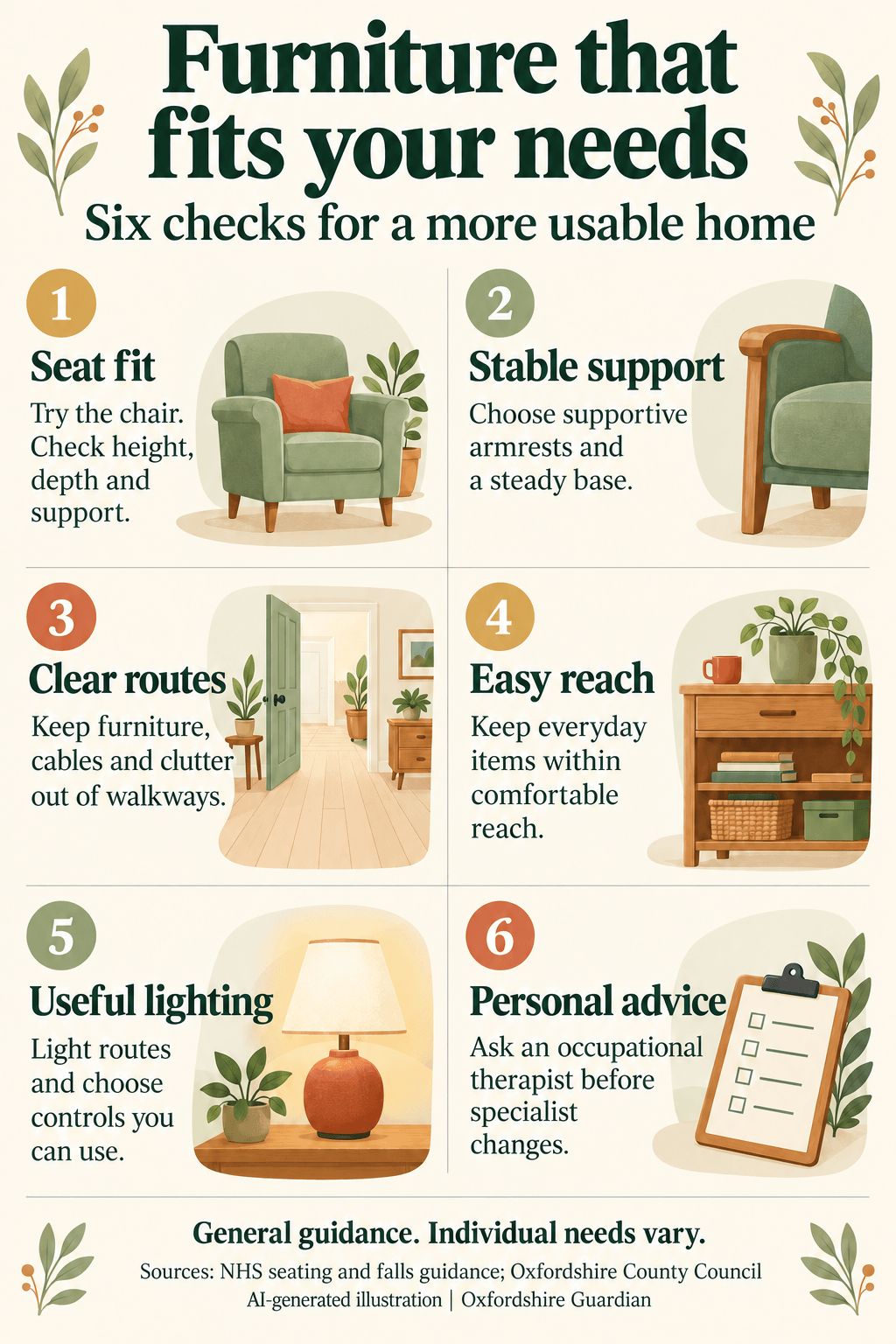
You can start by taking stock of your existing pieces and how you and your guests interact with them; noting how elderly or low-mobility visitors get on might provide some clues. A room-by-room review of how well each piece supports transitions from sitting to standing, their stability when used, and overall accessibility is the most efficient approach.
For instance, if you head to priority areas such as the living room or bedroom, can you mitigate the risks of falls? In many cases, it’s the height of a bed or armchair that makes safe transitions tricky, or a sofa that is too soft and too low-slung. Of course, there’s a golden compromise to be had – at around 40-50cm – where getting up from the seat is more manageable as well as practical for manoeuvres from wheelchair to seat.
Other adaptations include castor wheels for mobility, which are a natural addition to an armchair, or opting for chair silhouettes comprised of tall, enveloping backs, arm and footrests, alongside recliner action. These are sumptuous to experience in youth, but a lifesaver come old age or injury.
Decluttering, likewise, has a role to play: simplifying the space, optimising layouts, removing trip hazards and making way for wider thoroughfares each improves quality of life. To enact these changes, you’ll likely want to rethink your storage. Built-in cabinetry is an efficient use of space, but don’t forget to pair these storage features with ergonomic design; cupboards can easily be integrated with pull-down or electric rails for those with limited reach.
When assessing safety, lamps are another crucial element to ponder, considering that navigation can be one of the first things impacted by old age and/or disability. Our living spaces should be well-lit and conducive to a toasty, hospitable ambience. At the same time, these fixtures shouldn’t pose a barrier to those with poor finger dexterity. Here, simple push buttons, smart, voice-activated bulbs or phone-controlled lighting are future-looking, universally accessible solutions.
Accessibility Is Chic
Lastly, I want to point out that age-in-place-friendly furniture and trendy, deliciously layered interiors are not at all mutually exclusive. Just as you might purchase a cute walking cane or bedazzle a walker, your accessible furnishings are cherished most when they align with your self-expression and personal taste; after all, everyone deserves nice things.
No two bodies are the same, and neither are our homes, so tailoring your environment to your practical and emotional needs will be an intensely personal process.
It’s time we retire the tired idea that accessibility = white plastic, ugly add-ons. In actuality, it can be quite chic.