

















Oxfordshire’s science and technology ecosystem spans Harwell Campus, Milton Park, Oxford Science Park and Begbroke, from university labs and NHS research units to contract testing and scale-up manufacturing. In this environment, reliable, audit-ready equipment helps teams shorten lead times, cut repeats and pass accreditation and regulatory inspections the first time.
Across pharmaceuticals, food testing, environmental monitoring and academic research, lab teams face pressure to deliver faster results without compromising accuracy. Mistakes carry real consequences, financial, scientific and regulatory, so dependable instruments and robust data systems are essential for upholding quality standards.
Reliable tools reduce repeats, save time and materials, and stabilise methods. Skilled staff are vital, but even the best teams are undermined by inconsistent instruments, weak calibration, or systems that don’t integrate cleanly with LIMS/ELNs.
This guide explains how equipment choices affect performance, and what to do in the next 90 days to raise accuracy and uptime. It includes a selection matrix, KPIs, a practical instrument lifecycle, and details of UK standards and guidance (UKAS, NPL, MHRA, HSE).

The role of equipment in lab performance
Accurate results depend on consistency. Even small variations in equipment operation can shift outcomes, especially in high-volume labs. Errors often stem from devices that are worn, uncalibrated, or poorly matched to their intended use.
Everyday tasks such as liquid handling, pH measurement and sample prep rely on precise operation. When tools perform as expected, repeatability improves and results stay within control limits. That consistency builds trust between teams and reduces the need for external validation.
Digital feedback, alarms and streamlined interfaces reduce setup errors. Above all, choose tools that perform without delay or confusion and that fit your data workflows.
Common efficiency barriers
- Unreliable instruments: drive rework, wasted samples and staff frustration.
- Manual processes: more checks, slower turnaround; reduce where risk allows.
- Steep learning curves: poor UI means longer ramp-up and more errors across shifts.
- Unexpected maintenance: ageing kit leads to unplanned downtime; spares scarcity compounds it.
First 90 days: raise accuracy and uptime
- Calibration & traceability: compile a register for critical instruments (balances, pipettes, pH meters, titrators). Use UKAS-accredited providers and maintain traceability to national standards (e.g., NPL). Record due dates and out-of-tolerance actions.
- Method validation refresh: confirm accuracy, precision, linearity, range, robustness and LOD/LOQ (where relevant). Document measurement uncertainty and acceptance criteria.
- Data integrity (ALCOA+): enable audit trails in LIMS/ELN and instrument software; lock raw data; restrict admin roles; document e-signatures (EU Annex 11 / 21 CFR Part 11 where applicable).
- Preventive maintenance: move to CMMS-driven PM; track MTBF/MTTR; stock fast-moving spares for high-risk assets.
- Environmental monitoring: log temperature/humidity/pressure; set alarms and define environmental acceptance limits by method.
- Competence: run brief competency refreshers (pipetting technique, balance use, instrument start-up), then re-authorise in training records.
Equipment selection matrix (shortlist criteria)
| Criterion | What “good” looks like | Evidence |
|---|---|---|
| Accuracy & precision | Meets method specs with low CV/RSD | Validation report; certificates |
| Calibration & traceability | UKAS-accredited calibration; traceability to NPL/NIST | Calibration certs; provider scope |
| Data integrity | Audit trail, e-signatures, Annex 11/Part 11 ready | Vendor compliance statement |
| Integration | LIMS/ELN drivers; open file formats/API | Driver list; API docs |
| Service & spares | Local support; spares ≤ 5 days; loaner options | SLA; parts catalogue |
| TCO & sustainability | Low energy/consumables; WEEE/end-of-life plan | TCO calc; environmental data |
Automation and digital tools
Use automation to remove repetitive steps and standardise high-risk tasks. Digital controls and smart interfaces provide real-time feedback, reduce variability and speed audits. Choose modular systems that scale with demand and integrate with your LIMS/ELN so data flows without transcription.
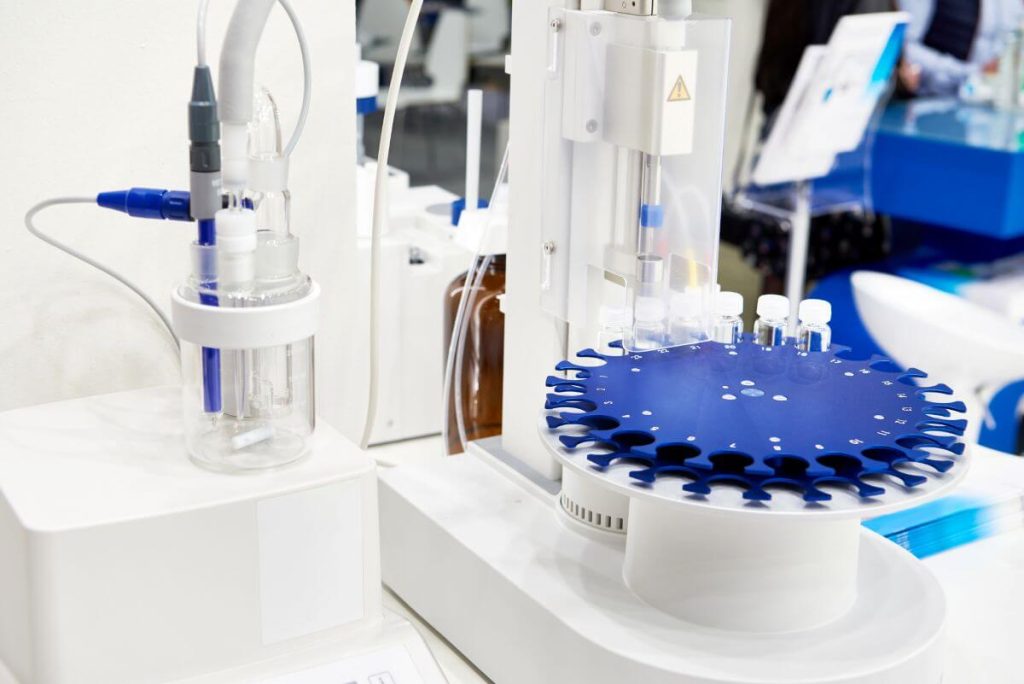
An automated titrator for labs is one example of how professionals streamline operations while keeping accuracy high. These instruments can manage tasks that would otherwise require constant supervision, making them well-suited for both research and production environments.
Track what matters (KPIs)
| Area | KPI | Target |
|---|---|---|
| Accuracy/precision | % runs within acceptance; CV/RSD by method | ≥ 95% passes; CV as per validation |
| Right-first-time | % results without repeat/rework | ≥ 98% |
| Uptime | MTBF/MTTR; % preventive vs corrective maintenance | ↑ MTBF, ↓ MTTR; ≥ 70% PM |
| Data integrity | Audit-trail exceptions per month | 0 critical |
| Cost | Cost per test (consumables + time) | Trend down QoQ |
Instrument lifecycle: make reliability stick
- Qualification: URS → IQ/OQ/PQ; risk assessment (FMEA).
- Operation: SOPs; training/competence records; daily checks; control charts (e.g., Levey–Jennings).
- Maintenance: CMMS PM schedule; spares; service contracts; calibration windows.
- Review: KPI & deviation trending; CAPA; proficiency testing/inter-lab comparisons.
- Retire/replace: obsolescence plan; data/record retention; WEEE disposal.
Standards & guidance (UK)
- Accreditation: ISO/IEC 17025 (testing/calibration), ISO 15189 (medical labs) — via UKAS.
- Regulatory: MHRA GxP data integrity expectations; OECD GLP (non-clinical).
- Safety: HSE/COSHH for chemical safety and control measures.
- Metrology: NPL resources on measurement uncertainty and traceability.
- Data integrity: ALCOA+, EU Annex 11, 21 CFR Part 11 for electronic records/signatures.
Choosing the right tools for your lab
Match capacity to throughput; oversized or undersized tools both hurt flow. Prioritise intuitive UIs, open data formats and secure integration. Consider total cost of ownership, energy/consumables, and support responsiveness. Modular designs help you expand without replacing entire systems.
FAQ
How often should pipettes and balances be calibrated?
Base intervals on risk and usage: many labs calibrate pipettes every 3–6 months (with monthly in-house checks) and balances every 6–12 months, with daily verification using certified weights.
What’s the difference between validation and verification?
Validation shows a method or system meets its intended use; verification confirms it continues to meet specs in routine use (e.g., system suitability tests).
Do we need ISO/IEC 17025 or ISO 15189?
Customer/regulatory expectations drive this. 17025 suits testing/calibration labs; 15189 is for medical laboratories. UKAS can advise on scope and readiness.
Make smarter equipment choices that improve results
Choosing reliable equipment affects every aspect of performance. Accuracy improves when devices deliver consistent results with minimal variation. Efficiency rises when tools reduce manual input and integrate with your data workflows. Use the 90-day plan, the selection matrix and KPIs above to guide pragmatic upgrades, and review outcomes quarterly.














