

















Formal performance reviews still have a place, but they are often a poor way to collect frank, useful feedback. By the time a review takes place, concerns may have been softened, forgotten or left unsaid altogether. Both Acas and the CIPD stress that employee voice matters because it helps employers make better decisions, build trust and create workplaces where people feel able to speak up.
For Oxfordshire employers, that matters whether the business is a small café, a school, a manufacturer or a growing office-based team. If feedback only appears once or twice a year in a formal setting, it is much harder to spot problems early, test ideas or understand how staff are actually experiencing day-to-day work. The best feedback systems tend to be regular, low-pressure and backed by visible follow-through.
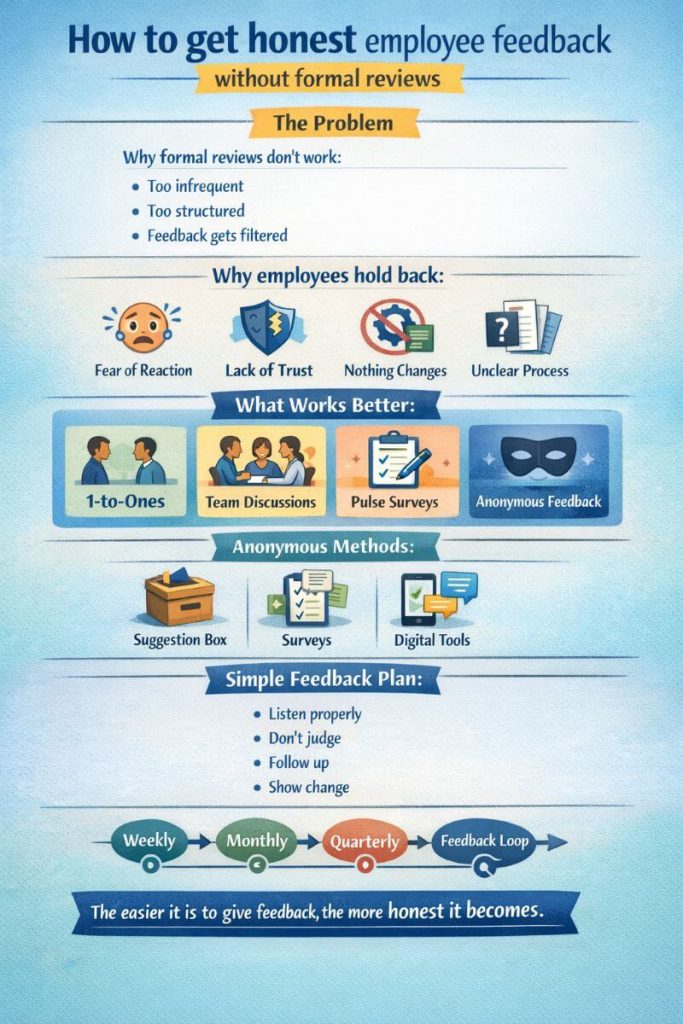
Why formal reviews do not always produce honest feedback
Annual or twice-yearly reviews are structured by design, and that can make them useful for performance conversations. But structure can also work against honesty. Employees may focus on what feels safe to say, especially if the discussion is tied to pay, progression or a direct manager’s judgement. The CIPD says employee voice depends on people feeling able to express views, concerns and suggestions in ways that genuinely influence decisions at work.
That is one reason many employers are moving away from relying on reviews alone. Acas says listening to employees’ views helps employers make more fully informed decisions, and that consultation works better when staff believe their views have genuinely been considered.
Why employees hold back
In most workplaces, silence is not caused by a lack of opinions. It is caused by a lack of confidence that speaking up will be safe or useful.
The CIPD’s evidence review on trust and psychological safety says people are more likely to speak up when they feel they are treated fairly and listened to with respect. It also highlights the importance of managers paying full attention, showing empathy, avoiding judgement and asking for constructive feedback. In contrast, poor manager relationships make people less likely to share suggestions or concerns.
That is especially important in remote and hybrid teams. The CIPD says newer ways of working, including remote and hybrid models, create new challenges for employee voice and make it harder to judge trust, motivation and opinion unless employers adapt how they listen.
What works better than reviews alone
The strongest approach is usually a mix of methods rather than one big annual conversation.
Regular one-to-ones
Short, consistent one-to-one conversations are often the best place for early concerns to surface. They work best when they feel like real conversations rather than mini-appraisals.
Team discussions
Well-run team meetings can reveal practical frustrations, bottlenecks and ideas that would never make it into a formal review form.
Short pulse surveys
Shorter, more frequent surveys can help employers spot patterns quickly instead of waiting six or 12 months for a review cycle.
Anonymous channels
For some issues, people will be more honest if their name is not attached.
The HSE’s Stress Talking Toolkits are a good example of the value of regular conversations. They are designed to help managers and teams identify the causes of stress and discuss solutions, and can be used in one-to-ones, return-to-work conversations and wider management discussions.
When anonymous feedback works best
Anonymous feedback is useful when people are uncomfortable raising an issue directly, especially around manager behaviour, workload, team culture or fairness. It is often the easiest way to surface smaller frustrations before they become larger problems.
However, anonymity only works if staff believe it is real. HSE’s Stress Indicator Tool protects anonymity by requiring at least 10 responses before it can be used, and recommends different approaches for smaller teams. That is a useful reminder that in very small workplaces, anonymous surveys can be difficult to run convincingly.
In practice, employers do not need anything elaborate to start. A simple anonymous form, a short pulse survey or a structured staff forum may be enough. Acas says workplace forums can be a useful way for employees to raise ideas and questions, and for employers to present proposals while listening to views and concerns.
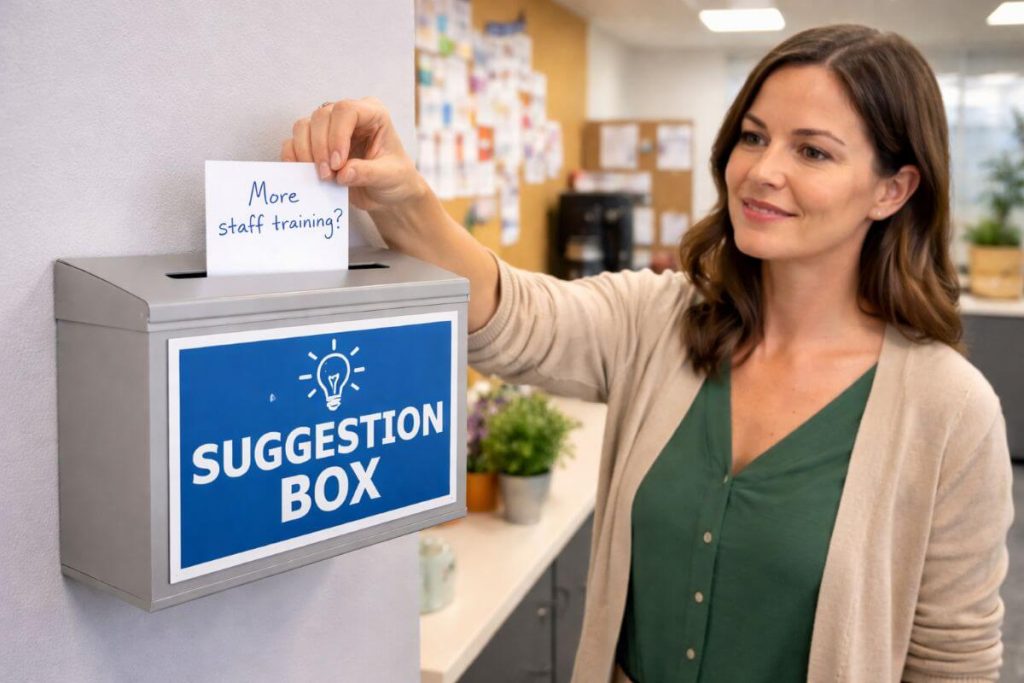
In some workplaces, physical suggestion boxes can still be useful for collecting anonymous comments, especially where staff are less likely to use digital tools.
What managers should do differently
If employers want better feedback, manager behaviour is often the deciding factor.
The CIPD recommends that managers:
- involve people in decisions that matter to them
- focus on progress and learning rather than blame
- pay full attention when team members speak
- avoid interrupting or jumping to conclusions
- ask for and offer constructive feedback
- lead by example by being open about mistakes and uncertainty.
That means the quality of a feedback culture is rarely about the survey platform alone. It is much more about whether people believe they can speak honestly without being punished, ignored or labelled difficult.

A simple feedback plan for smaller employers
For many Oxfordshire employers, the most effective system will be simple.
A practical starting point could look like this:
- weekly or fortnightly one-to-ones for managers and direct reports
- monthly team check-ins to raise recurring issues
- quarterly anonymous pulse surveys to spot wider patterns
- a short “you said, we did” update after feedback is collected
That final step matters most. If staff give feedback and never hear what happened next, trust falls quickly. Acas says employees are more likely to support changes when they believe their employer has genuinely considered their views and taken them on board.
Common mistakes to avoid
A few patterns tend to undermine employee feedback systems:
- only asking for feedback during performance reviews
- collecting anonymous feedback without acting on it
- asking for views, then never reporting back
- relying on one method for every team
- treating employee silence as a sign that everything is fine
In hybrid or remote teams, there is an extra risk: people who are less visible may also be less heard. The CIPD says organisations need to adapt voice mechanisms to new ways of working and communicating.
At a glance
| What helps honest feedback? | Why it matters |
| Regular one-to-ones | Issues surface earlier than in annual reviews |
| Team check-ins | Good for shared frustrations and practical ideas |
| Anonymous feedback | Useful where staff are reluctant to speak openly |
| Psychological safety | People speak up more when they feel treated fairly |
| “You said, we did” updates | Shows feedback leads to action |
| Hybrid-friendly channels | Ensures quieter or remote staff are not missed |
FAQs
Why do employees stay quiet in formal reviews?
Because reviews can feel high-stakes and judgement-heavy. Employees may say what feels safe rather than what they really think, especially if pay, promotion or manager relationships are involved.
Are anonymous surveys better than performance reviews?
Not necessarily better, but useful for different purposes. Anonymous methods can surface concerns people would not raise face to face, while reviews are better for structured performance conversations.
How often should employers collect feedback?
More regularly than once a year. Short, frequent check-ins and pulse surveys are usually more useful than relying on annual reviews alone.
What should happen after feedback is collected?
Employers should acknowledge what they heard, explain what will change and say what will not change and why. Without that follow-through, staff are less likely to participate next time.
Does this matter for small businesses as well as large employers?
Yes. In smaller teams, day-to-day culture and manager behaviour often matter even more, because there are fewer formal channels and less anonymity.
The bottom line
If employers want more honest employee feedback, the answer is rarely more paperwork. It is usually better listening, more frequent conversations, safer ways to speak up and visible action afterwards.
For Oxfordshire employers, that means moving beyond the idea that annual reviews are enough on their own. A stronger feedback culture is built through consistency, trust and simple habits that make it easier for people to tell the truth.














