

















For many Oxfordshire businesses, growth is not driven by one dramatic decision. It often comes from small operational choices that save time, reduce errors and improve the customer experience day after day.
Running a business means making decisions constantly. Some are obviously strategic, such as whether to move premises, hire staff, invest in new equipment or enter a new market.
Others look smaller: changing a booking form, improving stock control, choosing a better payment system, updating customer records or checking addresses before orders are sent.
Those everyday decisions rarely make headlines, but they can shape whether a business feels organised, trustworthy and easy to use. For small firms, that can matter just as much as a major expansion plan.
Oxfordshire has a large and varied business base. The county’s latest economic baseline recorded 32,200 enterprises in 2022, while national figures show that SMEs make up 99.85 per cent of the UK business population. That means small operational improvements can matter at scale, particularly for firms competing on service, reliability and repeat custom.
At a glance
| Main point | Small operational decisions can have a cumulative effect on growth, efficiency and customer trust. |
| Why it matters locally | Oxfordshire has tens of thousands of enterprises, many of them small businesses competing on service, reliability and reputation. |
| Example decision | Using address validation to improve customer data, deliveries, fraud checks and service planning. |
| What to measure | Cost, time saved, error reduction, customer experience, compliance and repeat value. |
| Key warning | No single tool solves every problem. Small decisions work best when they fit a clear business process. |
Why small decisions deserve attention
It is not helpful for business owners to treat every decision as if it is make-or-break. That can slow people down and add unnecessary pressure.
But it is equally risky to dismiss operational decisions as trivial. A small weakness repeated hundreds or thousands of times can become expensive.
An address entered incorrectly at checkout can lead to a failed delivery. A vague booking process can create extra calls. Poorly maintained customer data can waste marketing spend. A slow form can make people abandon a purchase before they complete it.
For Oxfordshire businesses, from independent retailers and tradespeople to ecommerce firms, hospitality operators and professional services, these small frictions can affect how customers judge the whole organisation.
The question is not whether every small decision is important. The question is which small decisions are repeated often enough to change the bigger picture.
How to judge the impact of an operational change
A useful starting point is to look beyond the upfront cost.
Some business decisions look small because they take up only a small part of the budget. But their value may sit elsewhere: fewer mistakes, fewer complaints, faster admin, better data, improved compliance or higher repeat business.
Before changing a process, businesses should ask what problem they are trying to solve and how they will know whether the change has worked.
| Question | Why it matters |
|---|---|
| How often does this issue happen? | A small error repeated every day may cost more than an occasional large mistake. |
| Who is affected? | Some changes mainly help staff, while others directly improve the customer experience. |
| What does the mistake cost? | Include refunds, redelivery, wasted time, customer frustration and lost repeat orders. |
| Can the improvement be measured? | Track failed deliveries, abandoned forms, complaint volumes, call handling time or order errors. |
| Does it reduce risk? | Better processes can support fraud checks, data accuracy and compliance. |
Address validation as a practical example
Address validation is a useful example because it looks like a minor back-office detail, but it can affect several parts of a business.
In simple terms, address validation checks that an address is complete, correctly formatted and suitable for use before it enters a business system.
For a retailer, that could happen at checkout. For a tradesperson, it could happen when booking a home visit. For a professional service firm, it could happen when creating a customer record. For a delivery business, it could happen before planning routes.
Commercial services such as address4.com offer address verification and related data tools. Businesses can also compare these with other providers and official data sources before choosing a system that fits their needs.
Royal Mail’s guidance on accurate address capture says better address data can improve customer experience, speed up data entry, reduce abandoned checkouts and help avoid wasted deliveries. That makes address accuracy a practical operational issue, not just an admin detail.
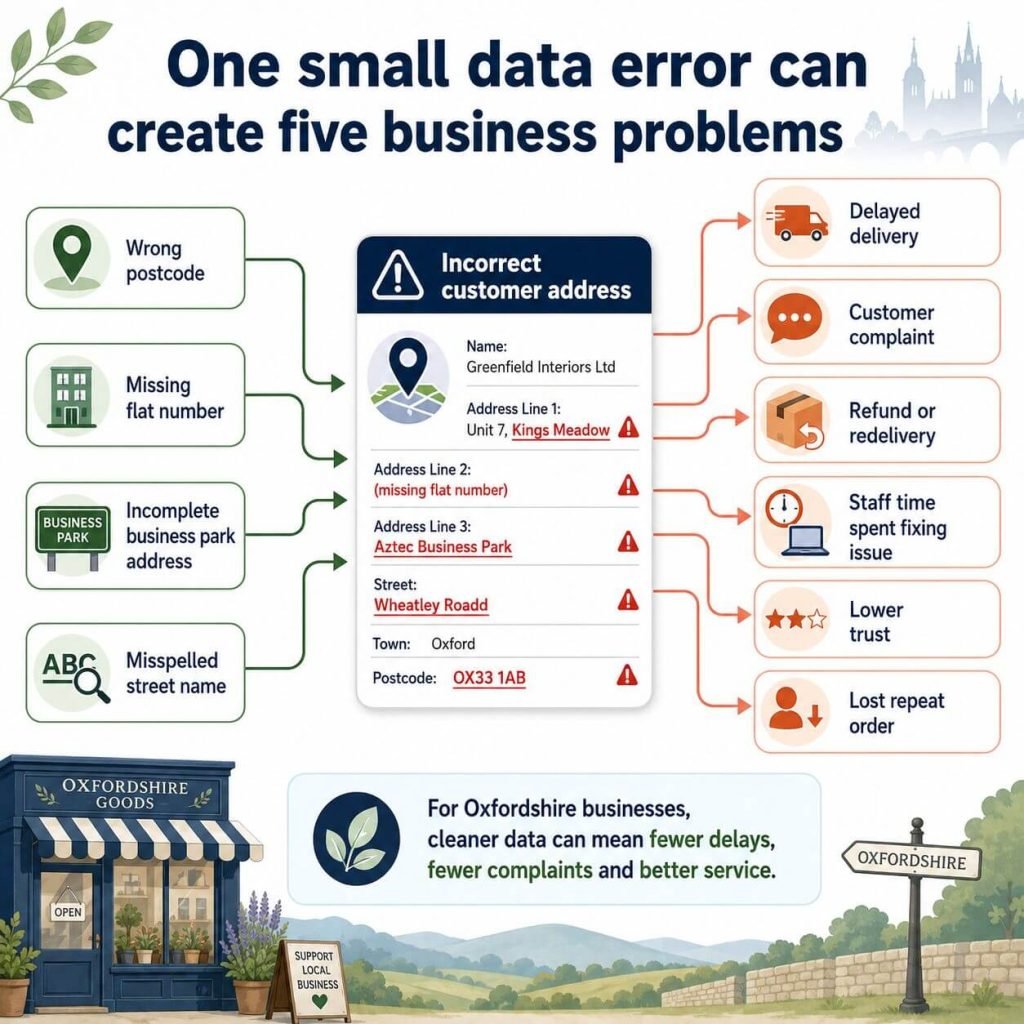
Where better address data can help
1. Fewer delivery problems
For businesses that deliver products, send documents or visit customers at home, address accuracy is not cosmetic. It affects whether the work can happen properly.
A wrong postcode, missing flat number or unclear building name can mean a parcel is delayed, a driver loses time, or a customer has to contact the business to fix the problem.
Industry research from Retail Economics found that 55% of consumers across surveyed markets expect delivery to arrive within 48 hours. That does not mean every Oxfordshire customer expects every order within two days, but it does show how strongly speed and reliability now shape expectations.
For local businesses, accurate addresses can help protect the basics: getting the right item, document or staff member to the right place first time.
2. Better customer experience
Customers rarely think about address validation when it works. They notice it when it fails.
A form that suggests the correct address after a postcode is entered can reduce typing, shorten checkout and prevent small mistakes. That can be especially useful on mobile devices, where long forms are easier to abandon.
For Oxfordshire hospitality venues, clinics, tradespeople, online shops and service providers, smoother data entry can make the first contact with a customer feel more professional.
3. More efficient planning
Some address validation systems also include geocoding, which links an address to geographical coordinates.
That can support route planning, service-area checks and scheduling. For example, a trades business covering Oxford, Abingdon, Witney and Bicester may be able to group appointments more efficiently if addresses are entered consistently.
The benefit is not only fuel or mileage. It can also mean fewer missed appointments, more predictable arrival windows and less staff time spent correcting records.
4. Fraud and risk checks
Address validation is not a fraud-prevention system on its own, and it should not be presented as one.
But it can be one layer in a wider risk process. A business may want to know whether a delivery address exists, whether customer details are complete, and whether information looks consistent before processing an order or opening an account.
That matters because fraud is a large and changing risk for UK businesses and consumers. The Government’s 2026 fraud strategy says fraud represented 45% of all crime recorded in the Crime Survey for England and Wales in the year ending September 2025.
For small firms, the practical message is straightforward: better data will not stop every bad transaction, but poor data makes it harder to spot problems early.
5. Data protection and accuracy
Accurate customer data is also part of good data governance.
The Information Commissioner’s Office says personal data should be accurate and, where necessary, kept up to date. It also says organisations should collect only the personal data they need for their specified purpose.
That means businesses should not collect more information than necessary. But the information they do collect should be useful, accurate and properly managed.
Address validation can support that aim, provided it is used proportionately and alongside proper privacy, security and retention policies.
Businesses should also remember that customer addresses are personal data. The Information Commissioner’s Office says personal data should be accurate and, where necessary, kept up to date. That does not mean collecting more information than needed, but it does mean taking reasonable steps to keep essential customer records correct.
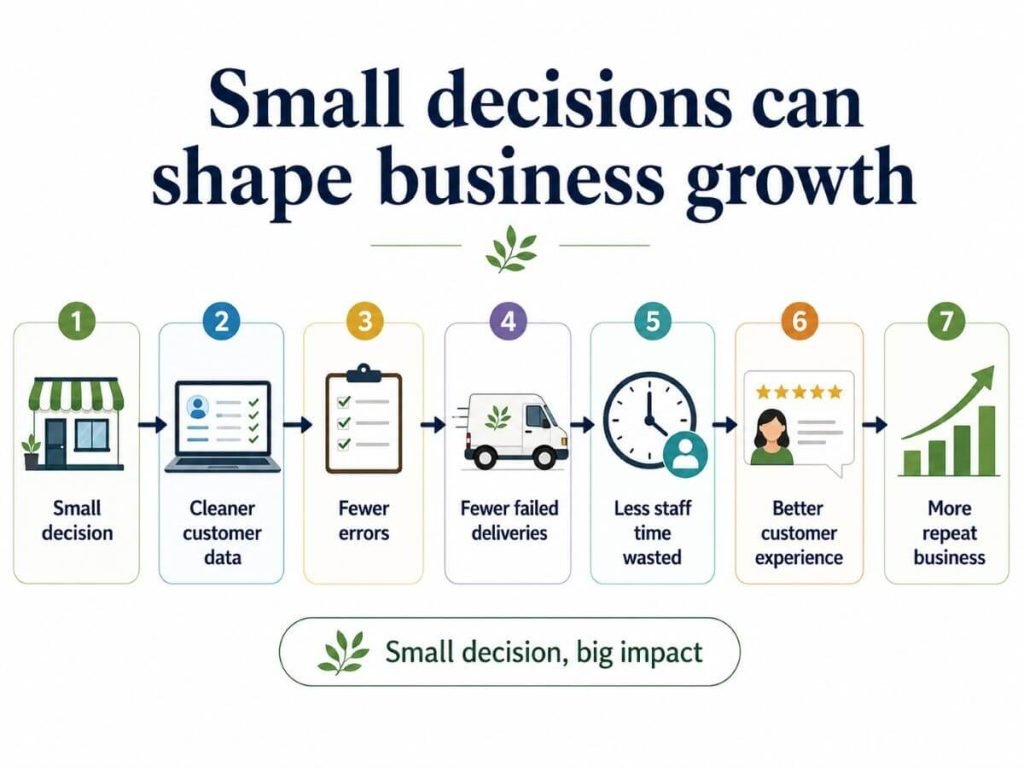
Small decisions can reveal bigger weaknesses
One reason operational decisions matter is that they often expose deeper issues.
If customers regularly enter addresses incorrectly, the problem may not be the customers. It may be the form.
If staff keep retyping the same information into different systems, the problem may be poor software integration.
If deliveries fail because flat numbers, building names or business parks are missing, the problem may be weak data capture at the start of the process.
Small fixes are useful when they solve the real problem rather than papering over it.
How Oxfordshire businesses can test a small change
A business does not need to overhaul everything at once.
A practical approach is to test one change in one part of the business, measure the result and decide whether it is worth extending.
| Step | What to do |
|---|---|
| Pick one problem | Choose a repeated issue, such as failed deliveries, bad address records, form abandonment or booking errors. |
| Measure the current position | Record how often the issue happens and what it costs in time, money or customer satisfaction. |
| Trial one change | Test a tool, form change, staff checklist or new process for a defined period. |
| Compare results | Look for changes in error rates, call volumes, delivery failures, refunds or customer feedback. |
| Check staff impact | A change that saves customers time but creates heavy manual work for staff may need redesigning. |
| Decide whether to keep it | Retain, adjust or drop the change based on evidence rather than assumption. |
What to ask before choosing a digital tool
Technology can help, but it should not be bought simply because it promises efficiency.
Before adopting a new tool, businesses should consider whether it fits their existing systems, staff skills and customer needs.
Decision checklist
| Is the problem frequent enough? | A tool is easier to justify when it fixes a recurring issue. |
| Does it integrate? | Check whether it works with your website, CRM, booking system or delivery software. |
| Is it easy for staff? | A system that staff avoid using will not deliver the expected benefit. |
| Is it easy for customers? | The best tools reduce friction rather than adding another step. |
| What data does it process? | Check privacy, security, supplier terms and whether the data collected is necessary. |
| How will success be measured? | Set a clear measure before the trial begins, not afterwards. |
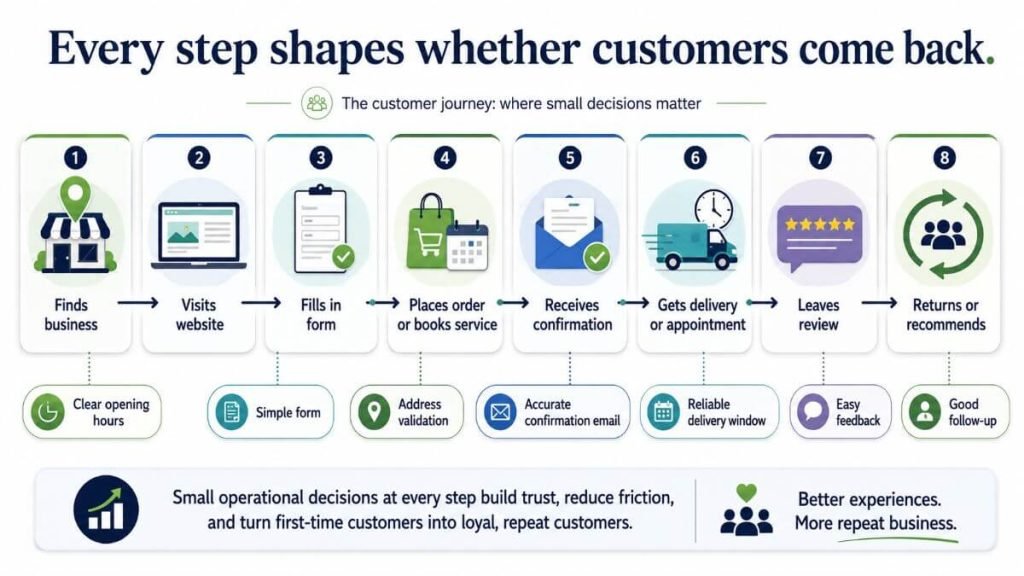
Why the small choices add up
Growth is often discussed in terms of expansion, investment and ambition. Those things matter, but they are not the whole story.
For many Oxfordshire businesses, growth also depends on being easier to buy from, easier to contact, easier to trust and easier to recommend.
That is where small operational decisions matter. Better address data can reduce delivery problems. Clearer forms can reduce checkout friction. Better scheduling can make staff more productive. Stronger record-keeping can support compliance and customer service.
None of these changes will transform a business alone. Together, they can make the difference between a company that feels stretched and one that feels reliable.
The best small decisions are not about chasing every new tool. They are about identifying repeated points of friction and fixing them before they become accepted as normal.
FAQs
What are operational decisions in business?
Operational decisions are everyday choices about how a business runs. They can include systems, processes, staffing, customer service, stock control, deliveries, booking forms and data management.
Why do small decisions matter for business growth?
Small decisions matter because they are repeated. A minor improvement that saves time, reduces errors or improves customer experience can have a large cumulative effect over months or years.
What is address validation?
Address validation is the process of checking that an address is complete, correctly formatted and suitable for use before it enters a business system.
How can address validation help a business?
It can help reduce address-entry mistakes, failed deliveries, customer-service issues and poor-quality data. Some systems also support geocoding for route planning and service-area checks.
Does address validation prevent fraud?
Not by itself. It can support wider fraud and risk checks by helping verify whether address information is complete and plausible, but it should be used alongside other controls.
What should Oxfordshire businesses measure before changing a process?
Useful measures include time spent correcting errors, failed deliveries, abandoned forms, customer complaints, refund requests, repeat orders, staff workload and the cost of the tool or process change.
Useful links for Oxfordshire businesses
| Business support | Enterprise Oxfordshire Business Support Tool |
| Start-up and growth advice | Business and Intellectual Property Centre Oxfordshire |
| Data accuracy | ICO guidance on the accuracy principle |
| Cyber and fraud risk | NCSC small organisations guide to cyber security |
| Fraud reporting | Report Fraud |














