

















Feeling more secure about money does not require a complicated financial plan. A clear view of household finances, a modest emergency buffer and a few well-organised protections can make a meaningful difference over time.
Financial security is sometimes presented as something that requires a large income, detailed spreadsheets and perfect knowledge of what the future will bring.
In reality, most households cannot predict every change in work, health, family life or living costs. What they can do is build routines that make unexpected events easier to manage.
That means knowing where the money goes, dealing with urgent problems early, saving what is realistically affordable and making sure important information can be found when it is needed.
At a glance
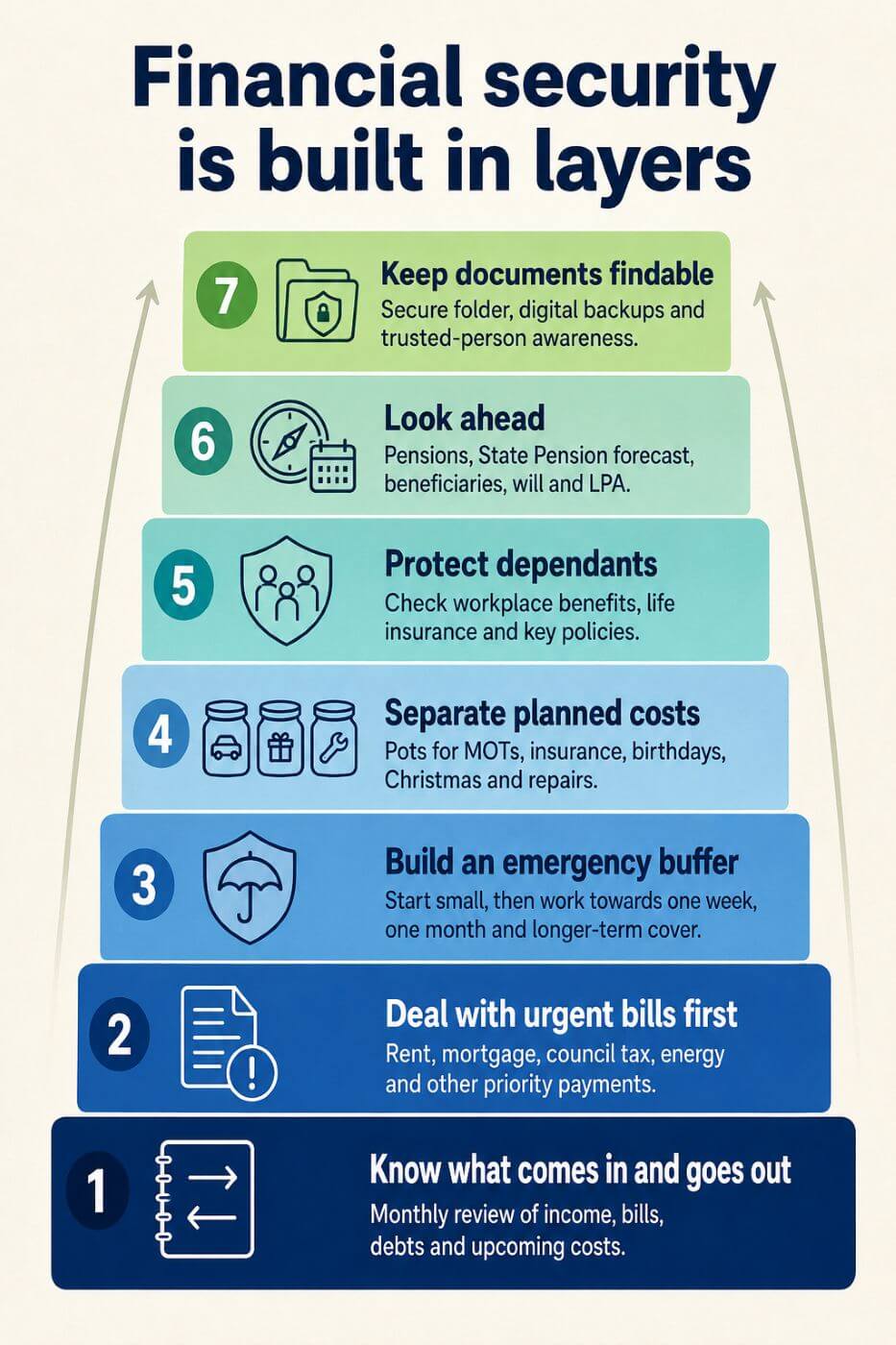
| Start with | A monthly review of income, bills, debts, savings and upcoming costs. |
| Deal with first | Rent or mortgage arrears, council tax, energy bills and other priority payments. |
| Build gradually | An accessible emergency fund for genuinely unexpected expenses. |
| Protect dependants | Check existing workplace benefits and compare insurance carefully before buying. |
| Look ahead | Review workplace pensions, old pension pots and your State Pension forecast. |
| Keep organised | Store important policies, account details and legal documents securely. |
| Review again | After major life changes and at least once a year. |
Begin with a short monthly money check
A regular financial review is one of the simplest ways to feel more in control.
Set aside around 30 minutes each month to look at household income, essential bills, debt repayments, savings and any larger expenses due soon.
This is not about judging every purchase. It is about noticing changes early. An energy direct debit may have increased, an insurance renewal may be approaching or a subscription may still be running after it stopped being useful.
Mind’s guidance on organising your finances recommends keeping important documents together, checking balances regularly and building money tasks into a manageable routine.
A monthly check could cover:
| Area | What to review |
|---|---|
| Income | Wages, pensions, benefits, maintenance, self-employed earnings and other regular income. |
| Essential bills | Housing, council tax, energy, water, food, transport, childcare and insurance. |
| Debt | Balances, interest rates, minimum payments and any missed or approaching payments. |
| Savings | Emergency money, short-term savings pots and pension contributions. |
| Upcoming costs | MOTs, annual insurance, school expenses, birthdays, home repairs and seasonal energy use. |
MoneyHelper’s free budget planner can help households compare money coming in with regular and occasional spending.
Use real bank statements and bills rather than estimates where possible. A budget is most useful when it reflects what is actually happening, not what someone thinks they ought to spend.
Deal with urgent bills before long-term goals
Building savings is important, but households already falling behind with essential payments may need a different first step.
Rent or mortgage arrears, council tax, gas and electricity bills and some court-related debts are known as priority debts because the consequences of not paying them can be particularly serious.
If several payments are overdue, do not simply pay the company applying the most pressure. Get free debt advice and establish which commitments need attention first.
StepChange explains how to identify priority bills and provides free debt advice. Citizens Advice can also help residents understand their options and check whether they are receiving all the support to which they are entitled.
People living in Oxford city, South Oxfordshire, the Vale of White Horse or West Oxfordshire can contact Citizens Advice Oxfordshire. Cherwell residents are served by Citizens Advice West Northamptonshire and Cherwell.
Seeking advice early does not mean a person has failed. It usually creates more options than waiting until court action, disconnection or eviction becomes an immediate risk.
Build an emergency fund in achievable stages
An emergency fund is money kept for costs that are both important and genuinely unexpected, such as an urgent car repair, a broken boiler or a sudden loss of income.
Guidance often suggests building towards three to six months of essential household spending. That can be a useful long-term goal, but it may feel impossible to someone beginning with no savings at all.
A more manageable approach is to build in stages:
| Stage | Possible target |
|---|---|
| First buffer | Enough to deal with one smaller emergency without borrowing. |
| Next step | One week of essential household spending. |
| Stronger cushion | One month of essential outgoings. |
| Long-term aim | Three to six months of essential costs, where income and circumstances allow. |
Saving £20 or £50 a month may seem modest, but regular contributions can gradually create a cushion for unexpected expenses.
Keep emergency money somewhere accessible rather than investing it in something that can fall in value or take time to withdraw. When comparing savings accounts, check the interest rate, access restrictions and whether deposits are protected by the Financial Services Compensation Scheme.
Do not be discouraged by a large target. A small buffer is still more useful than no buffer.
Separate emergencies from predictable costs
Not every large expense is an emergency.
Christmas, birthdays, annual insurance, an MOT and school uniform costs happen regularly, even if the exact amount varies.
Creating separate savings pots for these expected expenses can stop them consuming the emergency fund or ending up on a credit card.
For example, an annual car-insurance bill of £600 could be treated as a £50 monthly cost. The money can then be moved into a separate pot throughout the year.
These are sometimes called sinking funds. They work particularly well for:
| Vehicle costs | Insurance, servicing, MOT, tyres and tax. |
| Home costs | Annual maintenance, appliance replacement and decorating. |
| Family costs | School clothing, birthdays, Christmas and planned activities. |
| Professional costs | Memberships, equipment, training and self-employed tax bills. |
The goal is not to create dozens of complicated accounts. Two or three clearly labelled pots may be enough to prevent predictable bills from becoming financial shocks.
Make plans for people who depend on you
Financial security is not only about savings. It also means considering how a partner, child or other dependant would cope if an income stopped unexpectedly.
Before buying insurance, work out what the household would actually need. This might include outstanding mortgage or rent commitments, childcare, household bills, debts, funeral costs and an amount to replace lost income.
Check whether protection already exists. Some employers provide death-in-service cover, while older mortgage or pension arrangements may include benefits that have been forgotten.
There are several forms of life insurance, and they do not all work in the same way. Term insurance covers a defined period, while whole-of-life policies can continue as long as premiums are maintained.
For older applicants, options such as life insurance for over 50s may be considered as part of a wider plan.
However, these policies need careful comparison. MoneyHelper warns that some over-50s plans can offer poor value because:
| The payout is usually fixed | Its buying power can reduce as prices rise. |
| Premiums can exceed the benefit | Someone who pays for many years may contribute more than the policy eventually pays. |
| There may be an initial waiting period | The full benefit may not be available immediately. |
| Stopping payments can end the cover | Previous premiums are not normally returned. |
Compare the policy with regular life insurance, savings, workplace benefits and other ways of meeting the intended cost. MoneyHelper has independent guidance on whether over-50s life insurance is worth it.
Before using an insurer, broker or financial adviser, check that the business is authorised for the relevant service through the FCA Firm Checker.
Check pensions before assuming retirement is covered
Retirement can feel too distant to prioritise, particularly when current household costs are high. But checking existing arrangements does not require making an immediate investment decision.
Begin by locating the information already available:
| Workplace pension | Check the current balance, contribution rate and how much the employer pays. |
| Old pensions | List former employers and trace any schemes that may have been forgotten. |
| State Pension | Check the forecast, State Pension age and National Insurance record. |
| Beneficiary nominations | Make sure providers have current instructions about who should receive any death benefits. |
The Government’s Pension Tracing Service helps people find contact details for workplace and personal pension schemes. It does not tell users whether money is held in a scheme, but it identifies who to contact.
The State Pension forecast service shows how much someone may receive, when they can claim it and whether there may be ways to improve the forecast.
Anyone aged 50 or over with a defined-contribution pension can also use Pension Wise for a free, impartial appointment before deciding how to access the money.
Do not transfer, combine or withdraw pensions solely for convenience. Charges, guarantees, tax and valuable benefits can differ between schemes, so seek regulated advice where a decision is complex.
Keep important financial information easy to find
A clear filing system can save hours during an insurance claim, house move, illness or bereavement.
Keep paper documents together in a secure, clearly labelled folder and store digital copies in protected cloud storage or another backed-up location.
The folder could contain:
| Banking | A list of institutions and account types, without recording card PINs or full security credentials. |
| Insurance | Policy numbers, renewal dates, beneficiaries and claims contacts. |
| Pensions | Provider names, scheme numbers, statements and nomination details. |
| Housing | Mortgage, tenancy, service-charge and buildings-insurance information. |
| Debts | Lender names, account references and repayment arrangements. |
| Legal documents | Will, lasting power of attorney and details of where originals are stored. |
| Important contacts | Solicitor, financial adviser, accountant, insurer and pension providers. |
Do not store passwords, card PINs and security answers in an unprotected document. A reputable password manager or clear instructions explaining how an authorised person can access necessary records may be safer.
Tell a trusted person where the folder is kept. An organised file is of little value if nobody knows it exists.
Make a will and consider a lasting power of attorney
A will allows someone to state what should happen to their money, property and possessions after death.
Without a valid will, intestacy rules decide who inherits. Those rules may not reflect the person’s wishes, particularly for unmarried partners, blended families or more complicated households.
Government guidance on making a will explains the basic legal requirements. Professional advice is particularly sensible when someone owns a business or overseas property, shares a home with an unmarried partner, has children from different relationships or wants to provide for a vulnerable dependant.
A lasting power of attorney serves a different purpose. It allows a trusted person to make decisions about property and finances, or health and welfare, if assistance is needed in the future.
An LPA must be registered before it can be used. Details are available through the Government’s lasting power of attorney service.
Wills and LPAs are not only relevant to wealthy or elderly people. They are practical ways of reducing uncertainty for relatives and making personal wishes clearer.
Review the plan when life changes
A financial plan does not need constant adjustment, but it should not remain untouched for decades.
Review the main arrangements at least once a year and after significant changes such as:
| Starting or leaving a job | Income, pensions and workplace insurance may change. |
| Moving home | Housing costs, insurance and emergency-fund needs may rise or fall. |
| Marriage, separation or divorce | Beneficiaries, wills, property arrangements and insurance may need review. |
| Having a child | Childcare, protection and long-term savings needs may change substantially. |
| Becoming a carer | Working hours, benefits and household responsibilities may be affected. |
| Illness or disability | Income, care arrangements, insurance and legal documents may need attention. |
| Approaching retirement | Pension forecasts, spending plans and decisions about accessing savings become more immediate. |
An annual review does not need to become a major project. Confirm that documents are current, beneficiaries are correct, policies remain suitable and savings targets still reflect household circumstances.
Where Oxfordshire residents can get help
Anyone struggling with essential costs should seek help before the situation becomes an emergency.
Oxfordshire County Council’s cost-of-living support pages bring together information on local help with food, energy, household costs and financial advice.
The Oxfordshire Crisis Support Scheme can provide limited one-off assistance for residents who are in, or at risk of, financial crisis and have no other available support. It is intended for immediate needs rather than ongoing household expenses.
Useful sources of help
| Money guidance | MoneyHelper provides free and impartial guidance backed by government. |
| Local advice | Citizens Advice Oxfordshire supports residents in Oxford, South Oxfordshire, Vale of White Horse and West Oxfordshire. |
| Cherwell advice | Citizens Advice West Northamptonshire and Cherwell. |
| Debt support | StepChange Debt Charity offers free debt advice. |
| Immediate local crisis | Oxfordshire Crisis Support Scheme. |
| Check a financial firm | FCA Firm Checker. |
A simple financial-security routine
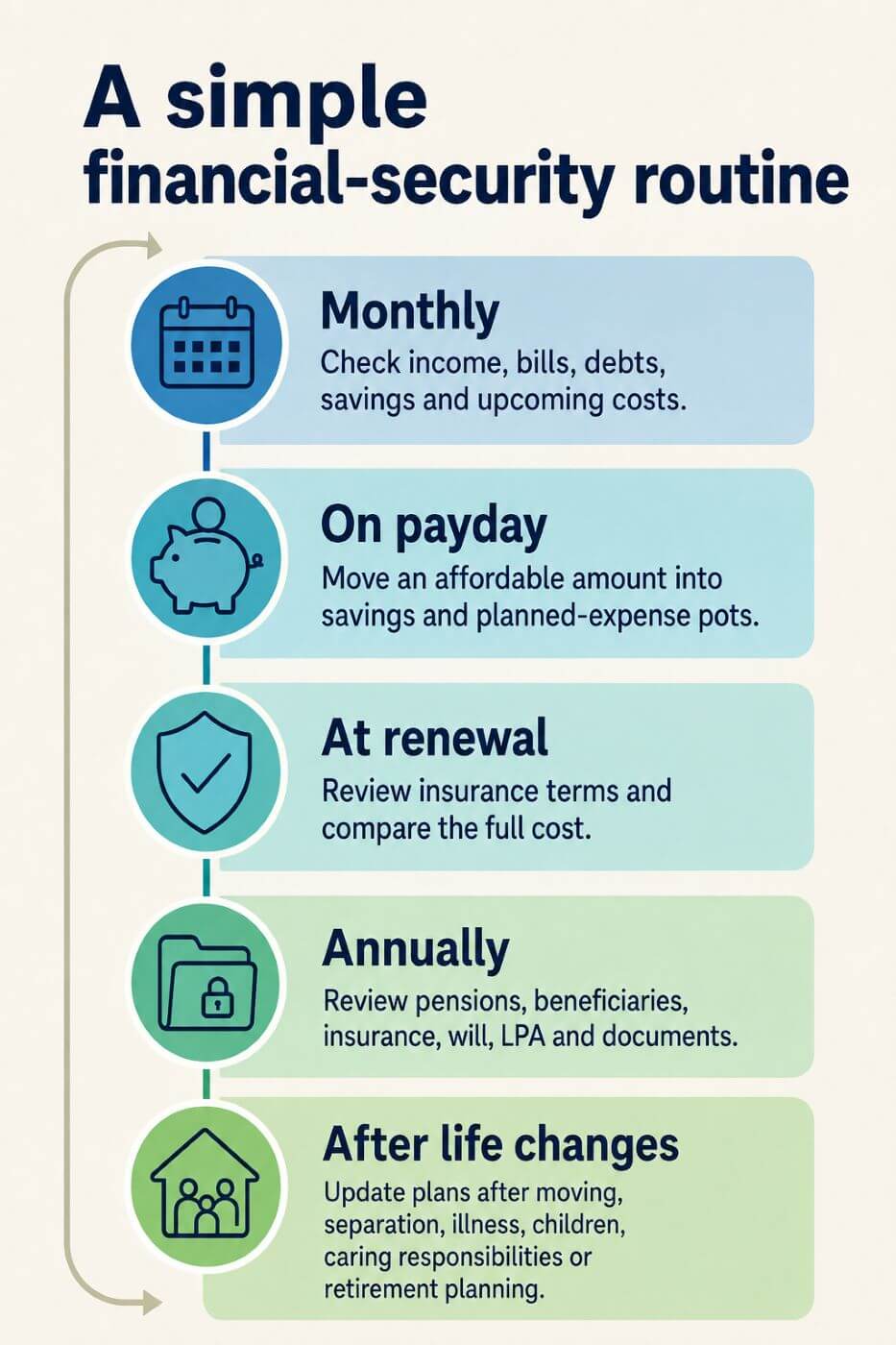
| How often? | What to do |
|---|---|
| Monthly | Review balances, bills, debt payments, savings and upcoming costs. |
| On payday | Move an affordable amount into emergency savings and planned-expense pots. |
| At renewal | Check insurance terms and compare the full cost rather than allowing automatic renewal without review. |
| Annually | Review pensions, beneficiaries, insurance, wills, documents and household goals. |
| After a major life event | Update the parts of the plan affected by the change. |
Financial security is built through consistency
No household can prepare for every possible event.
The aim is not to remove all uncertainty, but to make an unexpected bill, income change or family emergency less destabilising.
A regular money review, a gradually growing savings buffer, suitable protection and organised documents can achieve more than an elaborate plan that is too difficult to maintain.
Start with the most urgent issue, take one practical step and return to the plan regularly. Financial security is rarely created by one dramatic decision. It is built through small actions that continue to work month after month.
FAQs
How much should I keep in emergency savings?
MoneyHelper describes three to six months of essential outgoings as a useful rule of thumb. That is a long-term target rather than a minimum entry requirement. Begin with an affordable amount and increase it gradually.
Should I save money if I have debt?
It depends on the type and cost of the debt. Priority arrears and expensive borrowing may need attention first, although a small emergency buffer can help prevent further borrowing. Free debt advice can help establish the right order.
Is over-50s life insurance good value?
Not always. Acceptance can be straightforward, but the payout is normally fixed and someone may pay more in premiums than the policy eventually provides. Compare it with regular life insurance, savings, workplace benefits and other alternatives.
Do I need life insurance?
It may be useful when a partner, child or other dependant relies on your income, or when you want to cover a mortgage, debts or funeral costs. Check existing employer and pension benefits before buying additional cover.
What financial documents should I keep?
Keep current details of bank accounts, insurance, pensions, housing, debts, legal documents and important contacts. Store them securely and tell a trusted person where they can be found.
Do I need a will if I do not own a house?
A will can still be useful because it covers money, possessions and other wishes. Without one, the law decides who inherits under intestacy rules.
What is the difference between a will and a lasting power of attorney?
A will deals with what happens after death. A lasting power of attorney allows trusted people to make specified decisions during a person’s lifetime.
Where can Oxfordshire residents get free money advice?
MoneyHelper, Citizens Advice Oxfordshire, Citizens Advice West Northamptonshire and Cherwell, and StepChange all provide free guidance or advice. Oxfordshire County Council also publishes information about local cost-of-living and crisis support.