

















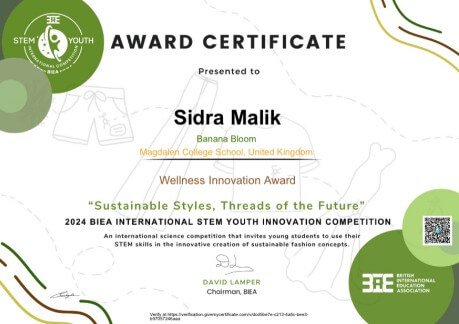
An Oxford student has turned agricultural waste into a prototype reusable sanitary pad — and she wants the science to do the talking when she takes the stage as Miss Oxford. Sidra Malik (19) won the Wellness Innovation Award at the BIEA International STEM Youth Innovation Competition for a pad made from banana fibre, a natural material that is absorbent, breathable and biodegradable.
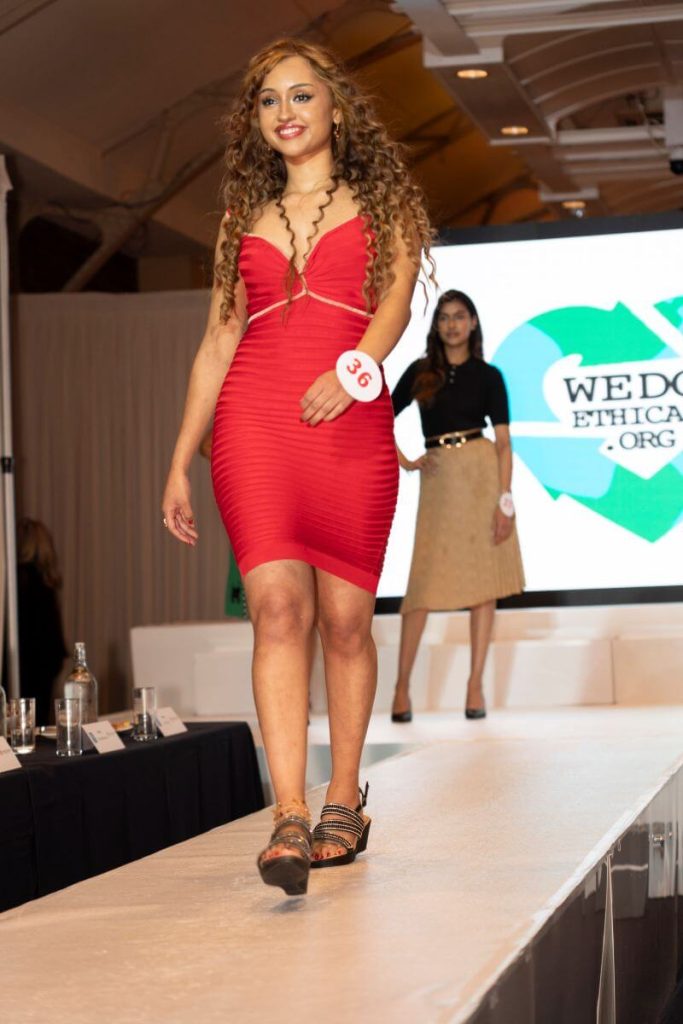
Next month (20th & 21st November) she’ll showcase the idea at the Miss England final’s Eco-Fashion round, but says the priority is sustainability and women’s health, not pageantry.
Malik’s project is titled Banana Bloom. Her certificate confirms the Wellness Innovation Award under the theme “Sustainable Styles, Threads of the Future” in 2024, when she was a pupil at Magdalen College School, Oxford. She is continuing the project in Oxford while developing the engineering and testing.
“I have a deep passion for sustainability,” said Sidra. “The climate crisis is more prominent now than ever before, and I believe businesses and individuals should work in harmony with the environment to reduce harm rather than escalate it. My design offers an eco-friendly solution that’s not only better for the planet but also creates opportunities for developing countries to benefit from banana fibre production.”
The science in brief
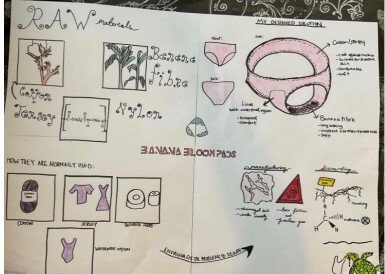
- Material core: banana-stem fibre, a cellulose-rich by-product often discarded after harvest — used for the absorbent layer.
- Companion fabrics: cotton jersey and nylon to balance absorption, comfort and airflow while minimising plastics.
- Design intent: a layered construction that can be washed and re-used multiple times, or disposed of with far less long-term waste than plastic-based pads.
- Next tests: absorbency, tensile strength, wash-wear durability, and comfort across sizes/flows.
Concept artwork
Why it matters
Disposable pads typically contain plastics that can persist for decades in landfill. Malik’s concept aims to reduce waste at source, reuse where practical, and valorise farm by-products that are abundant in banana-growing regions, potentially creating ethical supply chains and income alongside environmental benefits.
Why this could matter in the developing world
Reusable pads made from banana fibre are promising where period products are unaffordable, supply chains are fragile, or banana stems are treated as waste.
Four potential benefits
- Lower lifetime cost — a washable pad spreads cost over dozens of cycles and can reduce monthly spend.
- Local materials, local jobs — banana stems are plentiful across East Africa, South Asia and Latin America; turning stems into fibre supports micro-enterprises and keeps more value in-country.
- Less waste — where disposal systems are limited, a re-usable design reduces burning and dumping of plastic pads.
- School attendance & dignity — reliable protection, paired with education, supports attendance and participation.
This ground-breaking idea means an affordable pad that can be made close to where it’s needed, with banana fibre giving a route from farm by-product to women’s health.
Re-usables work best when:
- Water, soap and privacy are available for washing and sun-drying.
- Users receive clear care instructions (how often to change; how to wash; when to retire a pad).
- Fabrics are colourfast and skin-safe; stitching is robust; edges don’t fray.
- There’s a plan for distribution and feedback (schools, clinics, women’s groups).
How a pilot could work (six steps)
- Local fibre: partner with banana co-ops to collect stems; pay farmers for by-product.
- Processing: simple decortication; wash, dry and card the fibre.
- Manufacture: train a women-led sewing unit; certify a standard pad in three sizes/flows.
- Quality checks: absorption, leak, re-wet, tensile and wash-wear tests; basic microbiology on laundered pads.
- Distribution & teaching: work via schools and clinics; provide the wash kit and pictogram guide.
- Measure impact: track usage, comfort, attendance, replacement rate and user feedback; iterate.
What comes next
Malik plans to keep developing the prototype after the Miss England final on 20–21 November (Grand Station, Wolverhampton). The next milestones include:
- Lab and user testing (absorbency, durability, wash cycles, comfort).
- Refining the pattern for different flows and sizes.
- Partnerships with manufacturers, NGOs and universities for small pilot runs.
- Compliance pathway (materials safety, labelling and product standards).
“Beauty and sustainability can sit side by side,” said Miss England director Angie Beasley, who praised Malik for using a mainstream platform to promote a science-led solution in women’s health.
About the award
- Competition: BIEA International STEM Youth Innovation Competition (2024)
- Theme: Sustainable Styles, Threads of the Future
- Prize: Wellness Innovation Award
- Project: Banana Bloom
- School at time of entry: Magdalen College School, Oxford














