

















Oxford’s traffic-filter trial began on Monday 28 September 2026, replacing the temporary congestion charge at six camera-controlled points. Drivers can no longer pay £5 to take a restricted car through a filter during its operating hours.
Cars need a valid permit unless an exemption applies. Drivers without one can choose a route that avoids the filters or travel outside the published restriction times.
The council has transferred most qualifying congestion-charge permits, but some central-area permits expired. Check your account, registered vehicles and remaining day passes before relying on a permit.
Updated 16 October 2026: this guide now reflects the start of the trial and the permit transition. Figures about the earlier congestion charge are identified by their reporting period.
At a glance
| Trial began | Monday 28 September 2026 |
| Temporary congestion charge ends | The charge ended on 27 September 2026; the £5 option is no longer available |
| Number of filters | Six |
| Vehicles restricted | Cars and motorhomes classified as M1 vehicles, including electric cars |
| Oxford resident permit | 100 free travel days during a 12-month permit |
| Oxfordshire resident permit | 25 free travel days during a 12-month permit |
| Standard fine | £70, reduced to £35 if paid within 21 days |
| Initial warning | The first contravention during the first six months will result in a warning rather than a fine |
| Consultation | Consultation runs from 28 September 2026 to 28 March 2027 |
| Maximum trial length | 18 months under an Experimental Traffic Regulation Order |
| Apply | Check eligibility and apply for a traffic-filter permit |
What changed on 28 September 2026?
The traffic filters use the same six locations, cameras and broad permit system as Oxford’s temporary congestion charge.
The main difference is that a driver without a permit can no longer pay £5 to take a car through a restricted point.
| Temporary congestion charge | Traffic-filter trial |
|---|---|
| Drivers could pay £5 to pass a charge point without using a permit. | There is no £5 option. A restricted car needs a valid permit or an alternative route during operating hours, unless exempt. |
| Six camera locations operated at specified times. | The same six locations and operating times remain. |
| Permit holders could pass without paying. | Valid traffic-filter permit holders can pass during operating hours. |
| Introduced while Botley Road remained closed. | The council says every part of Oxford can be reached without crossing a filter, although the route may differ. |
| Temporary interim measure. | Experimental trial lasting up to 18 months, with consultation and monitoring. |
There are no gates, bollards or physical road closures at the filter points. Automatic number plate recognition cameras read vehicle registrations and check them against the permit system.
Drivers who do not qualify for a permit can still reach every part of Oxford by car, but may need to choose a different route.
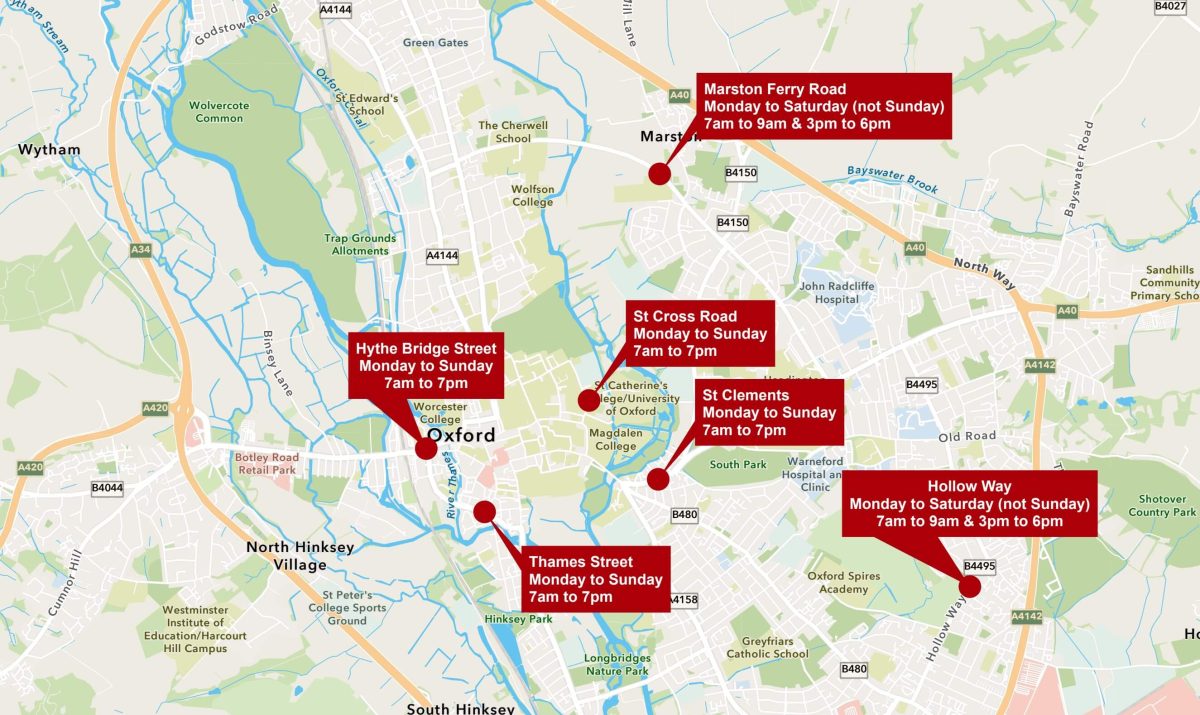
Where are the six Oxford traffic filters?
| Traffic-filter location | Operating days | Operating times |
|---|---|---|
| Hythe Bridge Street | Monday to Sunday | 7am to 7pm |
| St Cross Road | Monday to Sunday | 7am to 7pm |
| St Clement’s Street | Monday to Sunday | 7am to 7pm |
| Thames Street | Monday to Sunday | 7am to 7pm |
| Marston Ferry Road | Monday to Saturday | 7am to 9am and 3pm to 6pm |
| Hollow Way | Monday to Saturday | 7am to 9am and 3pm to 6pm |
The filters operate throughout the year, including on bank holidays.
Outside the published operating times, any vehicle can pass through without a permit. The traffic filters on Marston Ferry Road and Hollow Way do not operate on Sundays.
Blue advance signs warn drivers approximately 80 yards before each filter, providing an opportunity to change route. Yellow signs on both sides of the road mark the camera-enforced restriction itself.
Drivers can view the locations and resident permit boundaries through the council’s official traffic-filter map.
Which vehicles are affected?
The restrictions apply to cars and motorhomes recorded by the DVLA as M1 vehicles.
Electric cars are not automatically exempt. An electric car needs a permit in the same way as a petrol, diesel or hybrid car.
Vehicles such as vans, lorries, buses, coaches, motorbikes, mopeds and scooters can pass through the filters without a traffic-filter permit.
Taxis and private-hire cars classified as M1 need the relevant permit. Exempt cars include emergency-service and military vehicles, and vehicles used for highway or utility work in specified circumstances. Drivers who are unsure should check the “vehicle type approval” field through the DVLA vehicle checker. An M1 classification means the vehicle is normally covered by the restriction; check any applicable exemption or permit.
How do the resident day passes work?
Residents in two designated areas can apply for free permits providing a limited number of days on which they can drive through the filters.
| Resident permit | Travel allowance | Vehicles | Permits per address |
|---|---|---|---|
| Oxford permit area | 100 days during a 12-month permit | Up to three cars on each permit | Up to three qualifying permits |
| Oxfordshire permit area | 25 days during a 12-month permit | Up to three cars on each permit | Up to two qualifying permits |
The allowance is measured in days rather than individual filters or crossings.
When a registered car travels through a filter for the first time that day, one pass is deducted automatically. The same car can then use the filters again during that day without another pass being taken.
If a second car listed on the same permit passes through a filter on that day, another day pass is deducted.
The passes belong to the permit rather than to each individual vehicle. Each eligible person is limited to one resident permit. Once its day-pass allowance is used, that permit no longer authorises passage during operating hours. The council sets out the Oxford and Oxfordshire resident rules separately.
Residents do not need to identify their permit area before beginning an application. The online system will use their address to display the permit for which they may qualify.
What happened to existing congestion-charge permits?
The council confirms that most qualifying temporary congestion-charge permits have transferred automatically to the trial.
Holders should check their existing account and the council’s notification rather than submit a duplicate application.
Resident allocations reset at the start: 100 days for Oxford permits and 25 for Oxfordshire permits. Subsequent qualifying journeys reduce that allowance.
Unused resident passes from the old scheme were not added to the new allocation.
Some central-area permits have expired
The temporary central permit area does not exist in the traffic-filter scheme. The council says every part of Oxford can now be reached without crossing a filter.
| Central-area resident permit | Converted to an Oxford permit-area resident permit with an initial allocation of 100 day passes. |
| Central-area resident visitor permit | Expired with the temporary charge. Unused passes are not valid for the traffic-filter trial. |
| Central-area workplace parking permit | Expired and was not transferred. The holder may qualify for another permit. |
| Central-area sports club, nursery or military training permit | Expired and was not transferred. The organisation should check whether another permit applies. |
Anyone holding one of the expired permits should read the council’s notification carefully and apply for a different permit where eligible.
Who else may qualify for a permit?
The council has created 20 permit categories for people and organisations whose work, health, disability or caring responsibilities may make car access necessary.
They include permits for:
| Area of need | Examples |
|---|---|
| Health and disability | Blue Badge holders, disabled-tax-class vehicles, disability benefit claimants, frequent hospital patients and pupils with SEND |
| Care | Unpaid carers and community health or care workers using personal cars |
| Schools and public services | School cars used for home-to-school transport, firefighters and magistrates travelling to court |
| Business and goods | Qualifying business or personal cars being used as goods vehicles and organisational pool cars |
| Transport and other services | Licensed taxis and private-hire vehicles, approved driving instructors, car clubs and funeral vehicles |
Eligibility conditions, evidence and vehicle limits differ between categories.
A Blue Badge permit, for example, provides unlimited travel through all six filters while the car is being used by, for or in connection with the badge holder. Up to two cars can be registered, and the badge holder does not need to be their registered keeper.
A person, or their child, attending planned medical appointments at a hospital in the Oxford permit area on at least three separate occasions within a 90-day period may qualify for a frequent hospital patient permit. Blue Badge, disability benefit and frequent-patient permits are not restricted to Oxfordshire residents.
The complete list is available through the council’s traffic-filter permit page.
How to apply for a traffic-filter permit
Applications are made online through Oxfordshire County Council’s permit system.
Traffic-filter permits are virtual. Successful applicants will not receive a sticker, card or paper permit to display in the car. The ANPR cameras will read the number plate and check it against the online account.
A resident application will normally require proof of address and the vehicle’s V5C logbook or an accepted alternative document.
The council aims to process an application within ten working days, but warns that it may take longer during busy periods.
A pending application does not allow the vehicle to pass through a filter. Drivers must wait until they receive confirmation that the permit has been approved.
Permit application checklist
| Check your existing account | Check whether your qualifying congestion-charge permit has already transferred; do not submit a duplicate application. |
| Select the correct permit | Eligibility and evidence differ between resident, disability, care, health and business categories. |
| Prepare evidence | This may include proof of address, V5C documents, benefit evidence, appointment information or professional confirmation. |
| Apply promptly | Allow at least ten working days and longer during busy periods. |
| Wait for approval | Submitting an application does not create temporary access. |
| Check number plates | Make sure every vehicle registration is entered accurately before travelling. |
What happens if a car passes without a permit?
A car recorded passing through a filter during its operating hours without a valid permit can receive a £70 Penalty Charge Notice.
The charge is reduced to £35 if paid within 21 days. If the recipient neither pays nor submits formal representations within 28 days of the PCN being served, the council can issue a charge certificate increasing the penalty to £105. Follow the deadlines and appeal instructions on the notice.
During the first six months of the traffic-filter trial, the council says the first contravention will result in a warning notice rather than a PCN.
No payment is required for that warning. However, it does not provide permission for later journeys. The driver must then avoid the filter or obtain an approved permit.
A later contravention can result in the full penalty.
Details about payments and challenges are available through the council’s traffic-filter fines page.
Can every part of Oxford still be reached by car?
Yes. The council says every part of Oxford can be reached by car without passing through a traffic filter, although some journeys require a different route.
Some drivers will need to approach from a different direction or use part of the ring road.
The filters should not be treated as barriers dividing Oxford into areas that cars cannot enter. They restrict selected through-routes during published hours.
Drivers should plan unfamiliar journeys before leaving and check the roadside signs rather than relying entirely on a sat-nav that may not yet contain the restrictions.
People travelling regularly to an Oxford hospital can use the council’s hospital travel guidance to compare unrestricted routes and permit options.
Background: what the July 2026 congestion-charge data showed
Oxfordshire County Council says monitoring of the temporary congestion charge has shown increases in bus and Park & Ride use and lower traffic levels on several routes into the city.
The July 2026 monitoring report recorded these changes in car-park entries. These figures concern the former charge, not the subsequent traffic-filter trial:
| Park & Ride | Change from July 2025 |
|---|---|
| Redbridge | 43.6% increase |
| Oxford Parkway, including the station car park | 32.7% increase |
| Seacourt | 30.7% increase |
| Peartree | 14% increase |
| Thornhill | 8.1% increase |
The Seacourt comparison does not include data after 25 July, while parts of the Oxford Parkway and Peartree occupancy records were also incomplete.
The council’s 2 September 2026 announcement reported Oxford Bus Company figures of around 41,000 additional passenger journeys per week across Oxfordshire compared with the same period in 2025, an increase of approximately 12%. About 17,450 of those extra weekly journeys were linked to Park & Ride services.
June traffic counts showed reductions of 8% on Magdalen Bridge, 12% on Folly Bridge and 5% on Abingdon Road south of Weirs Lane.
However, the picture is not positive on every route. Some sections of the outer road network and ring road experienced longer journey times, including routes around Headington, Marsh Lane, Kennington, Heyford Hill and Hinksey Hill.
Most July traffic-volume figures were unavailable because automatic counter and National Highways databases were undergoing transfer and maintenance work.
The figures do not prove a single cause
The council cautions that the temporary congestion charge was not the only factor capable of changing traffic, bus use, spending or Park & Ride activity.
Roadworks, weather, school and university terms, economic conditions, special events and changes to bus services may also have affected the comparisons.
The monthly figures are published shortly after collection, and the council says minor discrepancies may remain.
The latest monitoring information is available through the temporary congestion-charge dashboard.
More than 129,000 permits issued
The council’s permit system recorded 129,454 temporary congestion-charge permits issued between 24 September 2025 and 26 August 2026.
These included 36,207 Oxford resident permits and 65,048 Oxfordshire resident permits.
Unlimited-access categories included more than 13,000 Blue Badge permits, 4,619 permits for community health and care workers using personal cars, and hundreds of permits for hospital patients, disability benefit claimants, unpaid carers and other eligible users.
How much did the temporary charge raise?
The July monitoring dashboard reports gross income of £8.06 million between the temporary charge beginning on 29 October 2025 and 31 July 2026.
Before operating costs, this comprised approximately £2.85 million from £5 congestion-charge payments and £5.2 million from penalty charges.
That July report said income was being used for the combined Park & Ride ticket offer and the scheme’s implementation and administration.
The £5 payment option ended when the traffic-filter trial began. These figures are not the final total for the former scheme.
How long will the trial last?
The filters were approved by Oxfordshire County Council’s cabinet in November 2022 following a consultation that attracted 5,700 survey responses and 485 separate emails.
Implementation was delayed because the prolonged Botley Road closure prevented the full trial from operating as designed.
The filters were introduced under an Experimental Traffic Regulation Order, which can remain in force for up to 18 months.
The public consultation opened on 28 September 2026 and closes on 28 March 2027. Residents, businesses and other road users can comment on their experience of the trial.
The council will monitor matters including traffic levels, bus journey times and displacement onto other routes. Monthly data is expected to be published during the trial.
The evidence and consultation responses will inform a later decision on whether the filters should be removed, changed or made permanent.
The council’s current project page gives an estimated cost of £6.56 million, funded by the Government.
Speaking before the launch, in the council’s announcement of 2 September 2026, Councillor Gareth Epps, Cabinet Member for Transport Management, said: “If you don’t currently have a permit and think you may be eligible, now is the time to check and apply.
“Taking action now will help ensure a smooth transition when the trial begins on 28 September.”
FAQs
When did Oxford’s traffic filters begin?
The trial began on Monday 28 September 2026.
Can drivers still pay £5 to pass through?
No. The £5 option ended on 28 September 2026. During operating hours, a restricted car needs a valid permit unless exempt, or must use a route that avoids the filter.
Where are the six filters?
They are on Hythe Bridge Street, St Cross Road, St Clement’s Street, Thames Street, Marston Ferry Road and Hollow Way.
Do the filters operate on bank holidays?
Yes. They operate throughout the year, including bank holidays, according to the days and hours published for each location.
Are electric cars exempt?
No. Electric cars are covered in the same way as other cars and require a permit during operating hours.
Are vans and motorbikes affected?
Vans, lorries, buses, coaches, motorcycles, mopeds and scooters can pass through without a traffic-filter permit. Drivers should check the DVLA vehicle classification if unsure.
Do existing permit holders need to reapply?
Most do not. Qualifying congestion-charge permits have transferred automatically. Central-area visitor, workplace, nursery, sports-club and military-training permits expired instead.
Will unused congestion-charge day passes carry over?
No. Resident allocations reset to 100 days for Oxford permit holders and 25 days for Oxfordshire permit holders when the trial began.
Does one journey through several filters use several day passes?
No. The first passage by a registered car on a particular day uses one pass. Further passages by that same car during the day do not use another. A second registered car would use a second pass.
Does a Blue Badge automatically allow access?
No. A Blue Badge holder must have an approved traffic-filter permit and register the relevant cars. Existing qualifying permits have transferred automatically.
How long does a new permit application take?
The council aims to process applications within ten working days, although it may take longer during busy periods. A vehicle cannot use the permit until approval has been confirmed.
Can every part of Oxford still be reached by car?
Yes. The council says every part of Oxford remains accessible, although some drivers may need to take an alternative route.
How much is the fine?
The standard PCN is £70, reduced to £35 if paid within 21 days. During the first six months, the first contravention should receive a warning notice rather than a fine.
Where can people apply?
Eligibility, evidence requirements and applications are available through Oxfordshire County Council’s traffic-filter permit service.














