

















OXFORD’S Flood Alleviation Scheme (OFAS) could start two years sooner and cost £70 million less if the Environment Agency (EA) considered “demonstrable, viable alternatives” says Andrew Byass, a planning and environmental barrister in closing remarks to the Public Inquiry, which has been sitting at The Kings Centre, Osney Mead, Oxford since November 14th.
Inquiry Inspector Joanne Burston has been hearing evidence from the EA, and objectors, as to whether the proposed 1,000 Compulsory Purchase Orders (seizure by the state) were legal – given alternatives which the EA still refuse to examine to the same level of optimisation as their own scheme.
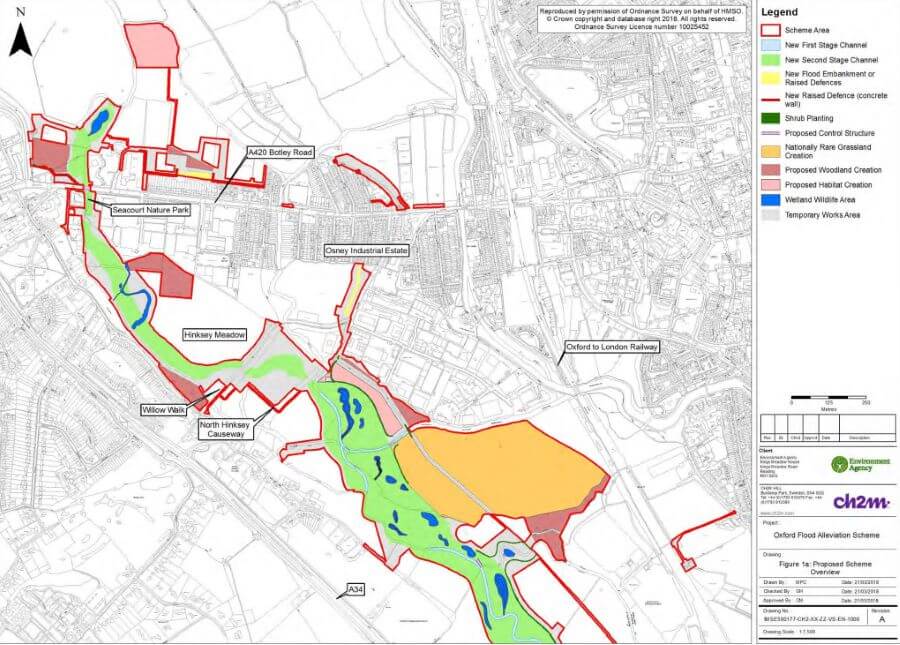
The current OFAS, led by the EA, is said to currently cost £176-million, and includes creating a 5km long ‘channel’ which would run from just north of Botley Road, to south of the A423 southern bypass near Kennington, where it would re-join the River Thames. Leading independent ecologists say the dug channel would destroy 13 acres of the rich, rare species of the irreplaceable plant community of the 1,000-year-old Hinksey meadow.
An estimated 4,000 mature trees and miles of hedgerows would also be lost in the West Oxford wildlife corridor and green belt. As would 1.3 Hectares of rare and irreplaceable MG4 Grassland, destroyed when alternatives exist, lowland river floodplains considered to have high biodiversity value.
Mr Byass of Landmark Chambers, London, on behalf of the Ferry Hinksey Trust, and the Oxford Flood and Environment Group (opponents of the channel component of OFAS), told the Inspector that the channel scheme was “destructive of the local environment” and, that his clients’ cost-saving options provided even greater efficacy – if only the EA would seriously examine local, creative options and not always rely on ‘off the peg’, expensive solutions, delivered by favoured, national contractors.
The lawyer said:
“My clients’ share the local community’s concerns about flood risks in Oxford. They are part of the local community. They have been flooded themselves. They agree that flood alleviation works are needed in Oxford. But the flood alleviation works need to be the right works!”
It is for the EA to show that their proposals are the right works. They have not done so. In short, the Trust & OFEG have shown through their evidence to this inquiry that there has been inadequate consideration given to alternatives to the CPO scheme.
“This is of fundamental importance, since it is for the EA to demonstrate that there is a compelling case in the public interest justifying the compulsory acquisition of land. It is a feature of this high threshold ….. that proper consideration must be given to whether the purpose for which the [EA] is proposing to acquire the land could be achieved by any other means.”
He reminded the Inspector that in cross-examination during the Inquiry, senior EA Officer, James Raynor, agreed that the same level of “optimisation” had not been carried out with any of the alternatives put forward by the Trust & OFEG, as had been carried out with the CPO Scheme.
On the final day of the Inquiry (JAN26), held virtually, the Inspector heard that the Trust & OFEG had instructed flood expert Clive Carpenter, who has more than 30 years of global experience in the strategic planning, feasibility, and design of large-scale water projects. Mr Carpenter reviewed the EA’s approach to alternatives.
Mr Byass told the Inquiry:
“Regrettably, his conclusion is that the EA’s work falls short. Quite simply, not enough has been done to interrogate alternatives.”
“What Mr Carpenter’s evidence demonstrated was that the potential alternatives at the least warranted further investigation and optioneering, to see if additional or amended flood defences could be put in place with a no-channel alternative which could achieve the same or similar beneficial flood alleviation effects, without however the significant environmental cost of the CPO scheme, and the need for the compulsory acquisition of the Trust’s land.
“For all the reasons advanced in evidence at the inquiry, the EA has failed to show that there is a compelling case in the public interest such as to justify the confirmation of the CPO. The Inspector and the Secretary of State are urged to provide a clear statement to the EA that a scheme such as this quite simply cannot be used as a basis to acquire land and cause the significant environmental and other harms described at the inquiry, without it being shown that this is the right scheme.”
Following the inquiry, a decision on the CPO’s is expected in April 2024. Whilst the EA has claimed work could start in late-2024, Planning Permission is yet to be granted and the Oxfordshire County Council Planning Consultation is still open. Future legal options may also be considered by landowners subject to CPOs if the Secretary of State does not order that the alternatives must be first considered.
Canon Chris Sugden, Chair of the Ferry Hinksey Trust, which owns land subject to a CPO said:
“Our battle as Oxford residents against the EA was a bit like ‘David and Goliath’ – another case of little people trying to get a big national organisation to listen and take our evidence seriously. Yet the alternatives proposed to the EA, and offered in evidence to the Inquiry, would save the environment, could start relatively quickly – and save the taxpayer £70 million!”














