

















New camera-enforced School Street restrictions will begin in Banbury, Carterton and Didcot on Wednesday 2nd September 2026, alongside an extension of the existing scheme in Headington. Here are the roads, operating times, exemption rules and official maps.
Six schools will be served by four restricted areas intended to create calmer and safer conditions around school entrances during morning drop-off and afternoon collection times.
The local road-safety initiative is intended to create a calmer environment around school entrances for children, families, teachers and nearby residents.
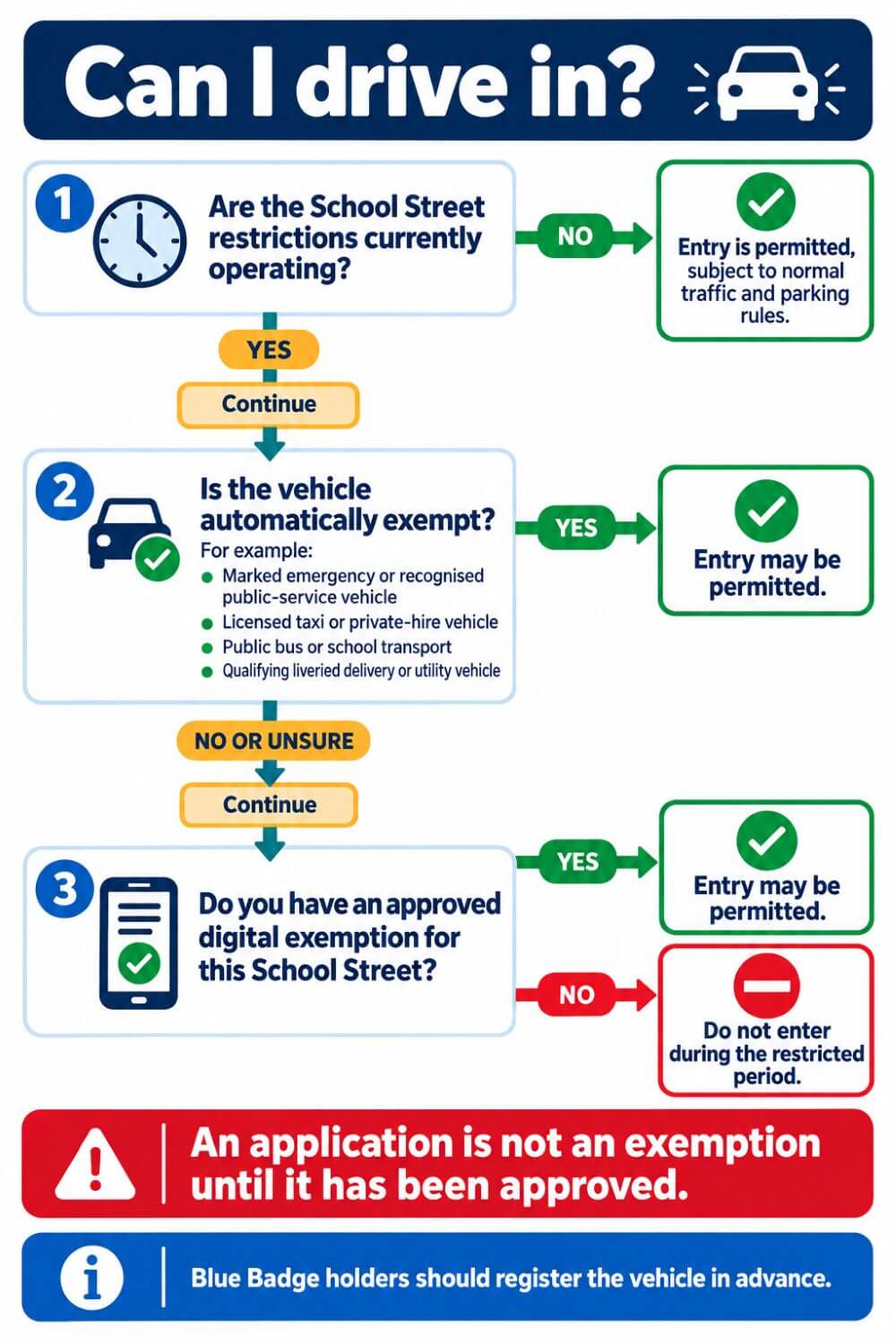
The restrictions will apply on weekdays during school term time, covering the morning school drop-off and afternoon collection periods. Most motor vehicles will be prohibited from entering the affected roads while the restrictions are in operation.
Automatic number plate recognition cameras will record vehicles entering each area. A non-exempt vehicle may receive a Penalty Charge Notice, while a vehicle already inside a zone before the restriction begins can remain parked and leave without being penalised for exiting.
At a glance
| Start date | Wednesday 2 September 2026 |
| Schools affected | Six |
| School Street areas | Four |
| Operating days | Monday to Friday during school term time |
| Enforcement | Automatic number plate recognition cameras |
| Physical barriers | No staffed or pop-up gates; drivers must follow the roadside signs |
| Exemptions | Free, digital and specific to the individual School Street |
| Initial trial | Six months |
| Maximum experimental period | Up to 18 months under an Experimental Traffic Regulation Order |
| Apply for an exemption | Use Oxfordshire County Council’s School Street exemption service |
Important: council information currently conflicts
Didcot boundary: Oxfordshire County Council’s main School Streets page says Kynaston Road was removed from the trial and replaced by Lynmouth Road. The dedicated trial page still lists both Lynmouth Road and part of Kynaston Road.
Blue Badge holders: The council’s overview describes Blue Badge vehicles as exempt, but its detailed guidance says the vehicle registration must still be submitted. Blue Badge holders should register before entering.
Feedback deadline: One council page says the consultation closes on 18 October 2026, while the dedicated trial page gives 1 March 2027. Submit comments as early as possible and check the live survey before relying on either date.
Drivers should follow the roadside signs, consult the latest official map and contact the council where the published information remains unclear.
Which schools and roads are affected?
| Location and schools | Roads covered | Morning restriction | Afternoon restriction |
|---|---|---|---|
| Banbury: Harriers Banbury Academy | Harriers View, from its junction with Bloxham Road for the road’s full length | 8.15am to 9.15am | 2.30pm to 4pm |
| Carterton: Edith Moorhouse Primary School and St Joseph’s Catholic Primary School | Carter’s Close, Edgeworth Drive, Home Close, Lavender Place, Richens Drive, Rose Close and Spurrett Gardens; Lawton Avenue between Alvescot Road and the Arkell Avenue/Rock Close junction | 8.15am to 9.15am | 2.30pm to 3.30pm |
| Didcot: Willowcroft Community Primary School and St Birinus Boys School | Abbott Road, The Croft, Glebe Road, Lynmouth Road, part of Mereland Road, Richmere Road and Ridgeway Road. Council pages currently conflict over part of Kynaston Road. | 8am to 9am | 2.30pm to 3.30pm |
| Headington: Sandhills Community Primary School | The existing Terrett Avenue, Elton Close and Sweet Green Close zone, extended along Delbush Avenue from Merewood Avenue to Hill View | 8am to 9am | 2.30pm to 3.30pm |
The restrictions apply only on school days. The signs will remain in place during weekends, holidays and inset days, but the cameras should not enforce the School Street outside its designated operating periods.
Why are School Streets being introduced?
School Streets are a road-safety and active-travel initiative intended to reduce vehicle movements and congestion around school entrances at the busiest times of day.
The project sits at the intersection of transport, education and public safety because changes to the school run affect children, families, teachers, nearby residents and other road users.
The council says the aim is to improve pedestrian safety and make walking, wheeling and cycling more attractive for pupils and families. Reducing traffic immediately outside schools may also create a quieter environment during arrival and collection times.
The phase-three project will test the effect of the restrictions on surrounding areas, including whether traffic moves into nearby residential streets.
The experimental approach allows the council to monitor the implementation, consider public comments and concerns, and modify a scheme during the trial where necessary. Earlier consultations and evidence collected during the trial will inform the eventual decision on whether each School Street should end, change or become permanent.
Banbury: Harriers Banbury Academy
The Banbury School Street covers the full length of Harriers View from its junction with Bloxham Road.
It will operate from 8.15am to 9.15am and from 2.30pm to 4pm. Its afternoon restriction is longer than those at the other phase-three locations.
Drivers approaching from Bloxham Road must not enter Harriers View during those times unless their vehicle qualifies for an exemption.
View the Harriers Banbury Academy School Street and ANPR map.
Carterton: Edith Moorhouse and St Joseph’s
Edith Moorhouse Primary School and St Joseph’s Catholic Primary School will share one School Street area.
The restriction covers Carter’s Close, Edgeworth Drive, Home Close, Lavender Place, Richens Drive, Rose Close and Spurrett Gardens.
It also applies on Lawton Avenue between its junction with Alvescot Road and the Arkell Avenue/Rock Close junction.
The operating periods are 8.15am to 9.15am and 2.30pm to 3.30pm.
Because the boundary covers a wider residential area rather than only the road immediately outside each school, residents, carers, visitors and delivery drivers should check the map before travelling.
View the Edith Moorhouse and St Joseph’s School Street and ANPR map.
Didcot: Willowcroft and St Birinus
Willowcroft Community Primary School and St Birinus Boys School will share a School Street operating from 8am to 9am and from 2.30pm to 3.30pm.
Oxfordshire County Council’s main School Streets page says the restriction covers:
- Abbott Road
- The Croft
- Glebe Road
- Lynmouth Road
- Mereland Road between the Abbott Road and Kynaston Road junctions
- Richmere Road
- Ridgeway Road
Sinodun Road, Abbott Close, Laburnum Grove and Bridge Close are also eligible for resident exemptions because access to those streets depends on travelling through the School Street area.
Unresolved Kynaston Road discrepancy
The council’s main overview says Kynaston Road was removed after the introduction of the Didcot Centre South controlled parking zone, with Lynmouth Road added in its place.
However, the dedicated trial page, last updated on 26 August, still lists Kynaston Road between Mereland Road and Ridgeway Road as being inside the restriction.
A separate council location table omits Kynaston Road but lists some access-dependent streets alongside roads that are directly restricted, adding to the lack of clarity.
Drivers using Kynaston Road should check the latest legal order, map and roadside signs. Questions can be sent to SchoolsActiveTravel@Oxfordshire.gov.uk.
View the current Willowcroft and St Birinus School Street and ANPR plan.
View the Didcot Experimental Traffic Regulation Order.
Headington: Sandhills Community Primary School
Sandhills already has a permanent camera-enforced School Street covering Terrett Avenue, Elton Close and Sweet Green Close.
Phase three extends the restricted area along Delbush Avenue, from its junction with Merewood Avenue to the junction with Hill View.
The existing operating times remain unchanged at 8am to 9am and 2.30pm to 3.30pm on school days.
The council says the extension responds to concerns about school-run parking, obstructed pavements and access to properties on Delbush Avenue.
The existing three-road scheme is permanent. The Delbush Avenue addition is the part being introduced experimentally.
View the Sandhills School Street extension and ANPR map.
How do the ANPR cameras work?
The cameras check vehicle registration plates against the exemption list for that particular School Street.
They operate only during the published morning and afternoon periods on school days.
The council says the cameras photograph the number plates of vehicles entering. They do not continuously record the surrounding street, pedestrians, nearby properties or vehicles leaving the area.
A non-exempt vehicle that enters while the restriction is operating may generate a Penalty Charge Notice.
A vehicle already parked inside the area before the restriction starts can leave without being penalised. If the same non-exempt vehicle then re-enters before the operating period ends, it may be recorded as a contravention.
A School Street exemption does not provide permission to park on yellow lines, school keep-clear markings, pavements or in contravention of a controlled parking zone.
Who needs to apply for an exemption?
Residents do not lose access to their homes, but their vehicles must be registered before entering during operating hours.
The council says the following people or vehicles may apply:
- residents living within the School Street;
- residents whose only route to their property passes through it;
- staff of qualifying businesses based within the area who need to park;
- people using private off-street parking accessed through the School Street;
- regular visitors providing care, healthcare or childcare;
- registered and informal carers;
- Blue Badge holders;
- school staff and regular school visitors who require access to on-site parking;
- contractors directly engaged by a school who cannot attend outside the operating times; and
- emergency or public-service workers using an unmarked private vehicle.
A separate application is required for each School Street. Approval for one location does not create an exemption for another.
Regular visitors may include registered or informal carers, health visitors and family members providing regular care or childcare, although evidence of that continuing need may be required.
Blue Badge holders must register
The council’s detailed guidance says Blue Badge holders are eligible for an exemption but must still submit the vehicle registration.
Displaying the badge alone will not prevent the ANPR system from identifying the vehicle, because the cameras cannot automatically access Blue Badge records.
A Blue Badge holder can register up to three vehicles and must provide an image of the badge showing its number and expiry date.
Read the Blue Badge exemption guidance.
Exemptions for SEND, illness and injury
A school can approve an exemption where a pupil has SEND, behavioural difficulties or mobility needs that mean they need to be driven into the area.
Parents and carers should discuss this directly with the school, which may ask for evidence of the child’s needs.
Schools can also consider temporary exemptions following illness or injury. Examples include collecting a sick child or helping a pupil, parent or carer who cannot walk from outside the boundary because of a short-term mobility problem.
These exemptions are discretionary and may take time to add to the digital system. Families should contact the school as early as possible.
Which vehicles are normally allowed?
The council lists the following types of vehicle as qualifying for access:
- emergency-service and recognised public-service vehicles;
- licensed taxis and private-hire vehicles;
- public buses;
- school buses and other school transport;
- Dial-a-Ride and specialist passenger services;
- public waste-collection vehicles;
- branded or liveried commercial delivery vans such as Royal Mail, UPS and DPD; and
- roadworks and utility vehicles carrying out work in or beside a restricted road.
Parents using an ordinary private car for the school run are not exempt unless they have another qualifying reason.
An unlicensed private driver is not covered by the taxi exemption.
What about deliveries and tradespeople?
The council distinguishes branded commercial delivery fleets from ordinary one-off deliveries.
Its exemption guidance lists liveried commercial vans such as Royal Mail, UPS and DPD as qualifying vehicles.
However, non-branded delivery vehicles, couriers, tradespeople and general service providers are not normally exempt. Residents and businesses should arrange those visits outside School Street hours where possible.
A plumber, maintenance worker or other contractor engaged directly by a school can be registered where the visit cannot take place outside the restriction, but the vehicle details should be submitted in advance.
How to apply
School Street exemptions are free and digital. No paper permit or windscreen badge is issued.
The vehicle registration is added to an exemption list for the specified School Street.
The council advises applicants to allow at least ten working days for a first application.
A subsequent change of vehicle should normally be submitted at least 48 hours before the replacement vehicle is used.
Drivers should wait for confirmation that the exemption has been approved. Entering while an application remains pending may result in the vehicle being recorded.
Apply for a School Street exemption.
How phase three follows Oxfordshire’s earlier School Streets
Oxfordshire’s School Streets programme began before the current rollout.
Phase 1 launched in 2021 with a six-week trial involving nine schools, after which four locations became permanent: St Nicolas Church of England Primary School in Abingdon, and Larkrise Primary School, St Ebbe’s Church of England Primary School and Windmill Primary School in Oxford.
Phase 2 introduced School Streets at five more schools in Didcot and Oxford during 2024: Manor Primary School, New Hinksey Church of England Primary School, St Mary and St John Church of England Primary School, Sandhills Community Primary School and Tyndale Community School.
Those five schemes were approved as permanent on 9 October 2025. The nine Phase 1 and Phase 2 School Streets remain in operation, while Phase 3 adds three new locations and extends the existing Sandhills scheme along Delbush Avenue.
What residents and parents should do now
| Residents | Register every vehicle that needs to enter during the operating periods and wait for confirmation. |
| Blue Badge holders | Submit the badge details and up to three vehicle registrations. |
| Parents of pupils with additional needs | Speak to the school about a discretionary exemption. |
| Regular carers or childcare visitors | Apply for the visitor’s vehicle to be registered. |
| Delivery customers | Arrange non-exempt deliveries outside the morning and afternoon restrictions. |
| Other school-run drivers | Park legally outside the boundary and walk, wheel or cycle the final part of the journey. |
What is the penalty for entering?
The standard moving-traffic Penalty Charge Notice in Oxfordshire is £70.
It is reduced to £35 when paid within 21 days. If the charge is neither paid nor successfully challenged, it can increase later in the enforcement process.
The council’s general moving-traffic policy says that, during the first six months after enforcement begins at a new site, a driver’s first contravention at that location will receive a warning notice. A later contravention at the same location can result in a PCN.
However, the School Street exemption page separately warns that a PCN may be issued where a driver enters before an application has been approved.
Drivers should therefore treat the restriction as fully enforceable from the start and should not use the possible warning notice as permission to enter.
How to challenge a PCN
A PCN will be sent to the registered owner or keeper of the vehicle, regardless of who was driving.
Only the registered owner or keeper can submit the formal challenge.
The appeal will normally require:
- the PCN number;
- the vehicle registration; and
- any documents or images supporting the challenge.
Do not pay the PCN before challenging it, as a paid notice is normally treated as closed.
General appeals can be made through the council’s PCN appeal service.
Where the issue relates specifically to an exemption, the council also gives pcnenquiries@oxfordshire.gov.uk as a contact address.
How long will the trials last?
The new School Streets and the Sandhills extension will initially be monitored for six months.
The Experimental Traffic Regulation Orders can remain in force for up to 18 months.
During that period, the council can modify a scheme, change an entrance or operating time, end the trial or begin the process of making the restriction permanent.
A material change to an experimental order may open a new objection period relating specifically to that amendment.
How will the School Streets be evaluated?
The council says its assessment will consider:
- traffic volumes and congestion near school entrances;
- traffic displaced onto neighbouring roads;
- air-quality information;
- ANPR and enforcement data;
- levels of walking, wheeling, cycling and car use;
- changes in how pupils travel;
- feedback from parents and carers;
- the views of teachers and other school staff;
- the experiences of residents and businesses; and
- feedback from each participating school.
The evidence will contribute to a future report and a decision on whether each scheme should end, change, continue within the experimental period or become permanent.
How to comment on the trials
The dedicated trial page says its survey opens at noon on Wednesday 2 September.
It currently gives a closing date of 11.59pm on Monday 1 March 2027. However, the same page describes the survey as lasting six weeks, while the council’s main School Streets page says comments close on Sunday 18 October 2026.
Residents should submit their views as early as possible and check the live survey page before relying on the later date.
Visit the Oxfordshire School Streets trial survey.
Questions, feedback and requests for a paper survey can be sent to SchoolsActiveTravel@Oxfordshire.gov.uk.
Oxfordshire County Council can also be contacted on 01865 519800.
Official maps and guidance
| Document | Official link |
|---|---|
| Phase-three overview, roads and times | Oxfordshire County Council School Streets overview |
| Trial survey and document library | Let’s Talk Oxfordshire trial page |
| Harriers Banbury Academy map | Open the Banbury map |
| Edith Moorhouse and St Joseph’s map | Open the Carterton map |
| Willowcroft and St Birinus map | Open the Didcot map |
| Didcot Experimental Traffic Regulation Order | Open the Didcot made order |
| Sandhills extension map | Open the Headington map |
| Exemption eligibility | Read the exemption guidance |
| Exemption application | Apply online |
FAQs
When do the new Oxfordshire School Streets begin?
The new trials and the Sandhills extension are due to begin on Wednesday 2 September 2026.
Do the restrictions operate during school holidays?
No. They apply on weekdays during school term time. The signs remain in place throughout the year.
Can a vehicle leave during the restriction?
Yes. A vehicle already inside when the operating period starts can leave without receiving a PCN. A non-exempt vehicle must not re-enter until the restriction has ended.
Do residents need an exemption?
Yes. Residents retain access, but vehicles that need to enter during operating hours must be registered.
Does a Blue Badge automatically prevent a fine?
No. The council’s detailed guidance says the Blue Badge holder must register the relevant vehicle. Up to three registrations can be supplied.
Can parents drive through to drop children at school?
Not in an ordinary private car unless they have another qualifying exemption. Most parents will need to stop legally outside the boundary.
Are taxis exempt?
Licensed taxis and private-hire vehicles are listed as qualifying vehicles. An ordinary unlicensed private driver is not covered.
Are delivery drivers exempt?
The council lists branded commercial delivery fleets as qualifying, but ordinary delivery drivers, couriers and general service providers are not normally exempt.
How much is the fine?
The standard PCN is £70, reduced to £35 if paid within 21 days.
Is Kynaston Road included in the Didcot School Street?
Oxfordshire County Council’s webpages currently conflict. The main page says Kynaston Road was removed, while the dedicated trial page still lists part of it. Check the official map, legal order and roadside signs before entering.
When does the consultation close?
The dedicated trial page gives 1 March 2027, but the council’s overview says 18 October 2026 and the trial page also calls it a six-week survey. Submit feedback early and check the live page.
Which schools were included in Phase 1?
Phase 1 began in 2021 with temporary, volunteer-operated restrictions at nine schools. Four schools subsequently progressed to permanent, camera-enforced School Streets: St Nicolas Church of England Primary School in Abingdon, plus Larkrise Primary School, St Ebbe’s Church of England Primary School and Windmill Primary School in Oxford. A public consultation on making those four schemes permanent took place in 2022, with the council reporting that 88% of responses supported the proposals.
Which schools were included in Phase 2?
Phase 2 covered Manor Primary School in Didcot and four Oxford schools: New Hinksey Church of England Primary School, St Mary and St John Church of England Primary School, Sandhills Community Primary School and Tyndale Community School. The schemes initially used temporary pop-up gates before moving to ANPR camera enforcement. Following the experimental period, all five were approved as permanent School Streets on 9 October 2025.
Are the Phase 1 and Phase 2 School Streets still operating?
Yes. Oxfordshire County Council says the Phase 1 and Phase 2 arrangements remain in place. Eligible residents, Blue Badge holders, businesses and other qualifying road users can continue to apply for exemptions for those existing School Streets. The roads and operating times vary by location, so drivers should check the council’s current location list before travelling.
How is Phase 3 different from the earlier phases?
Phase 3 creates three new School Street locations in Banbury, Carterton and Didcot, serving five schools between them. It also extends the existing Phase 2 scheme at Sandhills Community Primary School in Headington. This means Phase 3 affects six schools across four locations, but only three of those locations are entirely new.
How many Oxfordshire School Streets are there altogether?
Once the Phase 3 trials begin, the countywide programme will comprise 12 operational locations serving 14 schools. Nine permanent locations come from Phases 1 and 2; Phase 3 adds three new locations and enlarges the existing Sandhills location rather than counting it twice.














