

















Open-plan rooms, hard floors and lively teams are great for energy, but not always for getting work done.
Ask anyone in a coworking space off The Plain or a small lab on the Science Park: a day of ringing phones, printer chatter and corridor conversations can leave even the best team frazzled.
The good news? You don’t need a full refit to make a noticeable dent in noise. A handful of smart choices, some as simple as moving a printer, can bring back focus and lower stress.
Start with what you’ve got
Before buying panels and pods, take a quick baseline. Walk the floor at a busy time and notice where sound builds: by the kitchen, in a long glass corridor, near the copier. A simple “clap test” tells you a lot, if the sound rings, the room needs more absorption.
A few comparative readings on a phone app (A-weighted dB) will help you track improvement without getting lost in numbers. For office comfort guidance, the HSE’s office noise guidance is a good primer.

Soften the surfaces
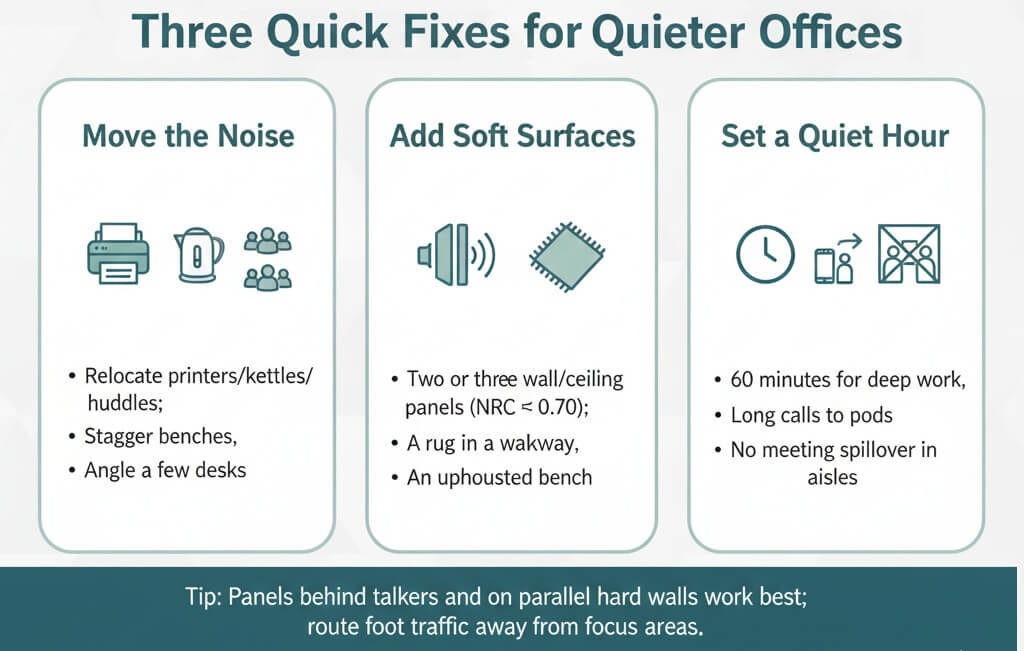
Noise loves hard, parallel walls and bare ceilings. What helps is adding materials that absorb, rather than bounce, sound. In plain English: fabric on the walls, a better ceiling tile, and a few upholstered pieces will take the edge off. If you’re choosing products, absorption ratings are a handy guide, many offices see a noticeable difference with panels around NRC ≈ 0.70 in focus areas.
Rugs in walkways, curtains on long glass runs, and bookcases or planters used as baffles all chip away at echo without changing the character of the office. For benchmark thinking, see the BCO Guide to Specification for widely used acoustic criteria.
Acoustic panels and sound-absorbing materials
Ceiling treatments make a big difference in open areas where sound bounces off hard surfaces. Adding acoustic ceiling panels can help cut echo and dampen background chatter, especially when paired with a few well-placed wall panels.
Using soft furnishings to improve acoustics
Furniture can double as sound control. Sofas, upholstered chairs and fabric-covered partitions soak up noise while keeping spaces comfortable. Even a strategically placed bookcase can help block sound paths. If you’re browsing options, furniture items with sound-absorbing properties are a simple way to add function without a full refit.
For benchmark thinking, see the BCO Guide to Specification for widely used acoustic criteria in modern workplaces.
Move the noise, not the people
Layout is a powerful (and free) tool. Cluster printers, dishwashers and impromptu huddles away from quiet desks. Stagger benches so people aren’t facing each other in long rows; angle a few workstations so conversations don’t fire straight across the room. If you’ve ever tried to concentrate next to a main corridor, you’ll know why it helps to route foot traffic a few metres away from heads-down work.
Give focus a home
Even in small premises, a little bit of quiet goes a long way. A couple of phone-booth style pods, a hush room, or simply a corner with screens and softer finishes gives people somewhere to take calls or dig into deep work.
Clear, friendly house rules, no long calls at the desk; grab a pod when you can, make the most of the space you already have. For neurodivergent colleagues, predictable quiet times and a retreat space can be a reasonable adjustment under the Equality Act 2010 guidance.
Etiquette still matters
Technology won’t fix everything. Agree a quiet hour, especially after lunch; keep “meeting spillover” out of aisles; use status lights or simple desk flags to signal “please don’t interrupt.” These are tiny changes that cost nothing and earn back concentration.
When tech helps
Sound-masking systems—think carefully tuned background sound, can make speech less intrusive in larger open areas. If you go this route, explain the purpose so it doesn’t feel like noise for noise’s sake. Noise-cancelling headphones are a personal option, not a policy.
Monitoring apps should be prompts rather than enforcement: anonymous cues that say “we’re getting loud, let’s move the huddle” are usually enough. For those exploring automation, some smart office systems can adjust background sound or nudge teams when levels spike.
What ‘good’ looks like, without the jargon
Aim for a space that feels calmer and clearer, not dead. In practice that means: fewer hard, bare surfaces; panels where sound first hits (behind talkers and on parallel walls); better ceiling tiles over focus areas; and noisy kit clustered out of earshot.
Some facilities teams track reverberation time; you don’t need to measure it to notice when a room stops ringing. For design context, the BCO acoustic sections are a useful reference point.
A local example
A small creative agency near Gloucester Green moved its printer and kettle out of a shared bay, added two fabric wall panels and an upholstered bench, and set a daily “quiet hour” from 2–3pm. Cost under £1,500; result: fewer complaints about concentration, meeting rooms freed up for real meetings, and happier Friday afternoons.
Costs and timing
Quick fixes like moving equipment, adding rugs and bookcases, setting a quiet hour, can happen this week. Mid-level changes like desk screens, a few wall panels, a pair of phone pods, often fit into a single quarter.
As a guide, desk screens start around £120–£250 each, small wall panels £80–£150, and phone-booth pods £2.5k–£5k (hire options exist). Bigger moves like proper quiet rooms, a sound-masking system, new ceiling tiles, are projects to plan, not necessarily a rebuild.
Know the framework
Office noise is usually a comfort and productivity issue, but it still sits alongside good health and safety practice. See the HSE’s office noise guidance. The BCO Guide to Specification includes widely used workspace benchmarks. For inclusion and adjustments, the Equality Act 2010 guidance is a helpful lens.
Bottom line
You don’t have to choose between collaboration and calm. A few thoughtful adjustments to finishes, layout and etiquette can make an open-plan office feel warmer, quieter and more productive, without calling in the builders.
Common Questions
What is NRC?
A simple rating of how much a material absorbs sound (0–1). Higher numbers = more absorption. Panels around NRC ≈ 0.70 are often effective in focus zones.
Do sound-masking systems add noise?
They add carefully tuned background sound that reduces speech distractions; done well, it feels like airflow, not “noise.”
Cheapest fix for open plan?
Move the printer and kettle, add a couple of soft finishes, and agree a quiet hour. Those three changes do a surprising amount.














