

















For many smaller businesses, the question is not whether digital marketing matters, but who should handle it. A café in Oxford, a solicitor in Banbury, a trades business in Bicester or a shop in Witney may all be trying to solve the same problem: how to reach more of the right customers online without wasting money on the wrong audience. In that context, local digital marketing services can still make a great deal of sense.
Digital marketing can now be managed from almost anywhere. A business in Oxfordshire can hire an agency in London, Manchester or even overseas and still build a strong online presence. In some cases, that works perfectly well. But for firms serving a clearly defined town, city or region, local support can offer advantages that are harder to reproduce at a distance.
That matters because people are spending an enormous amount of time online. The BBC recently highlighted just how much time many of us now spend connected, underlining why even smaller companies cannot afford to treat digital visibility as an afterthought. everyone using it for hours every day means competition for attention is constant. For local businesses, the challenge is not simply attracting more traffic, but attracting the right traffic from the places that actually matter.
Meeting your business’s local goals
If your business operates mainly in one area, there is often little point in building campaigns that cast the net too widely. A company may be visible to everyone online, but that does not mean everyone is a realistic customer. For a dentist, estate agent, café, retailer or electrician, relevance usually matters more than reach.
Digital marketing for local businesses works best when it reflects the way those businesses actually trade. If most revenue comes from a defined service area, the aim is to improve visibility and trust among nearby customers, not to generate clicks from places that are never going to convert. That is one of the main reasons local digital marketing agencies continue to appeal to smaller firms: they are often better placed to match marketing activity to the way the business really wins work.
Hyper-localised SEO
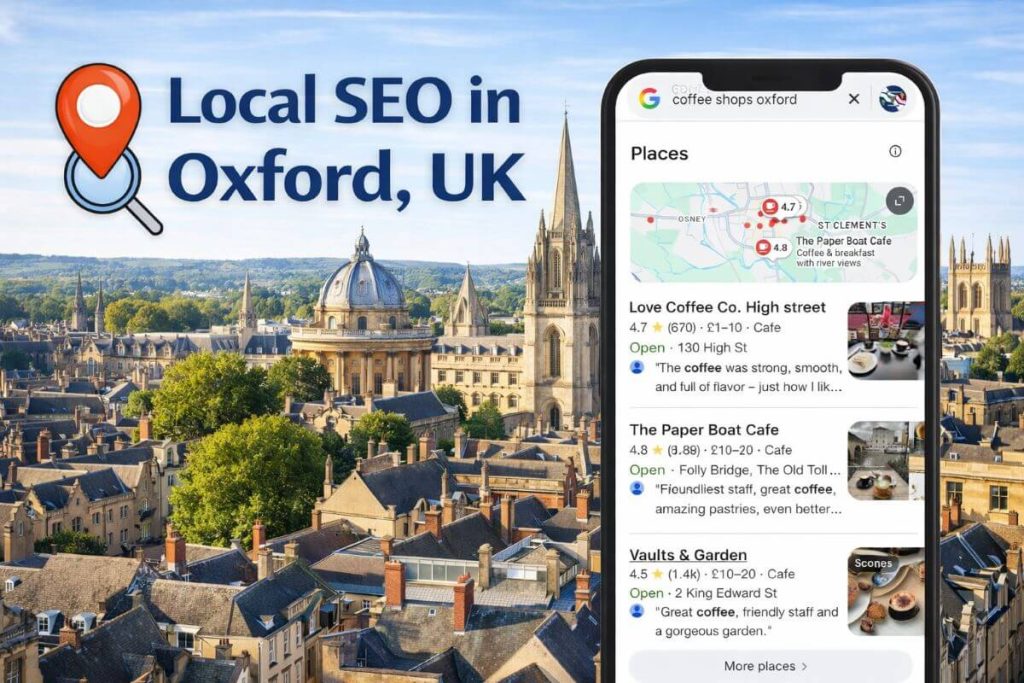
One of the strongest arguments for working with a local team is local search. A good local SEO specialist agency should be thinking about more than broad rankings. It should be looking at how a business appears in searches tied to place, intent and proximity, whether that is “accountant in Oxford”, “best lunch near me” or “emergency plumber Banbury”.
That usually means focusing on the parts of SEO that matter most for nearby discovery. In practice, this can include location-specific pages, reviews, local directories and strong Google Business Profile management. Google’s own guidance says local ranking is shaped by relevance, distance and prominence, which is why these local signals remain so important for service-led businesses.
It may also increasingly include answer engine optimisation, as more people use AI tools to discover information in ways that overlap with search. Research from McKinsey suggests these tools are increasingly used as search engines, which means businesses need clearer signals around who they are, where they are and what they do.
For many smaller firms, local visibility is not a nice extra. It is the difference between being found at the right moment and being lost beneath competitors who are simply better organised online.
Face-to-face strategising and collaboration
Remote working has made it easier than ever to build successful agency relationships at a distance, and there is no reason a remote team cannot do strong work. But there are still circumstances where being able to meet in person has real value. For smaller businesses, especially those new to digital marketing, strategy is often easier to shape when conversations happen face to face and the agency can see the business in its real setting.
That can be particularly useful when content needs to come from the business itself. A local agency is more likely to visit the premises, gather photography and video on site, and create material that feels specific to the business rather than generic. That does not mean remote teams cannot deliver. It means that for some firms, proximity can make planning, briefing and content gathering more practical and more natural.
Understanding of relevant local culture and dialect
The UK is not one uniform market. It is shaped by different identities, habits and expectations, and language still varies more than many marketers like to admit. The country is full of dialects and regional shorthands, and while a national agency can absolutely learn those nuances, a local team may begin with a better instinct for them.
That matters because smaller businesses often trade on familiarity and trust. Content that sounds too generic or detached from the place it is speaking to can feel flat, even if the technical SEO is perfectly sound. Understanding the difference between city centres, commuter towns and surrounding villages can sometimes be the detail that helps a business feel part of its own area rather than merely present online.
Better ROI for a smaller business budget
Budget is another reason local digital marketing services often appeal to smaller firms. Larger agencies can bring real expertise, but they may also come with higher minimum spends or broader retainers than a smaller local brief really needs. A local digital marketing agency may be more willing to tailor the work around a limited budget, particularly where the objective is not national growth but stronger local visibility.
That does not mean local automatically equals better value. Some national agencies are excellent at local campaigns, and some smaller agencies are not as strong as they claim. But for businesses that want a focused plan built around calls, leads, bookings or footfall from a particular area, local support can often be a better fit than a standardised package designed for broader markets.
Just as importantly, smaller businesses should be realistic about how they judge return on investment. A successful local campaign is rarely just about traffic. It is more often measured through the things that matter commercially: phone calls, direction requests, booking enquiries, quote forms and customers actually turning up.
How can I set up local digital advertising for my small business?
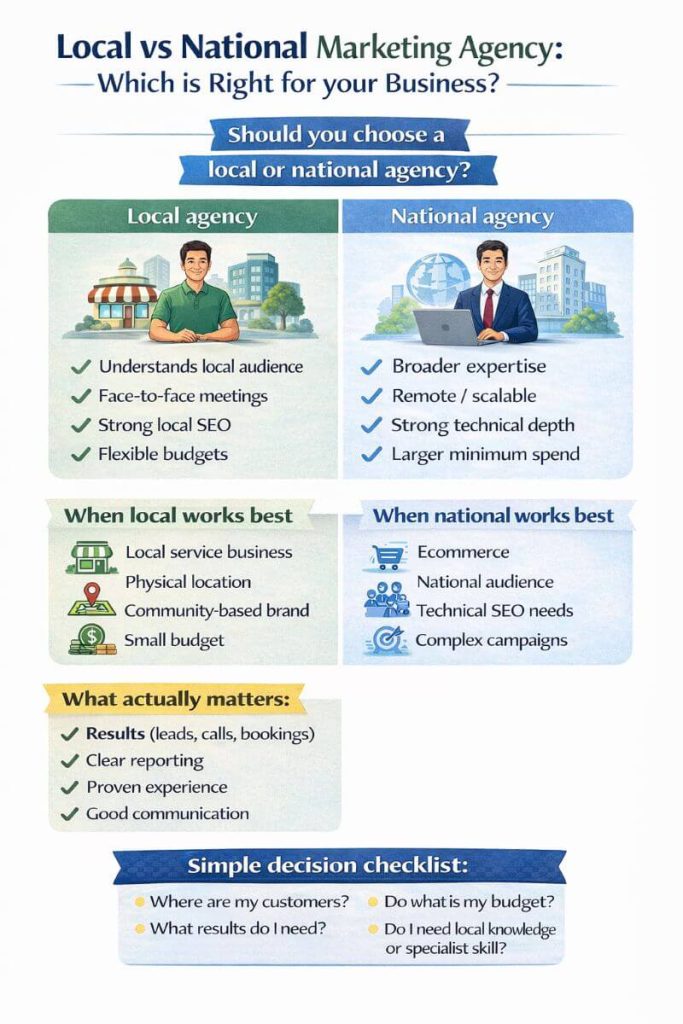
For most small businesses, the best starting point is not to ask whether local is always better. It is to ask what kind of agency actually understands the business. If most customers come from a defined service area, it makes sense to prioritise local search, location-based advertising and content that reflects how people nearby actually buy. If the business sells nationally, or needs highly specialist technical support, then a wider agency may be the stronger choice.
That is why the sensible comparison is not simply local versus national. It is whether the agency can explain how it will attract relevant customers, how success will be measured, what sort of work it will prioritise first, and whether its approach fits the business’s budget and goals. Plenty of national companies now specialise in local marketing strategies too, so that should form part of the comparison.
Before signing anything, smaller firms should be asking practical questions. How long is the contract? What reporting is included? What does success look like after three or six months? Has the agency worked with similar businesses before? Those questions usually tell you more than any pitch deck.
For many Oxfordshire firms, local digital marketing remains a strong option not because it sounds fashionable, but because it reflects the reality of how local businesses still grow: by being found by the right people, in the right place, at the right time.
At a glance
Best fit for: Smaller businesses serving a specific town, city or region
Main local advantage: Better visibility among nearby customers who are most likely to convert
Key local SEO elements: Google Business Profile, reviews, location pages, local directories and map visibility
When local may not be best: If your business sells nationally or needs highly specialist technical support
What to ask any agency: How success will be measured, what work comes first, whether reporting is included, and what experience they have with similar businesses
FAQs
What is local digital marketing?
Local digital marketing is marketing designed to help a business attract customers in a specific geographic area. That can include local SEO, Google Business Profile optimisation, local paid ads, reviews and content aimed at nearby customers.
Is a local digital marketing agency always better?
No. A local agency can be a strong fit for businesses serving a defined area, but a national or specialist agency may be better if your business operates across the UK or needs more advanced technical support.
How can I set up local digital advertising for my small business?
Start by identifying where your customers come from, which services matter most commercially, and what kind of enquiries you actually want. From there, compare agencies based on their understanding of local search, location-based advertising and how clearly they explain what they would do first.
What should a small business ask before hiring an agency?
Ask how success will be measured, what results they expect to deliver, what their local strategy includes, how long any contract lasts, whether reporting is included, and whether they have relevant examples of similar work.
Can a national agency still do local SEO well?
Yes. Plenty of national agencies are capable of running strong local campaigns. The question is whether they understand your service area, your audience and your commercial goals well enough to do it effectively.














