

















Rising costs, hybrid working and changing employee expectations have made office culture a practical business issue, not just an HR talking point.
For employers across Oxfordshire, the challenge is no longer simply getting people back to their desks. It is about creating workplaces where people understand what is expected of them, feel trusted to do good work, and have clear reasons to spend time with colleagues in person.
That matters in a county where recruitment and retention remain difficult for many employers. Oxfordshire Inclusive Economy Partnership describes the local labour market as extremely tight, with low unemployment, high job density and a shortage of people actively looking for work.
National working patterns have also changed. Office for National Statistics figures show that 28 per cent of working adults in Great Britain were hybrid workers between January and March 2025. Flexible working is now part of mainstream employment practice, and Acas says employees have a statutory right to request flexible working from their first day in a job.
At a glance
| What is changing? | Many workers now expect more flexibility, clearer communication and better support from managers. |
| Why it matters locally | Oxfordshire employers face recruitment and retention pressures in a tight labour market. |
| Key UK context | More than a quarter of working adults in Great Britain hybrid worked between January and March 2025. |
| Legal context | Employees can request flexible working from their first day in a job. |
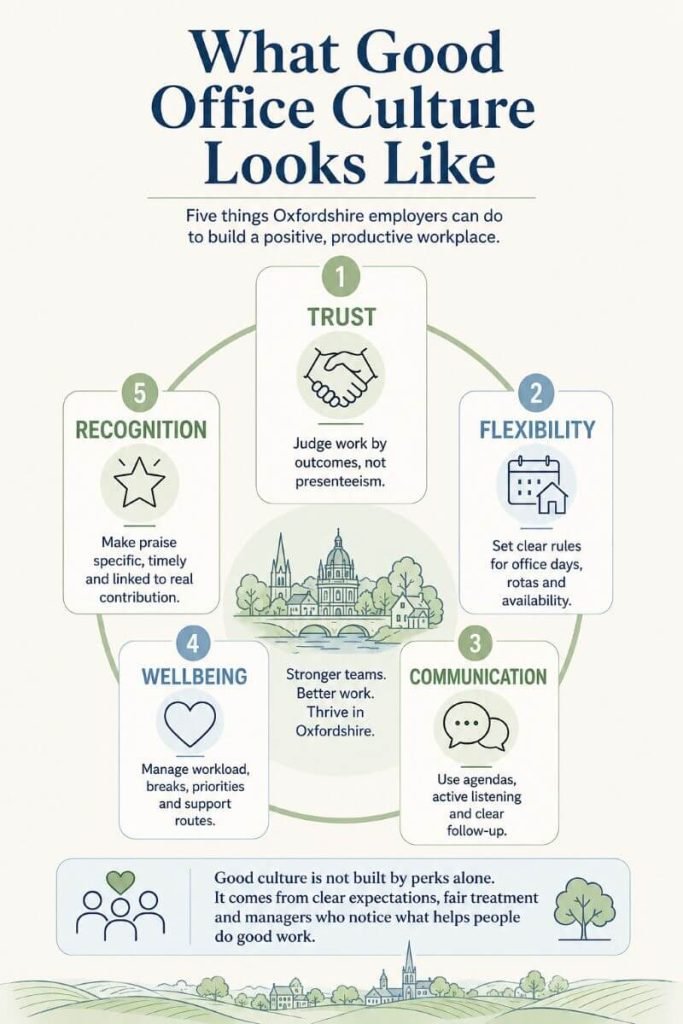
| Best approach | Good office culture is built through trust, fair policies, clear communication, manageable workloads and meaningful recognition. |
Flexible working needs clear rules, not guesswork
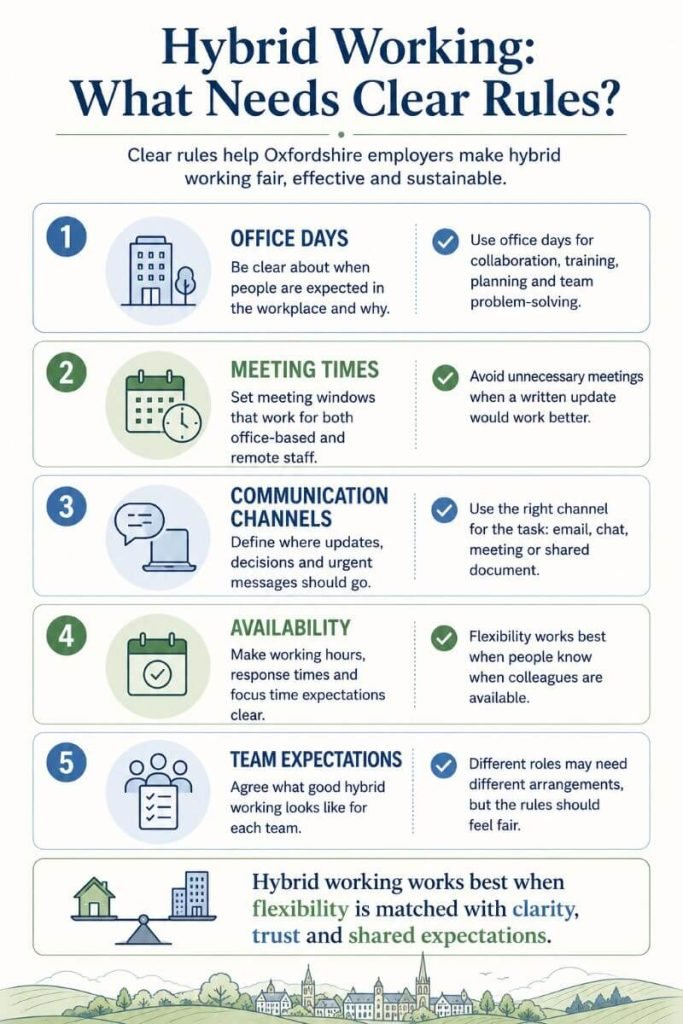
Hybrid and flexible working can help businesses attract staff, reduce commuting pressure and give employees more control over how they manage focused work. But it only works well when employers set clear expectations.
Some businesses have struggled because hybrid working was introduced quickly during the pandemic and never properly redesigned. The result can be confusion over who should be in the office, when meetings should happen, and which tasks are best done face to face.
Better employers are now treating office days as collaboration days rather than attendance days. That means using shared time for planning, training, creative work, client meetings and team problem-solving, while allowing quieter individual work to happen elsewhere where the role allows it.
This approach will not suit every sector. Retail, hospitality, care, manufacturing and logistics cannot be managed in the same way as office-based professional services. But even in roles that need people on site, employers can often offer some form of flexibility, such as fairer rotas, compressed hours, predictable shift patterns or more notice of changes.
Wellbeing has to go beyond office perks
Employee wellbeing is often discussed in terms of benefits, office design or social activities. Those things can help, but they cannot fix a workplace where people face unmanageable workloads, unclear priorities or poor management.
The Health and Safety Executive says 964,000 workers reported work-related stress, depression or anxiety in Great Britain in 2024/25. That makes wellbeing a serious management issue, not a soft extra.
Practical support can include regular workload reviews, protected lunch breaks, clearer handover processes, mental health training for managers and proper routes for staff to raise concerns without fear of being ignored.
Small improvements to the working day can also matter. Some employers are rethinking break areas, meeting spaces and shared facilities so staff have somewhere suitable to pause, talk and reset during the day. That might include better kitchen areas, quiet rooms or workplace refreshment options from suppliers such as Costa Coffee Professional. But these should be treated as supporting details, not substitutes for fair workloads and good management.
Office design should support the work people actually do
Many offices were designed around an older assumption that everyone would be present all day, five days a week. Hybrid working has exposed the weakness in that model.
If staff travel into the office only to sit on video calls, the journey can feel pointless. If they arrive for collaboration but cannot find a suitable meeting room, the office becomes frustrating rather than useful.
Businesses improving office culture are usually creating a better mix of spaces. Quiet areas help people concentrate. Small meeting rooms help teams work through problems. Informal breakout areas encourage natural conversation. Good technology allows colleagues working from home to join meetings without being treated as second-class participants.
For Oxfordshire employers, this can be especially important because commuting into Oxford, business parks or rural employment sites can be time-consuming and expensive. Staff are more likely to value office time when it is planned around work that benefits from being done together.
Better communication is central to better culture
Office culture is shaped less by slogans and more by everyday communication. Staff notice whether managers explain decisions, listen properly and give people enough information to do their jobs well.
Harvard Professional Development says clear communication, active listening, emotional intelligence and trust all play a role in stronger workplace communication. Its guidance on better communication habits is a useful reminder that leadership is not only about speaking clearly, but also about listening well.
In practice, that means setting agendas before meetings, giving quieter employees ways to contribute, summarising decisions afterwards and avoiding unnecessary meetings where a short written update would work better.
Inclusive communication also matters. A workplace where the loudest voices dominate every discussion is unlikely to get the best from its staff. Managers can improve this by inviting written input before meetings, rotating who leads discussions and checking whether decisions have heard from people closest to the work.
Recognition works best when it is specific
Recognition is one of the simplest ways to strengthen office culture, but only when it feels genuine.
Gallup argues that managers now acknowledge smaller achievements most effectively when recognition is honest, authentic and tailored to the employee. It also says recognition helps show other staff what success looks like inside an organisation.
That matters because vague praise can feel empty. Telling someone “good job” is less useful than explaining what they did well, why it mattered and how it helped colleagues or customers.
Recognition does not always need to involve bonuses or formal awards. It can be a short note from a manager, public thanks during a team meeting, a chance to lead a project, or private praise after a difficult piece of work. The key is that it should be timely, fair and linked to real contribution.
What businesses can do now
| Problem | Better response |
|---|---|
| Staff feel office days are pointless | Use office days for collaboration, training and decision-making, not routine admin that could be done elsewhere. |
| Hybrid working feels unclear | Set clear expectations around availability, meeting times, communication channels and team days. |
| Meetings are dominated by a few voices | Use agendas, written input and active facilitation so more employees can contribute. |
| Stress and absence are rising | Review workload, deadlines, management support and how staff can raise concerns. |
| Recognition feels tokenistic | Make praise specific, timely and linked to work that genuinely helped the business or team. |
| Staff do not feel trusted | Judge performance by outcomes and behaviour, not by presenteeism. |
Why this matters for Oxfordshire employers
Oxfordshire has a varied economy, from universities, science and technology firms to hospitality, retail, care, logistics, manufacturing and small independent businesses.
That means there is no single model of office culture that will work everywhere. A professional services firm in central Oxford will face different pressures from a manufacturer near Banbury, a hospitality business in Henley or a start-up around Science Vale.
But the underlying lesson is the same: employees are more likely to stay where work feels organised, fair and purposeful. Businesses that rely on rigid rules without explaining the reason behind them risk damaging morale. Businesses that combine flexibility with clarity are more likely to build trust.
Improving office culture does not always require expensive redesigns or big new benefits. Often, the most important changes are smaller: clearer communication, better-planned office days, fairer flexibility, proper breaks, realistic workloads and managers who notice good work.
FAQs
What is office culture?
Office culture is the way people experience work day to day. It includes management behaviour, communication, workload, trust, flexibility, recognition and how colleagues treat one another.
Does improving office culture mean allowing everyone to work from home?
No. Flexible working should suit the role and the business. Some jobs must be done on site. The aim is to create fair, clear and practical working arrangements rather than assuming one model works for everyone.
Do employees in the UK have a right to flexible working?
Employees have a statutory right to request flexible working from their first day in a job. Employers must consider requests properly, but the right is to request flexible working, not an automatic right to work from home.
How can small businesses improve office culture without spending much?
Small businesses can start with clear communication, predictable rotas, regular workload checks, proper breaks, fair recognition and better use of meeting time. Many culture improvements are about management habits rather than expensive perks.
What is the biggest mistake employers make with hybrid working?
The biggest mistake is treating office attendance as the goal. Office time works best when it has a clear purpose, such as collaboration, training, planning or relationship-building.














