A pillow is one of the most ordinary items in the house, but it can make a surprising difference to how comfortable you feel in the morning. For Oxfordshire residents juggling desk work, commuting, family life, student accommodation or older homes that run hot in summer and cold in winter, the wrong pillow can quickly become more than a minor irritation.
Modern pillows are no longer just bags of feathers or fibre. Many are now designed around sleep position, neck support, cooling, adjustability and material performance. Some of these features are genuinely useful. Others are simply marketing language. The sensible approach is to start with the problem you are trying to solve.
A pillow will not fix every sleep issue, and persistent pain should not be ignored. The NHS guide to neck pain and stiff neck advises people to see a GP if neck pain or stiffness does not go away after a few weeks, if painkillers have not helped, if they are worried, or if they have symptoms such as pins and needles or a cold arm. But if your current pillow is too high, too flat, too warm or no longer supportive, choosing more carefully can help improve comfort.
Why Pillow Choice Matters
The job of a pillow is not simply to feel soft. A good pillow should support the head and neck in a position that suits the way you sleep. That means the right pillow for a side sleeper may be wrong for a back sleeper, and the right pillow for a hot sleeper may be unnecessary for someone who stays cool through the night.
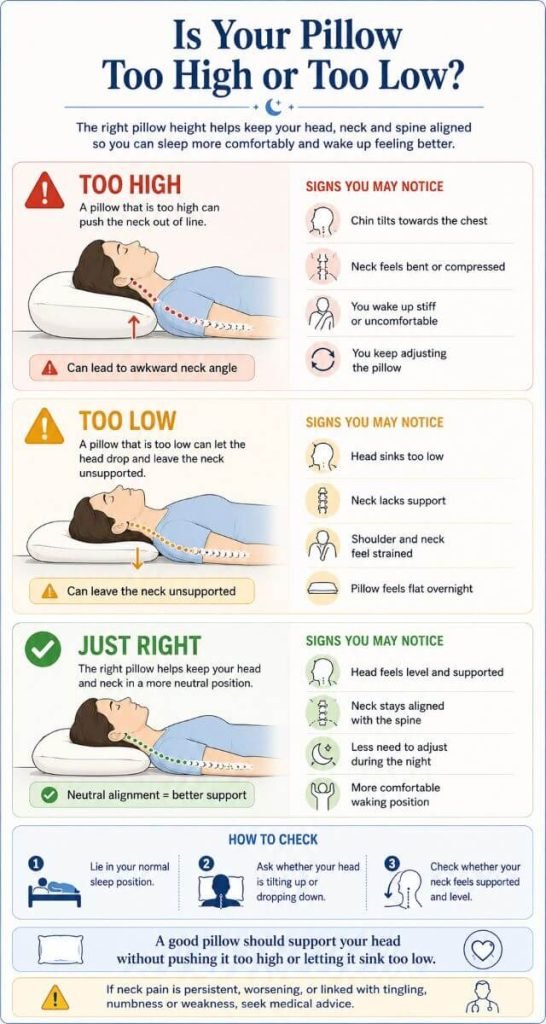
Many people only think about changing their pillow when it becomes lumpy or uncomfortable. But pillow height, firmness and material can all affect how well it supports you. A pillow that is too high can push the neck upwards. A pillow that is too low can let the head drop. A pillow that collapses during the night may feel comfortable at first but fail to support you by morning.
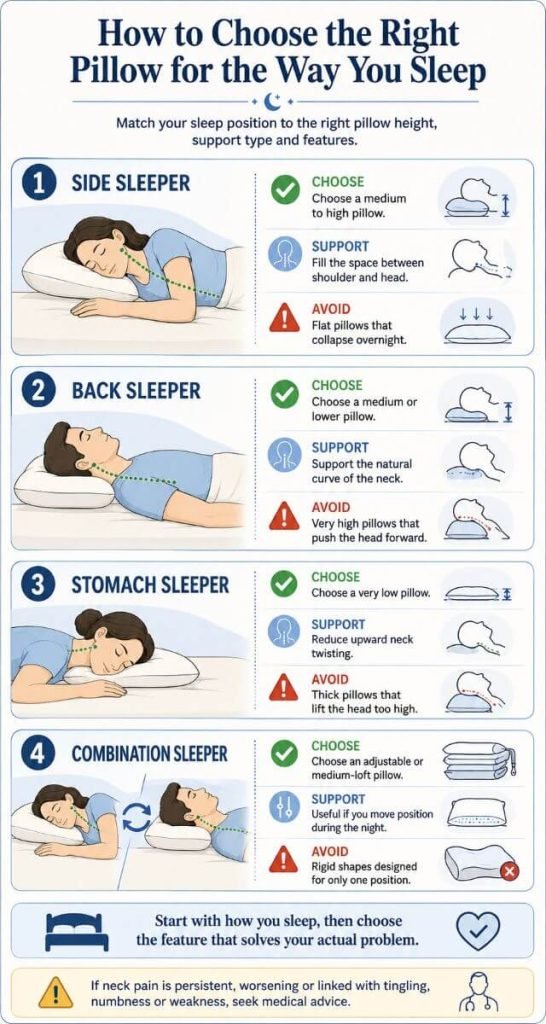
Match the Pillow to Your Sleep Position
The easiest way to narrow your choice is to think about your usual sleep position.
| Sleep position | What usually helps | What to avoid |
|---|---|---|
| Side sleeping | A medium to high pillow that fills the gap between shoulder and head | A pillow that flattens too much overnight |
| Back sleeping | A medium or lower pillow with gentle neck support | A very high pillow that pushes the head forward |
| Stomach sleeping | A very low pillow, or in some cases no pillow | Thick pillows that twist the neck upwards |
| Combination sleeping | An adjustable or medium-loft pillow that can adapt to movement | A rigid contour that only suits one position |
Mattress firmness matters too. A softer mattress lets the shoulder sink further, which can change the pillow height you need. A firmer mattress may require more loft, especially for side sleepers.
When Contoured Pillows Help
Contoured pillows use shape as part of their support. Instead of relying only on filling material, they may include a dip for the head, a raised neck section or shaped sides for different sleeping positions.
A cervical pillow may help some back sleepers by supporting the curve of the neck. A side-sleeper pillow may provide extra height to stop the head dropping down towards the mattress. These designs can be helpful, but they are not automatically better for everyone.
The test is simple: does the shape suit your body, mattress and sleeping position? If it does, the contour may feel supportive. If it does not, it may feel restrictive or uncomfortable.
Cooling Pillows: Useful, But Not Magic
Heat is a common sleep complaint, particularly in warm bedrooms, top-floor rooms and during summer nights. Some modern pillows try to reduce heat build-up around the head and neck.
Common cooling features include:
- Open-cell foam, designed to allow more air movement through the pillow.
- Ventilated foam, with holes or channels that create airflow paths.
- Gel-infused foam, which can absorb heat for a period before warming up.
- Breathable covers, often made from moisture-wicking fabrics.
- Phase-change materials, which absorb and release heat within a limited range.
These features can help hot sleepers, but they cannot overcome every cause of overheating. Room temperature, duvet tog, bedding fabric, pyjamas and ventilation all matter. The Sleep Charity’s advice on sleep environment notes that an ideal bedroom temperature is around 16–18°C, and that hot, cold or draughty rooms can affect sleep. A cooling pillow works best as part of a cooler sleep setup, not as a complete solution on its own.
Are Adjustable Pillows Worth It?
Adjustable pillows let you add, remove or move filling to change the height and feel. They can be useful if you are not sure what loft you need, or if your sleeping position changes through the night.
An adjustable pillow may be worth considering if:
- You switch between side and back sleeping.
- Your current pillow feels too high or too flat.
- You have recently changed mattress firmness.
- You want to fine-tune the pillow after trying it for a few nights.
- You share a bed with someone whose pillow needs are very different.
If you already know exactly what height and firmness you prefer, a well-made fixed pillow may be simpler and better value.
Which Pillow Material Should You Choose?
Pillow material affects support, warmth, feel and durability. There is no single “best” material; each has trade-offs.
| Material | Typical feel | Best suited to | Things to consider |
|---|---|---|---|
| Memory foam | Contouring and supportive | People who like pressure relief | Can retain heat unless ventilated or modified |
| Latex | Springy and responsive | Sleepers wanting support with some bounce | Often firmer and heavier than fibre pillows |
| Down or feather | Soft and mouldable | Sleepers who like a traditional feel | May need regular plumping and may not suit all allergy sufferers |
| Synthetic fibre | Soft and affordable | Budget-conscious buyers | May flatten faster than higher-density materials |
| Hybrid fill | Balanced support and softness | Sleepers wanting adjustability or a mixed feel | Quality varies widely by design |
Examples of Engineered Pillow Features
Readers comparing modern pillow designs may want to look at features such as adjustable loft, cooling materials, washable covers, sleep trials and returns policies. For example, Simba pillows with advanced support features show the kinds of support, cooling and adjustability claims that buyers can compare against other brands.
The important point is not to choose a pillow because it has the longest feature list. Compare what the pillow claims to do with the problem you are actually trying to solve.
What to Check Before Buying Online
Many people now buy pillows online, which makes product descriptions and returns policies more important. GOV.UK guidance on returns and refunds says online, mail and telephone order customers usually have the right to cancel their order for a limited time, including telling the seller within 14 days of receiving the item that they want to cancel. However, bedding return policies can vary, especially once packaging is opened, so always check the retailer’s own terms before buying.
Before purchasing, look for:
- Clear height and firmness information, not just words such as “premium” or “supportive”.
- Material details, including foam, latex, fibre, down or hybrid construction.
- Cover care, especially whether the cover is removable and washable.
- Allergy information, particularly for feather, down, latex or treated fabrics.
- Sleep trial or returns policy, including whether opened pillows can be returned.
- Warranty terms, including what counts as a fault rather than normal wear.
- Certifications, such as textile or foam safety standards where relevant.
If you run into a problem with a retailer, Citizens Advice consumer guidance can help you understand your rights and next steps.
When Should You Replace a Pillow?
A pillow does not need replacing just because it is old, but it should be replaced when it stops doing its job. Signs include:
- It feels flat or lumpy.
- It no longer supports your head properly.
- You wake up adjusting it repeatedly.
- It has lost shape after washing or regular use.
- It smells stale even after cleaning.
- You notice worsening comfort compared with a newer pillow.
Regular cleaning, pillow protectors and proper drying can extend useful life, but no pillow lasts indefinitely.
What Pillow Engineering Cannot Solve
A better pillow can improve comfort, but it cannot fix every sleep problem. It will not correct a poor desk setup, an unsuitable mattress, stress-related tension or an underlying medical issue.
That matters for many people who spend long hours at desks, whether working from home or commuting into Oxford, Bicester, Banbury, Abingdon, Witney or Didcot. If neck or shoulder discomfort is mainly linked to daytime posture, screens or stress, a pillow may help at night but will not address the whole cause.
If symptoms are persistent, worsening or accompanied by tingling, numbness or weakness, seek appropriate medical advice. Some people may also be able to use the NHS route for help with back or joint problems, including community musculoskeletal services such as physiotherapy.
A Simple Way to Choose
Instead of looking for the pillow with the most features, start with your main problem:
- Too hot? Look for breathable construction, cooling covers and lighter bedding.
- Neck unsupported? Focus on height, firmness and sleep position.
- Unsure about loft? Consider an adjustable pillow.
- Allergy concerns? Check materials, covers and washing instructions.
- No specific problem? A simple, well-made pillow may be enough.
The right pillow is not necessarily the most technical or expensive one. It is the one that supports the way you actually sleep.
Conclusion
Modern pillow design has become more sophisticated, and some of that engineering can be useful. Contoured shapes, cooling materials, adjustable fills and layered construction can all improve comfort when they match the sleeper’s needs.
The mistake is assuming that more features automatically mean better sleep. For some people, a traditional pillow is perfectly adequate. For others, especially side sleepers, hot sleepers, combination sleepers or those struggling with pillow height, a more carefully designed option may be worth considering.
The best starting point is simple: work out what your current pillow is failing to do, then choose the feature that solves that problem.
Frequently Asked Questions
What pillow is best for side sleepers?
Side sleepers usually need a medium to high pillow that fills the space between the shoulder and head. The aim is to keep the neck level with the spine.
Are cooling pillows worth it?
Cooling pillows can help if heat build-up around the head and neck is your main issue. They are most effective when combined with breathable bedding, a suitable duvet and a well-ventilated room.
Can a pillow help neck pain?
A better-matched pillow may help some people by improving support and sleeping position. Persistent neck pain should be discussed with a GP, physiotherapist or qualified health professional.
Are adjustable pillows better?
Adjustable pillows are useful if you are unsure what height you need or if you change position during the night. If you already know your preferred height and firmness, a fixed pillow may be enough.
How do I know if my pillow is too high?
If your chin is pushed towards your chest while lying on your back, or your neck bends upwards while side sleeping, the pillow may be too high.
How do I know if my pillow is too low?
If your head drops down towards the mattress or you feel unsupported around the neck, the pillow may be too low or too soft.