Electric cars are becoming more common on Oxfordshire’s roads, but the decision to switch is no longer just about range, charging and emissions. For many drivers, the bigger question is how to pay for one.
At a glance
| Why it matters | Electric cars now make up a growing share of new UK registrations, and many private new cars are bought using finance. |
| Green-energy context | Oxford aims to reach net zero carbon emissions citywide by 2040, while Oxford City Council has set a target to be a zero carbon council by 2030. |
| Local factor | Oxford’s Zero Emission Zone means petrol, diesel and hybrid vehicles face a daily charge in the pilot area unless exempt, while zero-emission vehicles can enter free of charge. |
| Charging factor | Oxford has Redbridge Energy Superhub, park and ride chargers, public car park chargers, on-street chargers and a planned LEVI-funded rollout of more than 300 additional chargepoints in the city. |
| Finance factor | PCP, HP, leasing, salary sacrifice and buying used all carry different costs and risks. |
| Key warning | Monthly payments are only part of the cost. Drivers should also check APR, mileage limits, final payments, insurance, charging costs and vehicle tax. |
Electric vehicles are no longer unusual on the Oxford ring road, at city park and rides or in supermarket car parks across the county.
The shift is being driven by national targets, cleaner vehicle rules, cheaper running costs for some drivers and the growing number of models available. Department for Transport figures show zero-emission cars accounted for 23 per cent of new UK car registrations in 2025, up from 19 per cent in 2024.
The trend has continued into 2026. The Society of Motor Manufacturers and Traders said April 2026 saw the UK’s two millionth battery electric car registered, with battery electric vehicles taking 26.2 per cent of new registrations that month.
For Oxfordshire drivers, that change is not only about what powers the car. It is also changing how people compare the cost of ownership, whether they buy outright, use finance or lease.
Why finance matters in the electric car market
Car finance is already central to the UK new-car market. The Finance & Leasing Association says its members funded close to 88 per cent of private new car purchases over the past year.
Electric vehicles add another layer to that decision. New EVs can still carry higher upfront prices than some petrol or hybrid alternatives, while used EV values, battery warranties, charging access and future model improvements can all affect what a driver feels comfortable committing to.
That does not mean finance is automatically the right answer. It means the finance agreement needs as much attention as the badge on the bonnet.
Drivers considering an electric car should look beyond the headline monthly payment and ask what they are paying in total, what they will own at the end, and what happens if their mileage, job, home-charging access or household budget changes during the agreement.
The Oxfordshire angle: net zero, ZEZ and charging
Oxford’s electric vehicle debate sits inside a wider local climate plan. Oxford City Council says Zero Carbon Oxford is the goal for the whole city to reach net zero carbon emissions by 2040, ten years ahead of the national legal deadline.
The city’s roadmap says transport-related emissions must fall by 88 per cent by 2040. That makes transport one of the most visible parts of Oxford’s climate challenge, alongside domestic, commercial, industrial and institutional emissions.
The city council has also set a target to be a zero carbon council by 2030. Its 2024–28 strategy says Oxford’s wider net zero city target depends on a citywide effort involving residents, businesses, institutions and government.
For drivers, the most visible local policy is Oxford’s Zero Emission Zone. In the ZEZ pilot area, petrol and diesel vehicles, including hybrids, face a daily charge unless they qualify for a discount or exemption. Zero-emission vehicles, including electric cars, can enter the pilot area free of charge.
Charging provision is also expanding. Oxford City Council describes Energy Superhub Oxford at Redbridge Park & Ride as Europe’s most powerful EV charging hub. It opened in July 2022 and offers fast and ultra-rapid charging for 42 vehicles at once, with 10MW of installed capacity on site.
The council says the Redbridge hub is powered entirely by renewable energy and is estimated to save 10,000 tonnes of CO2 every year. A 2025 council update said the hub had charged more than 137,000 vehicles since launch, providing more than 4.2 million kWh of electricity to vehicles.
More charging is planned across the county. Through the Local Electric Vehicle Infrastructure programme, Oxfordshire aims to triple the number of publicly available EV chargers by the end of 2028, delivering more than 1,500 new charging sockets across Oxfordshire. In Oxford, the programme is expected to support more than 300 new chargers in council car parks and on-street locations, especially for residents and visitors without off-street parking.
Responsibility for Oxford’s public on-street EV charging network is also moving to Oxfordshire County Council, allowing the county council to lead the next phase of on-street charging expansion. Oxford City Council will continue to manage EV chargers at Redbridge and Seacourt Park & Ride, and says it will install LEVI-funded chargers in a number of council-owned car parks.
Those local details matter because the cost and convenience of running an EV can vary sharply by household. A driver with a driveway, a home charger and an overnight electricity tariff may have a very different experience from someone relying on public chargers in Oxford, Witney, Bicester, Banbury or a village in West Oxfordshire.
Where Oxford drivers can charge
Oxford’s charging network is not limited to one type of site. Current and planned provision includes rapid charging at Redbridge Park & Ride, chargers at Redbridge and Seacourt Park & Ride, public car park chargers, on-street residential chargers, cable gully schemes for some homes without driveways, and dedicated rapid chargers for electric taxis.
Oxford City Council’s EV pages direct drivers to Zapmap to find live public charging locations. Oxfordshire County Council is also asking residents to use an interactive demand tracker to suggest where future EV chargers and electric car clubs should go.
The city has been trialling charging solutions for residents without driveways since 2017 through Go Ultra Low Oxford. The project has tested pop-up, lamppost, bollard and gully-style charging, and the council says there are now 40 bollard and lamppost chargers and 22 Gul-e chargers across Oxford.
For households without off-street parking, Oxfordshire County Council warns drivers not to trail charging cables across pavements because of trip and access risks. The county council says it wants to improve access for the 30 to 40 per cent of residents who cannot easily charge an EV at home, with public chargers and cable-channel options forming part of that work.
EV charging in Oxford: quick checks before buying or financing
| Can I charge at home? | Home charging is usually cheaper and easier, but many Oxford households do not have off-street parking. |
| Are there public chargers near where I live or work? | Check live chargepoint maps before choosing a car or signing a finance agreement. |
| Do I need rapid charging or overnight charging? | Rapid charging suits top-ups and longer journeys; lower-power chargers can work well where cars are parked for longer. |
| Will I regularly drive into Oxford’s ZEZ? | Zero-emission vehicles can enter free of charge, while petrol, diesel and hybrid vehicles may face a daily charge unless exempt. |
| Could a car club work instead? | Oxfordshire’s EV programme also supports electric car clubs as an alternative to ownership for some residents. |
| What happens if I move house or job? | A finance agreement may last several years, so access to charging should be considered beyond the next few months. |
How PCP works, and why it is popular
Personal Contract Purchase, usually called PCP, is one of the best-known ways to finance a new or nearly new car. It normally involves a deposit, monthly payments and an optional final payment if the driver wants to own the car at the end.
In simple terms, the monthly payments are based partly on the car’s expected loss in value during the agreement, rather than the full purchase price. That can make payments lower than some other forms of borrowing, but the driver does not automatically own the car at the end.
At the end of a PCP agreement, drivers usually have three choices: make the final balloon payment and keep the car, hand it back, or use any available equity towards another vehicle.
That flexibility can appeal to drivers who want to change car every few years, particularly while battery range, charging speed and in-car software are improving. But PCP is not risk-free. Mileage limits, condition rules, interest charges and the final payment all need to be understood before signing.
MoneyHelper advises drivers to check the deposit, balloon payment, monthly payments, interest, mileage allowance, wear-and-tear rules, fees and early return terms before agreeing a PCP contract.
Why EV values affect monthly payments
One reason EV finance can be complicated is residual value. That is the expected value of the car at the end of the agreement.
In a PCP agreement, this is linked to the Guaranteed Minimum Future Value, often shortened to GMFV. If a lender expects the car to hold its value well, monthly payments may be more competitive. If the lender thinks the vehicle could lose value more quickly, monthly payments may be higher.
EV residual values have been harder to forecast than petrol and diesel values because the market is younger. Battery technology, charging speed, new-car discounts, supply of used EVs and buyer confidence can all affect used prices.
Cox Automotive says EV depreciation has become more predictable, but still varies widely by model and segment. It says models with longer range, rapid charging capability, strong brand demand and good battery warranties tend to hold their value better.
For consumers, this means the cheapest-looking monthly deal is not always the best long-term choice. A lower payment may come with stricter mileage limits, a larger final payment or less flexibility if circumstances change.
Finance options compared
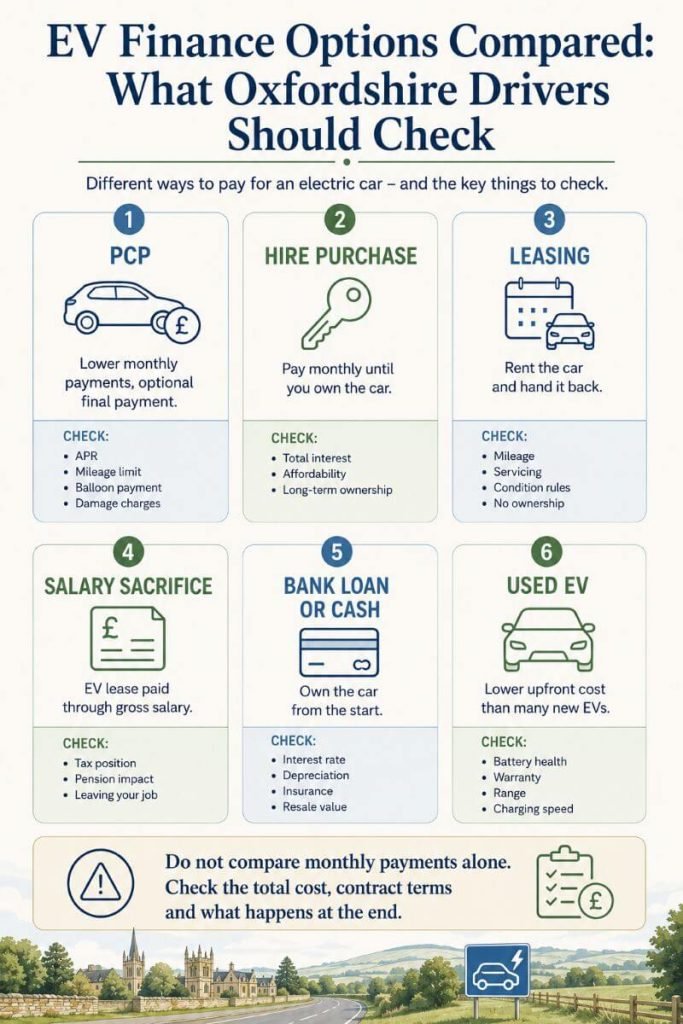
| Option | How it works | What to check |
|---|---|---|
| PCP | Deposit, monthly payments and an optional final payment if you want to own the car. | APR, total cost, mileage limit, balloon payment, damage charges and whether you are likely to keep the car. |
| Hire purchase | You make payments until the car is paid off, then own it at the end. | Monthly affordability, total interest and whether you want long-term ownership. |
| Personal contract hire or leasing | You rent the car for an agreed period and hand it back at the end. | Mileage, servicing, damage rules and whether you are comfortable never owning the vehicle. |
| Salary sacrifice | Some employers allow staff to lease an EV through gross salary deductions. | Tax position, pension impact, early exit rules and what happens if you leave your job. |
| Bank loan or cash purchase | You buy the car outright or with a personal loan and own it from the start. | Interest rate, depreciation, battery warranty, insurance and resale value. |
| Used EV purchase | You buy a second-hand electric car, often at a lower price than a new model. | Battery health, warranty, charging speed, service history, range and whether the car suits your regular journeys. |
MoneyHelper says the best way to finance a car depends on what the buyer wants. PCP can suit drivers who want lower monthly payments and flexibility over buying the car outright, while HP usually means higher monthly payments but ownership at the end of the agreement.
Costs drivers should not overlook
The monthly payment is only one part of the real cost of an electric car.
Charging is the obvious extra consideration. Oxfordshire County Council says home charging is usually the cheapest and most convenient option for drivers with off-street parking, because they can charge overnight, often using cheaper electricity rates.
That advantage is not available to everyone. Oxford City Council says household EV charging options are limited for people without access to off-street parking, while Oxfordshire County Council says residents should not trail cables across pavements.
For drivers without a driveway, the decision to finance an EV should include a realistic check of nearby public chargers, kerbside options, workplace charging and the price difference between home and public charging.
Insurance can also differ from an equivalent petrol car, depending on the model, repair costs and insurer. Drivers should get insurance quotes before committing to a finance agreement.
Vehicle tax has changed too. GOV.UK says electric, zero or low-emission cars registered on or after 1 April 2025 pay £10 in the first year, then the standard rate of £200. Electric, zero or low-emission cars registered between 1 April 2017 and 31 March 2025 pay the standard rate of £200.
There is also an expensive car supplement. Electric or zero-emission cars registered on or after 1 April 2025 with a list price of more than £50,000 are subject to the additional rate from the second year for five years.
Car finance is under closer scrutiny
Drivers should also be aware that motor finance has been under regulatory scrutiny. The Financial Conduct Authority has introduced an industry-wide redress scheme for some motor finance customers who were treated unfairly between 2007 and 2024.
The FCA said in May 2026 that the scheme had been legally challenged and that the regulator would defend it. It also published expectations for firms following the legal challenge.
That does not mean current car finance is unsuitable. It does mean buyers should be cautious, ask direct questions and keep records of what they are told about commission, interest, affordability and contract terms.
Before signing, drivers should ask for the total amount payable, the APR, the monthly payment, the deposit, any arrangement fees, the final payment, excess mileage costs and what happens if they need to end the agreement early.
Questions to ask before financing an EV
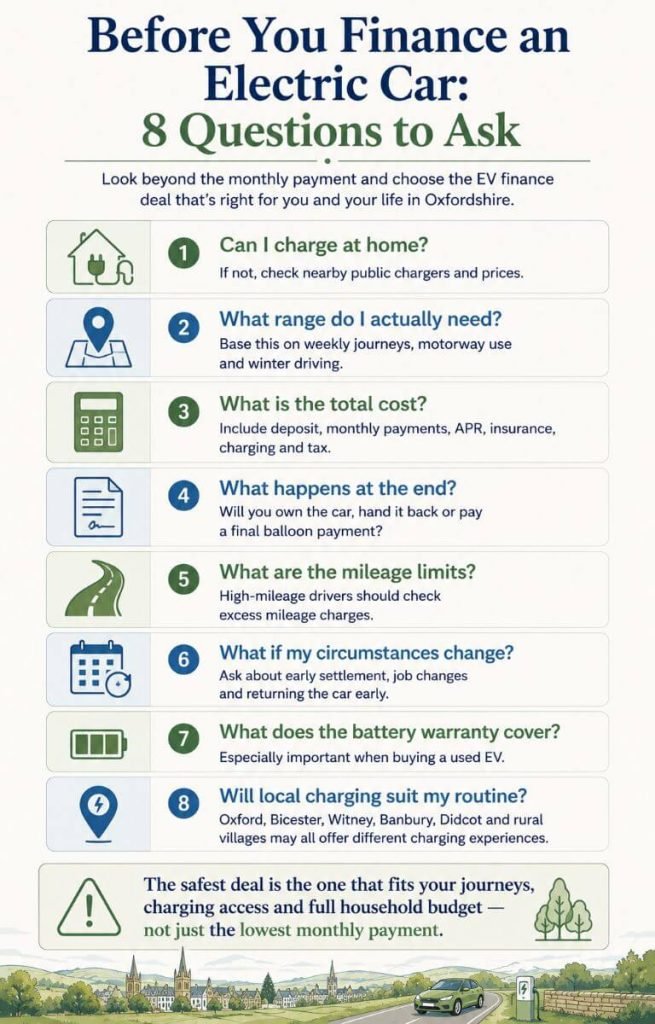
| Can I charge at home? | If not, check nearby public chargers and their prices before choosing a car. |
| What range do I actually need? | Base this on weekly journeys, motorway use and winter driving, not just the advertised range. |
| What is the total cost? | Include deposit, monthly payments, interest, final payment, insurance, charging and tax. |
| What happens at the end? | Check whether you will own the car, hand it back or need to make a large final payment. |
| What if my circumstances change? | Ask about early settlement, job changes, mileage changes and returning the car early. |
| Could I use an EV car club instead? | For some Oxfordshire residents who drive occasionally, shared access may be cheaper than ownership or finance. |
Where commercial finance guides fit in
Commercial finance providers can be useful for understanding common terms, but they should not be the only source a buyer relies on.
Readers comparing products can look at independent guidance from MoneyHelper and the FCA, as well as provider pages such as this guide to PCP vehicle finance.
The important step is to compare more than one option. A PCP deal may suit someone who wants a newer car every few years and understands the mileage and final payment rules. It may not suit someone who wants to own the vehicle outright, drives high annual mileage or needs maximum flexibility.
What it means for Oxfordshire drivers
Electric cars are becoming a normal part of Oxfordshire motoring, helped by national market growth, Oxford’s clean-air policies and expanding charging infrastructure.
But the right finance decision depends on local life as much as national trends. A daily commute into Oxford, access to a driveway in Witney, regular motorway journeys from Bicester or reliance on public charging in a village near Chipping Norton can all change the calculation.
Oxford’s green transport ambitions add another reason for drivers to think carefully. The city’s 2040 net zero goal, the ZEZ, the Redbridge superhub and new charging investment all point in the same direction, but access to charging is still uneven and ownership is not the only option for every household.
The safest approach is to treat the finance agreement as carefully as the car itself. Drivers should compare total costs, check the small print and make sure the vehicle suits their journeys, charging access and budget before committing to several years of payments.
FAQs
Is PCP a good way to finance an electric car?
It can be, but it depends on the driver. PCP may suit people who want lower monthly payments than some alternatives and like the option to change cars every few years. It may not suit drivers who want to own the car outright or who are likely to exceed mileage limits.
Does an electric car avoid Oxford’s Zero Emission Zone charge?
Zero-emission vehicles can enter the Oxford ZEZ pilot area free of charge. Petrol, diesel and hybrid vehicles incur a daily charge unless eligible for a discount or exemption.
What is Oxford’s net zero target?
Oxford’s citywide target is to reach net zero carbon emissions by 2040. Oxford City Council has also set a target to become a zero carbon council by 2030.
Where can drivers charge an EV in Oxford?
Charging options include Redbridge Energy Superhub, Redbridge and Seacourt Park & Ride chargers, public car park chargers, on-street residential chargers, taxi rapid chargers and some home-charging cable gully schemes for properties without driveways.
What is LEVI?
LEVI stands for Local Electric Vehicle Infrastructure. In Oxfordshire, the programme aims to deliver more than 1,500 new public charging sockets across the county by the end of 2028, including more than 300 in Oxford.
Can I charge an electric car if I do not have a driveway?
Yes, but it needs planning. Options may include nearby public chargers, workplace charging, on-street chargers, car clubs or approved cable-channel schemes. Oxfordshire County Council warns residents not to trail charging cables across pavements.
Do electric cars pay road tax?
Yes. Electric, zero-emission and low-emission vehicles now need to pay vehicle tax. The amount depends on when the vehicle was registered and its list price.
Should I buy a used EV instead of financing a new one?
A used EV can offer better value, but buyers should check battery health, warranty, range, charging speed and service history. Used EV prices vary significantly by model and age.
What is the most important thing to check before signing car finance?
Check the total amount payable, not just the monthly payment. Drivers should also check APR, deposit, final payment, mileage limits, damage charges and early exit terms.