Finding the right family car is not just about choosing the cheapest vehicle on the forecourt. For Oxfordshire households, value means space, safety, running costs, reliability, finance terms and whether the car fits everyday life.
Family car buying usually involves several competing priorities. Parents may need room for school bags, pushchairs, sports kit, shopping and holiday luggage, but the car also has to work for town driving, village roads, commuting and longer trips across Oxfordshire and beyond.
That makes the used market appealing. A carefully chosen second-hand estate, hatchback, hybrid or compact SUV can offer much of the practicality of a new car without the same upfront cost.
The challenge is working out what “best value” really means. A low purchase price can quickly be cancelled out by poor fuel economy, expensive insurance, high repair bills, weak safety equipment or the wrong finance agreement.
At a glance
| Best all-round family space | Skoda Octavia Estate |
| Best hybrid estate shortlist | Toyota Corolla Touring Sports |
| Best lower-cost estate option | Ford Focus Estate |
| Best compact hybrid or EV option | Kia Niro or e-Niro |
| Best budget seven-seat option | Dacia Jogger, but check safety rating and equipment carefully |
| Key local issue | Regular journeys into Oxford’s Zero Emission Zone may make an electric car worth considering |
| Most important buying check | Look at total cost of ownership, not just the monthly payment or screen price |
What makes a good family car in Oxfordshire?
Oxfordshire families often need cars that can do several jobs well.
A household in Oxford may care most about parking, short journeys, school runs, insurance and low-emission travel. A family in Banbury, Witney, Bicester, Chipping Norton, Abingdon or a surrounding village may put more weight on boot space, motorway comfort, rural roads and longer weekly mileage.
That means a good-value used family car should be judged against real use, not just popularity. The right car should have enough luggage space, safe rear seats, sensible running costs, good visibility, reliable service history and finance payments that leave room for insurance, servicing, tyres and fuel.
Families should also check whether they regularly drive into Oxford’s Zero Emission Zone. Oxfordshire County Council says most vehicles need to pay a daily charge depending on emissions if they are used in the pilot area, while zero-emission vehicles are charged £0.
Used family cars worth shortlisting
The cars below are not the only good options, but they are strong starting points for Oxfordshire families because they combine practicality, availability and sensible running-cost potential.
| Model | Why it is worth considering | Best for | What to check |
|---|---|---|---|
| Skoda Octavia Estate | Large boot, good rear-seat space, estate practicality and a strong reputation as a family workhorse. | Families needing maximum space without moving into a large SUV. | Service history, diesel mileage patterns, timing belt intervals, tyres and whether the trim has the safety and comfort kit you need. |
| Toyota Corolla Touring Sports | Hybrid estate with strong fuel-economy potential, especially for mixed town and A-road driving. | Families doing regular Oxford traffic, school runs and mixed commuting. | Hybrid battery warranty, service history, boot size by engine version and whether rear-seat space suits taller children or car seats. |
| Ford Focus Estate | Usually widely available used, practical enough for most families and often cheaper than more fashionable crossovers. | Buyers wanting estate space on a tighter budget. | Engine history, clutch, suspension, infotainment, service records and whether the particular engine suits your annual mileage. |
| Kia Niro Hybrid or e-Niro | Compact crossover shape, hybrid or electric options, useful family cabin and the possibility of remaining manufacturer warranty on newer used cars. | Families considering lower-emission motoring without needing a large car. | Charging access for e-Niro, battery health, warranty status, trim level and boot space differences between hybrid, plug-in hybrid and electric versions. |
| Dacia Jogger | One of the most affordable ways to get seven seats and a large flexible interior. | Larger families on a strict budget who need occasional seven-seat use. | Euro NCAP safety rating, driver-assistance equipment, third-row practicality, service history and whether you are comfortable with the safety trade-offs. |
Skoda Octavia Estate: the practical all-rounder
The Skoda Octavia Estate is one of the most useful used family cars because it delivers space without the bulk and running costs of many SUVs.
It is worth considering for families who regularly carry pushchairs, sports bags, dogs, camping equipment or holiday luggage. It is also a sensible option for households that want estate practicality but still need a car that feels manageable around Oxfordshire towns and villages.
Euro NCAP rated the Skoda Octavia at five stars in its 2022 assessment, making it a strong safety-conscious shortlist option as well as a practical one.
The main buying choice is usually petrol, diesel or plug-in hybrid. Diesel can still make sense for high-mileage motorway users, but petrol may suit lower-mileage families better. A plug-in hybrid only works well if you can charge regularly and understand how the smaller boot and real-world electric range affect daily use.
Toyota Corolla Touring Sports: the hybrid estate choice
The Toyota Corolla Touring Sports is a sensible shortlist option for families who want estate practicality with hybrid running costs.
It is especially relevant for drivers who spend time in Oxford traffic, make regular short trips and want an automatic car that can be easy to live with.
Euro NCAP rated the Toyota Corolla at five stars in 2019, with the rating applying to several body styles and engine variants.
The main compromise is that rear-seat space may not feel as generous as the Octavia’s, so families with rear-facing child seats or taller teenagers should test the cabin carefully before committing.
Ford Focus Estate: value without SUV prices
The Ford Focus Estate is a good example of why families should not ignore estates.
Crossovers and SUVs often attract more attention on used forecourts, but an estate can offer more usable load space, lower running costs and better value.
Euro NCAP rated the Ford Focus at five stars in 2018, although buyers should remember that safety tests change over time and should check the exact age, trim and fitted equipment of any used example.
Used buyers should pay close attention to engine choice and service history. Some Focus models are excellent value, but the right example is one with regular maintenance, sensible mileage and no warning signs in its MOT record.
Kia Niro and e-Niro: compact, efficient and family-friendly
The Kia Niro is a useful choice for families who want something higher-riding than an estate but not as large as a full SUV.
It is available as a hybrid, plug-in hybrid and electric model, although boot space and running costs vary between versions.
Euro NCAP rated the 2022 Kia Niro at four stars with standard equipment, so buyers should check whether the exact car they are considering has any additional safety pack or driver-assistance equipment.
For Oxfordshire families, the e-Niro becomes more attractive if regular journeys include Oxford’s ZEZ and home charging is available. Without reliable charging, a hybrid Niro may be easier to live with.
Charging access is a key local factor. Oxfordshire County Council’s guidance on EV charging without a drive says the county wants to improve access for the 30 to 40 per cent of residents who cannot easily charge an EV at home, including through public chargers and cable-channel options.
Residents can also suggest future EV charging locations through Oxfordshire County Council’s EV charger and car club demand tracker, which is being used to help plan new public charging bays across the county.
Dacia Jogger: budget space with an important caveat
The Dacia Jogger deserves a place in the conversation because it offers seven seats at a price many rivals cannot match.
That flexibility can make it appealing for larger families, grandparents who regularly carry children, or households that need occasional seven-seat use without paying large SUV prices.
The caveat is safety. Euro NCAP rated the Dacia Jogger at one star, so families should read the rating carefully and decide whether the low purchase price is worth the safety-equipment trade-off.
That does not mean every family should dismiss it automatically, but it does mean buyers should be clear-eyed about the compromise and compare it with other used seven-seat options before making a decision.
Finance: look beyond the monthly payment
Many families focus on the screen price but underestimate the importance of finance terms.
A slightly more expensive car can be better value if it has lower mileage, stronger service history, better warranty cover and more predictable running costs. Equally, a low monthly payment can become expensive if the agreement includes a large final payment, high interest, strict mileage limits or fees that are not obvious at first glance.
Some buyers concentrate exclusively on finding the lowest upfront cost, but that approach can limit your options. In some situations, carefully chosen car finance deals may allow you to purchase a newer, better-maintained vehicle with stronger reliability credentials. For example, spending slightly more on a car with a complete service history may reduce the likelihood of costly repairs compared with purchasing an older, cheaper model with an uncertain maintenance record. The goal should not be to maximise borrowing
Before signing any agreement, families should compare the total amount repayable, APR, deposit, monthly payment, final payment, mileage limits and early-exit terms.
Buyers should also be aware that motor finance has been under regulatory scrutiny. The Financial Conduct Authority’s car finance complaints page explains how consumers can check whether they may have been affected by historic commission arrangements and how to complain without using a claims management company.
Finance checks before buying
| Monthly payment | Can the household afford it even if insurance, food, fuel or mortgage costs rise? |
| Total amount repayable | This is often more important than the headline monthly cost. |
| APR | Compare interest rates between dealers, lenders and personal loans. |
| Deposit | A bigger deposit can reduce monthly payments, but should not wipe out emergency savings. |
| Final payment | PCP agreements usually include a balloon payment if you want to own the car. |
| Mileage limit | Make sure school runs, commuting, holidays and family visits are included in your estimate. |
| Exit terms | Check what happens if you need to sell, return or change the car early. |
Running costs can change the real value
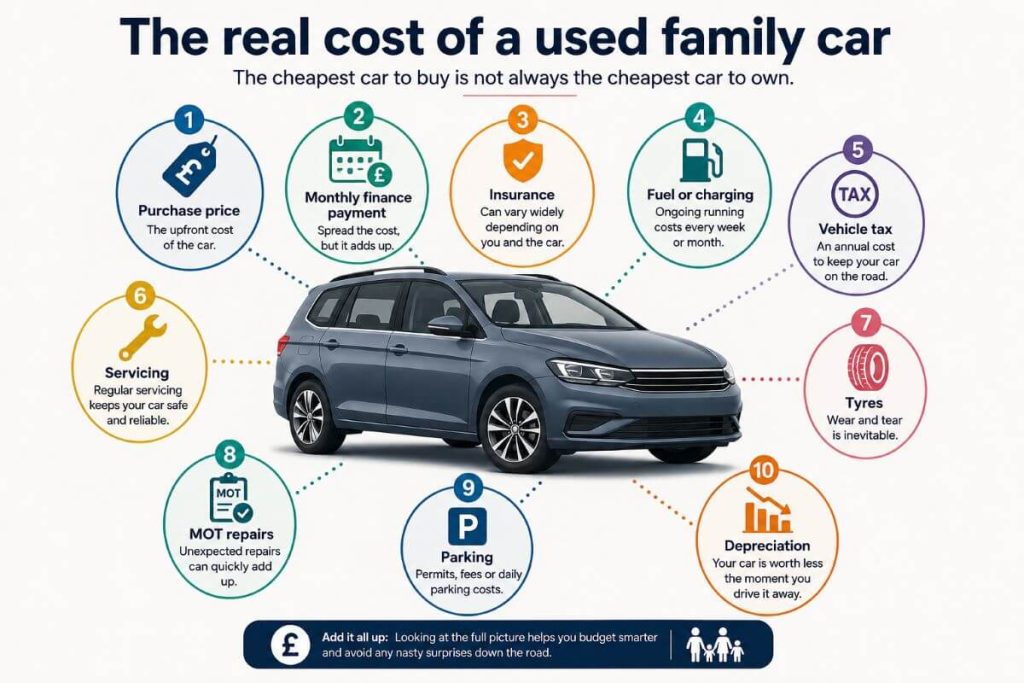
The cheapest car to buy is not always the cheapest car to own.
Fuel economy, insurance, tyres, servicing, MOT repairs, vehicle tax and parking all affect the real family budget.
For a family driving between Oxford, Banbury, Bicester, Witney, Abingdon and surrounding villages, fuel use can vary significantly between two cars that look similar online.
Hybrid models can work well for drivers who spend time in traffic or make many short journeys. Diesel may still suit high-mileage families who regularly drive longer distances, but it is less attractive for low-mileage urban use. Electric cars can be cheaper to run if charging is affordable and convenient, but public charging costs and access must be checked before buying.
Vehicle tax also needs checking. GOV.UK guidance on electric and low-emission vehicle tax says electric, zero or low-emission cars registered on or after 1 April 2025 pay £10 in the first year, then the standard rate of £200. Rules vary by registration date and list price, so buyers should check the exact car before purchase.
Oxfordshire-specific checks
| Local issue | Why it matters | What to check |
|---|---|---|
| Oxford ZEZ | Petrol, diesel and hybrid cars can be charged in the pilot area unless exempt. | Check whether regular journeys go into the Oxford Zero Emission Zone and whether an EV would be practical. |
| Village and rural roads | Rougher lanes can make tyre, suspension and wheel condition more important. | Inspect tyres, wheels, suspension noises and MOT advisories. |
| School runs and parking | Large SUVs can be awkward around narrow streets and school gates. | Test visibility, turning circle, parking sensors and rear camera quality. |
| Home charging | An EV is much easier to live with if you can charge at home or work. | Check driveway access, charger installation, electricity tariffs and public chargers near home. |
| Charging without a drive | Many households do not have off-street parking. | Read Oxfordshire County Council’s guidance on charging an EV without a drive before choosing an electric car. |
| Longer family trips | Boot space and rear-seat comfort matter more on holidays and motorway journeys. | Try child seats, luggage, buggy and sports kit before buying. |
Safety and family practicality checks
Safety should be part of the value calculation, especially for families carrying children.
Euro NCAP publishes independent crash and safety ratings, helping consumers compare vehicles. But buyers should remember that test standards change over time. Euro NCAP says its requirements are updated regularly, so an older five-star rating is not always directly comparable with a newer one.
Buyers should also check the exact trim level. Some safety equipment can vary between versions, and a car that looks good on paper may be missing features such as blind-spot monitoring, rear cameras, lane support or autonomous emergency braking.
Families should also check how easily child seats fit, whether there are ISOFIX points where needed, how wide the rear doors open, and whether the boot can handle real family items rather than just quoted litre figures.
Used car checks before you pay
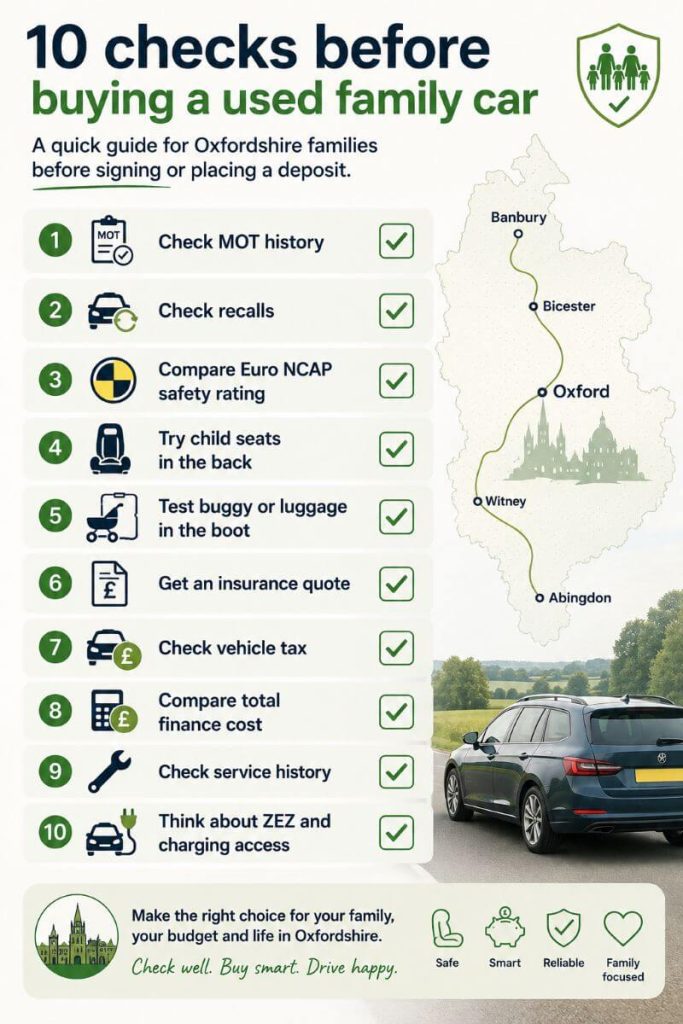
Before buying any used car, use the registration number to check its MOT history through GOV.UK.
The MOT history can show mileage records, previous failures, advisories and recurring issues. GOV.UK also has a separate recall checker, which can show whether a vehicle, part or accessory has been recalled.
These checks are free and should be done before placing a deposit.
Before buying a used family car
| Check MOT history | Use the GOV.UK MOT history service to check previous test results, recorded mileage, failures and advisories. |
| Check recalls | Use the GOV.UK vehicle recall checker to see whether a vehicle, part or accessory has been recalled. |
| Check safety rating | Use Euro NCAP to compare crash-test and safety-assistance ratings, but check the exact model year and specification. |
| Check finance and ownership | Use a proper vehicle history check to look for outstanding finance, write-off history or mileage concerns. |
| Check service records | Look for regular servicing, invoices and evidence of major maintenance such as timing belt work where relevant. |
| Check family fit | Take child seats, buggy, sports bags or dog crate to the viewing if those items matter. |
| Check all costs | Get insurance quotes and check tax, tyres, servicing and fuel or charging costs before signing. |
How to choose the right car for your family
The best-value used family car is the one that fits the way your household actually travels.
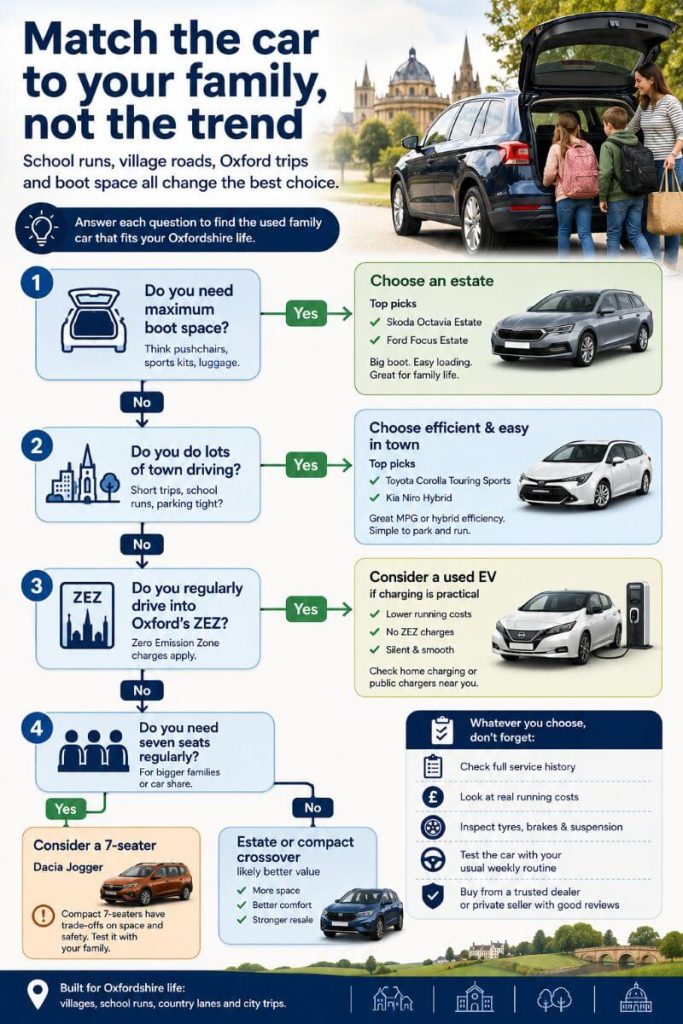
If boot space is the priority, start with estate cars such as the Skoda Octavia Estate, Toyota Corolla Touring Sports and Ford Focus Estate before assuming an SUV is necessary.
If most journeys are short and local, a hybrid may be more suitable than a diesel. If you regularly enter Oxford’s ZEZ and can charge conveniently, a used electric car such as an e-Niro may deserve a place on the shortlist.
If you need seven seats on a tight budget, the Dacia Jogger offers obvious value, but families should weigh that against its safety rating and equipment.
Above all, avoid choosing by monthly payment alone. A good family car should leave enough money in the household budget for insurance, servicing, tyres, repairs and unexpected costs.
That is what value really means: not the lowest price today, but the car that supports family life without creating unnecessary financial pressure later.
FAQs
What is the best used family car for boot space?
The Skoda Octavia Estate is one of the strongest used family options for families needing a large boot, especially if they want estate practicality without moving into a bigger SUV.
Are estate cars better value than SUVs?
Often, yes. Estates can offer more usable load space and better fuel economy than many SUVs, while usually costing less to buy used than fashionable crossovers.
Is a hybrid a good choice for Oxfordshire families?
A hybrid can make sense for families doing regular town driving, school runs and mixed short journeys. It may be less important for households that mainly do long motorway journeys.
Should I buy an electric family car in Oxfordshire?
An EV can work well if you can charge at home or work and regularly drive into Oxford’s ZEZ. If you rely entirely on public charging, compare local charger availability and prices before buying.
What should I check before financing a used car?
Check the total amount repayable, APR, deposit, monthly payment, final payment, mileage limits, early-exit terms and whether the car’s age and mileage suit the length of the agreement.
How can I check a used car’s history?
Use GOV.UK’s MOT history and recall checkers, and consider a paid vehicle history check for outstanding finance, write-off history, mileage concerns and ownership records.
Is the Dacia Jogger a good-value family car?
It can be excellent value for families needing seven seats, but buyers should check its Euro NCAP safety rating and equipment carefully before deciding.