Learning to drive can open the door to work, education and greater independence, particularly for people living outside Oxford. But rising costs, pressure on test appointments and major booking-rule changes mean learners need a realistic plan before getting behind the wheel.
Passing a driving test has never been as simple as paying for a few lessons and turning up at the test centre.
In 2026, learners must budget for a provisional licence, professional tuition, private practice, two separate tests and potentially several months of continued lessons while waiting for an appointment.
Passing is also only the beginning. Insurance, fuel, tax, servicing, tyres, parking and repairs can make the first year of driving considerably more expensive than the learning process itself.
For Oxfordshire learners, the challenge is particularly varied. A new driver may need to cope with congested streets and large numbers of cyclists in Oxford, faster roads such as the A34, rural bends and narrow lanes in the Cotswolds, and changing traffic restrictions in the city.
At a glance
| Provisional licence | £34 online or £43 by post |
| Theory test | £23 |
| Practical test | £62 on weekdays or £75 during evenings, weekends and bank holidays |
| Minimum official cost | £119 if applying online and passing both tests first time in a weekday slot, before lessons and insurance |
| Lesson requirement | There is no compulsory minimum number of lessons or practice hours |
| Local practical test centres | Oxford (Cowley) and Banbury |
| 2026 booking rule | Only the learner can book, change, swap or cancel the practical test |
| After passing | Six penalty points within the first two years will result in the licence being revoked |
How much does learning to drive really cost?
The fixed official fees are only the starting point.
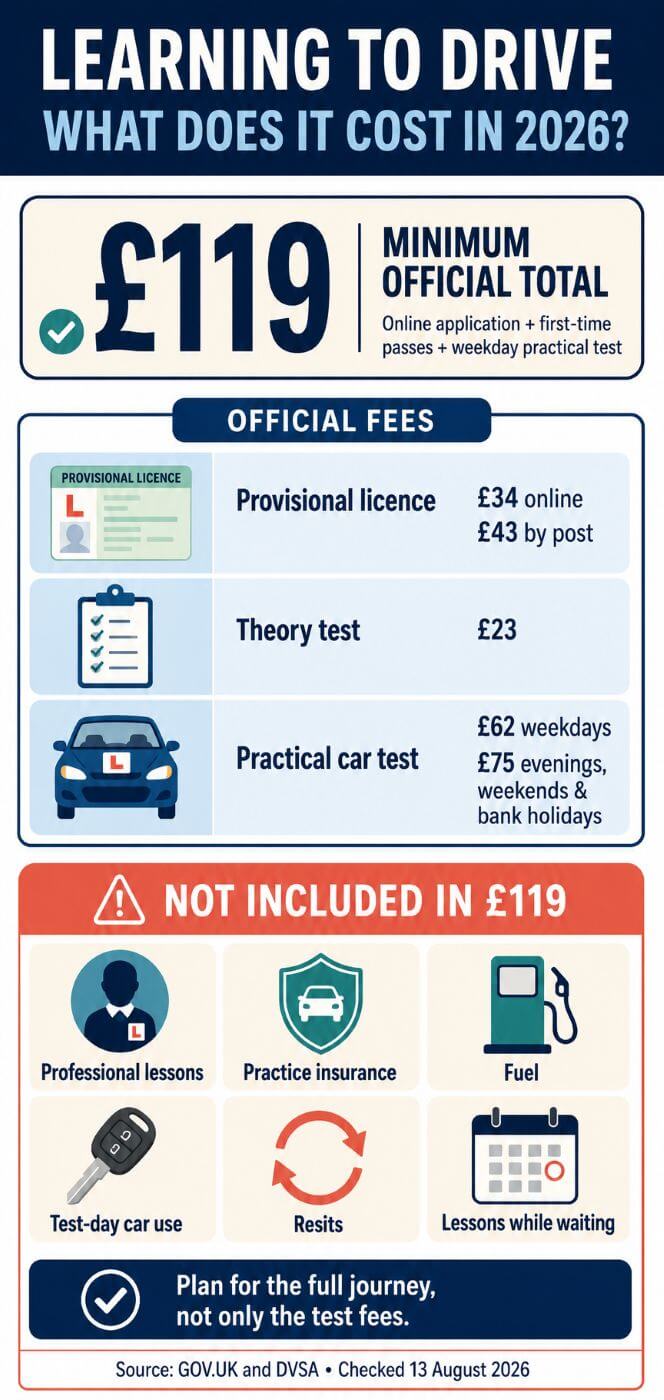
A first provisional licence costs £34 when obtained online through GOV.UK or £43 when applying by post. The theory test costs £23, while the practical car test is £62 on a weekday or £75 during evenings, weekends and bank holidays.
That means the lowest possible official cost is £119 for somebody who applies online, passes the theory test first time and passes a weekday practical test first time.
Most learners will spend considerably more because that figure does not include:
| Professional driving lessons | Usually the largest part of the learning budget |
| Private-practice insurance | Required when practising in a family member’s, friend’s or the learner’s own car |
| Fuel | Needed for private practice and sometimes reflected in lesson prices |
| Test-day vehicle use | Some instructors charge separately for the lesson before the test and use of their car |
| Resits | Each failed theory or practical test requires another fee |
| Continued lessons while waiting | Necessary for many learners who face a long gap before their test date |
Before choosing an instructor, ask for the hourly price, lesson length, cancellation rules, block-booking terms and test-day charges in writing. A cheap headline rate is not necessarily the best value if lessons are frequently unavailable or the learner makes little progress.
There is no correct number of driving lessons
The original draft suggested that an average learner would need around 40 hours of tuition. A more widely quoted planning estimate is 45 hours of professional lessons plus 22 hours of private practice, as explained in this guide to how long it can take to learn to drive.
However, DVSA’s current position is that there is no compulsory or ideal number of hours.
Some learners progress quickly, while others need more time to develop observation, planning, judgement and confidence. Previous road experience as a cyclist or motorcyclist may help with awareness, but it does not replace learning proper car control and decision-making.
The more useful question is not “How many hours have I completed?” but “Can I drive safely and independently in unfamiliar situations?”
DVSA says a learner will normally be ready when they no longer need prompts from their instructor, do not make serious or dangerous mistakes, can pass realistic mock tests and have their instructor’s agreement that they are ready.
Driving test delays remain a real problem
Test availability has improved in some areas, but waiting times remain unpredictable.
DVSA now publishes more than one measure because a single national figure can be misleading. In May 2026, its established availability measure stood at 21.8 weeks across Great Britain, while the median time between booking and taking a completed test was 9.7 weeks.
The difference exists because learners sometimes secure cancellations or appointments released before the end of the booking window.
Local experience can be much more difficult. DVSA reported that Banbury had the highest median completed-test wait in England in May 2026, at 24.3 weeks.
Waiting times change as appointments are released, moved and cancelled, so learners should check the official booking service rather than relying on old social media posts or unofficial estimates.
A long wait creates an additional financial problem. Learners who stop driving completely can lose confidence and fluency, but continuing weekly lessons for several extra months can add substantially to the cost.
The driving test booking rules changed in 2026
Learners need to take more responsibility for their appointments under rules introduced during spring and summer 2026.
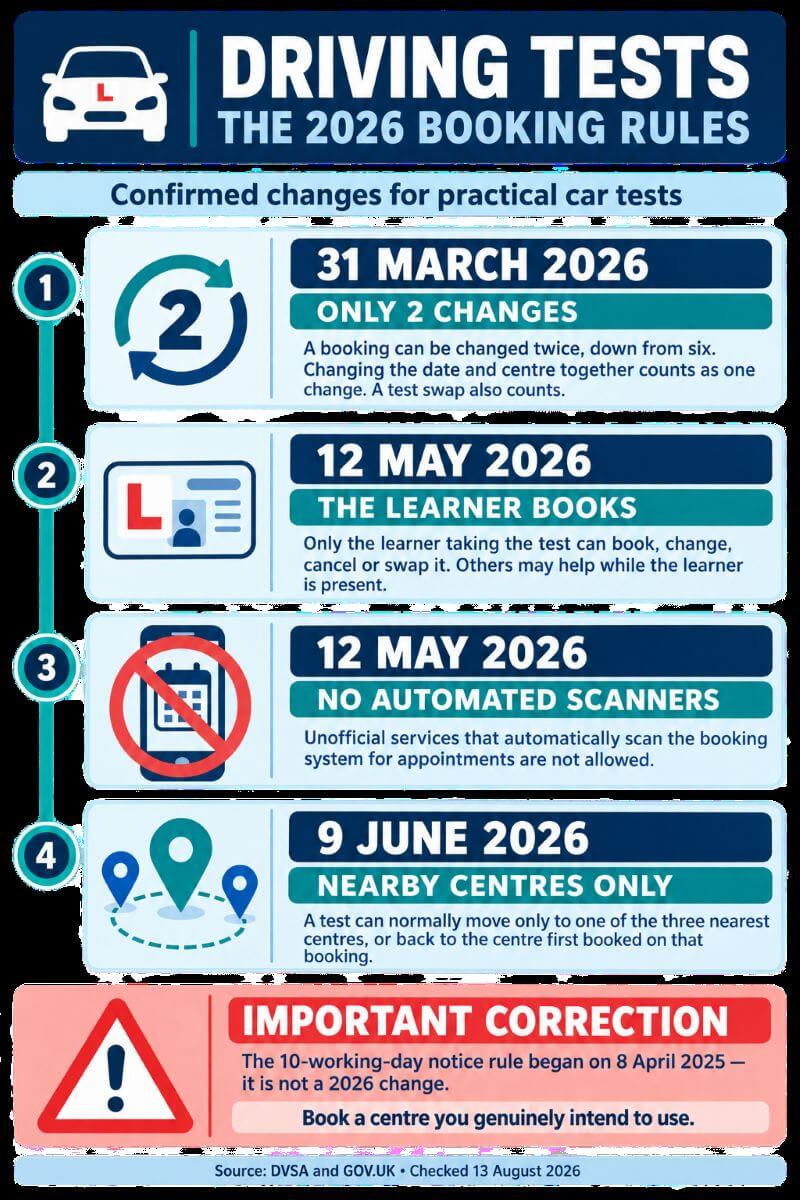
Only the person taking the test is now allowed to book, change, cancel or swap it. An instructor, parent or support worker can help, but the learner must remain present and complete as much of the process as possible.
Other important changes include:
| Rule | What it means |
|---|---|
| Maximum of two changes | A practical test appointment can normally be changed only twice before it must be cancelled and rebooked. |
| Nearby centres only | Learners can move an appointment only to one of the three nearest centres or back to the centre originally booked. |
| No automated cancellation scanners | Unofficial services that automatically search the booking system are prohibited under DVSA’s terms. |
| Ten working days’ notice | Learners normally need to change or cancel at least ten full working days before the test to avoid losing the fee. |
| Learner books personally | Instructors can provide their reference number so availability is checked, but cannot make the booking. |
For somebody booked at Oxford (Cowley), the three nearest centres named by DVSA are Aylesbury, Reading and Banbury. For a Banbury booking, the listed alternatives are Warwick, Rugby and Oxford.
The safest approach is to book a centre you genuinely intend to use and choose a date by which your instructor believes you can realistically be ready.
Do not rush simply because a test is available
In July 2026, 48 out of every 100 practical driving tests in Great Britain ended in failure.
There is no shame in needing another attempt, but taking a test before being ready adds another fee, increases pressure on the booking system and can damage confidence.
A proper mock test should replicate the conditions of the real assessment. The instructor should avoid prompting, allow the learner to make independent decisions and provide honest feedback afterwards.
The aim is not to memorise a test route. It is to demonstrate safe driving on whichever roads, junctions and traffic conditions arise on the day.
Learners should also remember that their theory-test pass lasts for two years. The practical test must be passed within that period or the theory test will need to be taken again.
Private practice can help, but the rules matter
Practice between professional lessons can help learners gain experience and make better use of paid tuition.
The supervising driver must be at least 21, have held a full licence for at least three years and be qualified to drive the type of vehicle being used. Some insurers impose a higher minimum age on the supervisor.
The learner must be properly insured. The car must be taxed, roadworthy, registered with DVLA and have a valid MOT where required. Legal L plates must be clearly displayed at the front and rear.
A supervisor has the same responsibility to stay attentive as the person at the wheel. They must not use a handheld phone, be over the alcohol limit or be impaired by drugs or medication.
Learners may drive on motorways only with an approved driving instructor in a dual-control car. A parent or friend cannot supervise motorway practice.
Build experience that reflects Oxfordshire roads
A learner who practises only on the same quiet residential streets may pass familiar junctions confidently but struggle when circumstances change.
Oxfordshire driving can involve sharply contrasting conditions, sometimes within the same journey.
Learners should gradually develop experience of:
| Busy urban roads | Including cyclists, pedestrians, buses, bus lanes, restricted streets and frequent junctions |
| Rural lanes | Where visibility, bends, narrow carriageways, mud and oncoming traffic require careful speed choice |
| A-roads and dual carriageways | Including joining, lane choice, overtaking and leaving safely |
| Roundabouts | From small local junctions to larger multi-lane layouts |
| Different weather and light | Including darkness, rain, low sun and wet road surfaces |
| Independent navigation | Following signs or a sat-nav without allowing the device to distract from the road |
There is no need to deliberately seek dangerous weather. The aim is to gain supervised experience when conditions vary naturally and to learn when a journey should be delayed or avoided.
Passing the test does not make driving cheap
New drivers should obtain insurance quotes before buying a car, not afterwards.
Premiums depend on the vehicle, driver’s age, postcode, mileage, occupation, where the car is kept, driving history and the level of cover. MoneyHelper warns that insurance for a young driver can sometimes cost more than the first car itself.
Specialist young driver insurance products are one possible route, but they should be compared with quotes from mainstream insurers and other brokers. Price is important, but so are the excess, exclusions, cancellation fees, mileage limits and level of cover.
Telematics or black-box insurance may reduce premiums for some careful drivers. Depending on the policy, the insurer may monitor mileage, speed, braking, acceleration, cornering and the times the vehicle is used. Drivers should understand exactly what is recorded and whether poor scores, night driving or additional mileage could increase the price.
Adding an experienced driver can sometimes reduce a quote, but the insurer must be told who genuinely uses the vehicle most. Falsely naming a parent as the main driver when the car is primarily used by the young person is known as fronting and can invalidate the policy.
Budget for the full first year
The cost of ownership extends well beyond the purchase price and insurance premium.
First-year driving costs to consider
| Insurance | Often the largest annual cost for a young or newly qualified driver |
| Vehicle tax | Depends on the car’s registration date, emissions and list price |
| Fuel or charging | Estimate from realistic weekly mileage rather than the occasional longest journey |
| MOT | Normally required annually once a car is three years old |
| Servicing | Regular maintenance can prevent avoidable breakdowns and larger bills |
| Tyres and repairs | Wear items and unexpected faults need room in the budget |
| Parking | Can be significant for people driving regularly into Oxford or other town centres |
| Breakdown cover | Optional, but potentially valuable for an older first car |
Before buying, check the vehicle’s MOT history, service record, insurance group, tax rate, tyre condition and outstanding safety recalls.
New drivers should also learn basic checks such as tyre pressures and tread depth, oil and coolant levels, screenwash, lights and dashboard warning symbols. Keeping the interior tidy is useful, but mechanical safety matters far more than whether the cupholders are spotless.
Oxford’s local traffic rules add another responsibility
Drivers using central Oxford need to understand local restrictions as well as the Highway Code.
The city’s Zero Emission Zone charges petrol, diesel and hybrid vehicles entering the pilot area, unless a discount or exemption applies. Zero-emission vehicles can enter without paying.
Oxford’s traffic-filter trial is currently due to begin on 28 September 2026, replacing the temporary congestion charge. Cars without valid permits will need to avoid the six filter points during their operating hours, although the county council says every part of Oxford will remain accessible by another route.
New drivers should check signs rather than relying unquestioningly on an old sat-nav route. Bus gates, camera-enforced restrictions, controlled parking zones and permit areas can all change how a journey should be planned.
Official information is available through Oxfordshire County Council’s Zero Emission Zone guidance and traffic-filter pages.
The first two years carry an important penalty-points rule
Newly qualified drivers are subject to stricter consequences under the New Drivers Act.
A full licence will be revoked if the driver reaches six or more penalty points within two years of passing their first driving test. Points still active on the provisional licence carry over after the test.
If the licence is revoked, the driver must apply and pay for another provisional licence and pass both the theory and practical tests again before driving unaccompanied.
This makes speeding, phone use, driving without insurance and other offences particularly serious for new drivers.
Green P plates are optional in England. They may encourage other road users to allow more space, but they do not alter the law or excuse unsafe driving.
What being test-ready should really mean
The purpose of learning is not simply to complete a manoeuvre correctly on one particular morning.
A test-ready driver should be able to make safe decisions without prompts, respond appropriately when another road user makes a mistake, manage nerves and recognise when conditions require greater caution.
They should also understand the responsibilities that continue after the pass certificate is handed over: insurance, maintenance, legal compliance, route planning and consideration for pedestrians, cyclists and other drivers.
Long waits and high costs make the process frustrating, but rushing usually creates more expense rather than less. A realistic budget, varied practice and honest assessment of readiness give learners the best chance of passing and becoming safer independent drivers.
FAQs
What is the minimum official cost of learning to drive?
The provisional licence, theory test and weekday practical test cost at least £119 if applied for online and passed first time. This does not include lessons, insurance, fuel or use of a car for the test.
How many driving lessons are required?
There is no compulsory minimum. A commonly used planning estimate is 45 hours of professional tuition plus 22 hours of private practice, but some learners need considerably more or less.
Where are the main car driving test centres in Oxfordshire?
The county’s main practical car test centres are Oxford (Cowley) and Banbury. Learners can find current centre details through the GOV.UK test-centre search.
Can a driving instructor book the practical test?
No. Since 12 May 2026, only the learner taking the test can book, change, swap or cancel it. An instructor or family member may help while the learner is present.
Can learners use a cancellation-finder app?
DVSA says learners must not use unofficial services that automatically scan its booking system for appointments. Breaking the booking terms can lead to online access being suspended or the test being cancelled.
Can a learner drive on a motorway?
Yes, but only with an approved driving instructor in a car fitted with dual controls. Motorway practice cannot be supervised by a family member or friend.
Who can supervise private practice?
The supervisor must normally be at least 21, have held a full licence for at least three years and be qualified to drive the type of car being used. The learner and vehicle must also have the correct insurance.
What happens if a new driver receives six penalty points?
If six or more points are accumulated within two years of passing the first test, the licence is revoked. The driver must obtain another provisional licence and pass the theory and practical tests again.