A rattle, blowing noise or unusual smell from a car exhaust can be easy to dismiss, especially if the vehicle still appears to drive normally. But motoring faults that start small can quickly become a safety issue, an MOT failure and a larger repair bill.
Exhaust problems often begin quietly. A slightly louder engine note, a rattle underneath the vehicle, a blowing sound when accelerating or an unusual smell after starting the engine can all seem like minor annoyances.
But exhaust faults rarely stay minor. Heat, vibration, moisture, road salt, potholes and everyday driving can turn a small leak, cracked joint, loose bracket or corroded pipe into a more serious problem.
For drivers in Oxford, Banbury, Bicester, Witney, Abingdon, Didcot and rural parts of the county, the issue is not only cost. A faulty exhaust can affect safety, emissions, fuel economy, MOT results and the comfort of people inside and outside the vehicle.
Expert advice: warning signs to take seriously
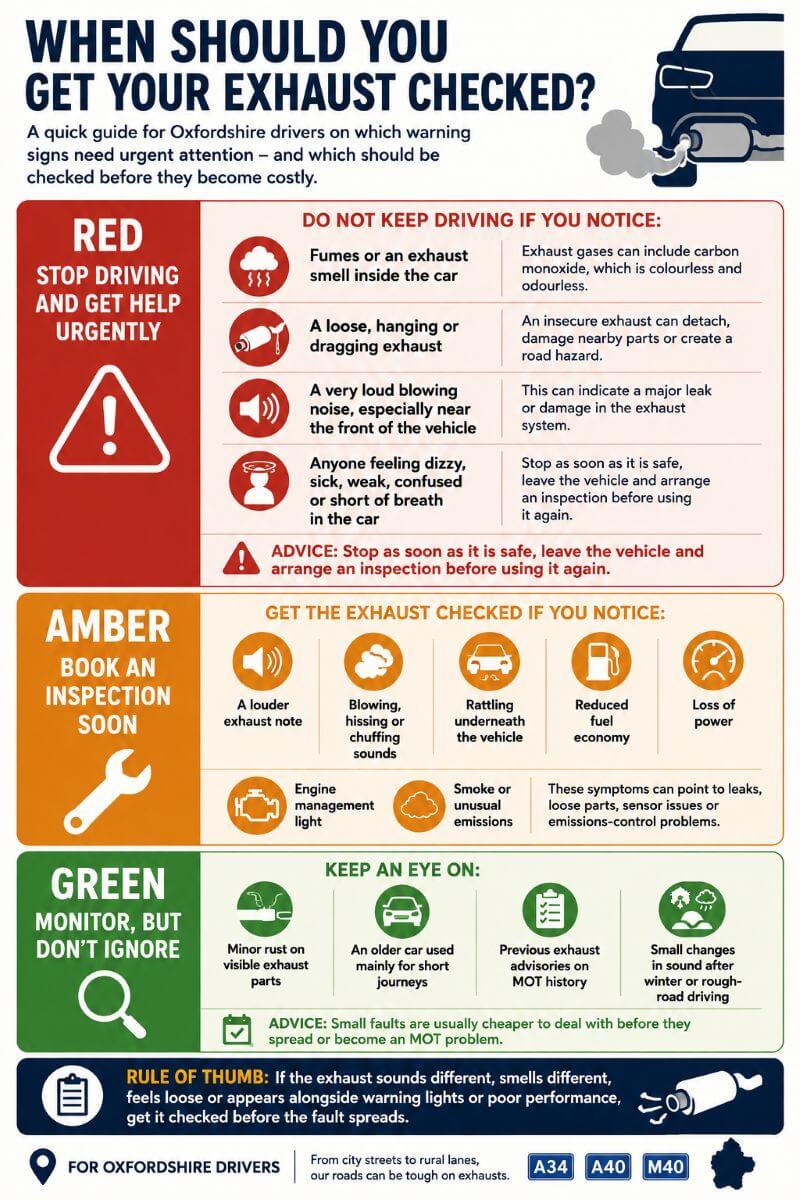
The exhaust experts at Magowan Tyres say drivers should not wait for a fault to become loud or obvious before getting it checked. An exhaust smell inside the car, unusual noises, rattling underneath the vehicle, warning lights, reduced performance or visible smoke can all point to a problem. If the exhaust sounds different, smells different or appears to be loose, motorists should arrange an inspection before the fault worsens or affects the vehicle’s MOT.
Advice box: when should you get an exhaust checked?
| Stop driving and arrange a check urgently | If you smell fumes inside the car, feel unwell while driving, hear a loud blowing noise near the front of the vehicle, or notice the exhaust hanging loose. |
| Book a garage inspection soon | If you hear rattling, hissing, chuffing or a louder exhaust note, or if fuel economy or performance has changed. |
| Check before your MOT | If the exhaust is noisy, rusty, insecure or has previously appeared as an MOT advisory. |
| Look into it before buying a used car | Check the vehicle’s MOT history for exhaust corrosion, leaks, emissions failures or repeated advisories. |
Small exhaust faults can spread
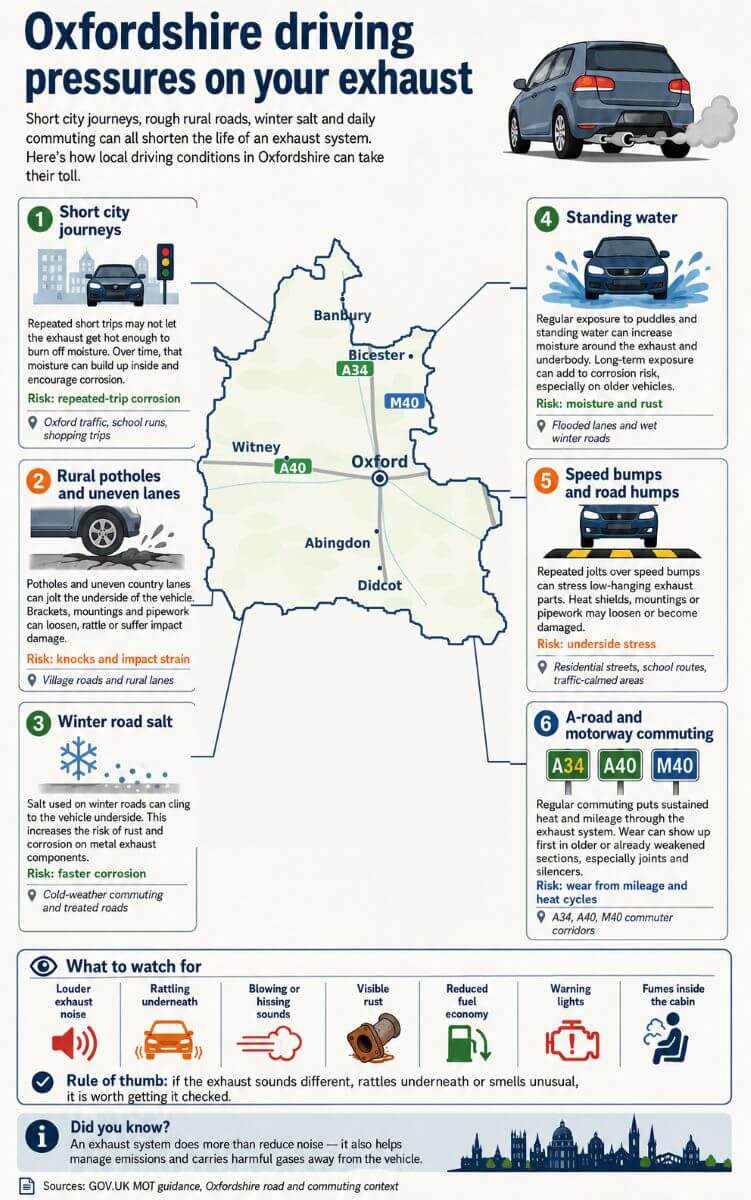
The exhaust system sits underneath the vehicle, where it is exposed to heat, vibration, standing water, road salt, speed bumps, potholes and rougher rural roads.
Once a hole, crack, loose joint or failed hanger appears, the system can begin to move more than it should. That movement can weaken neighbouring joints, damage brackets and put strain on sections that might otherwise have lasted longer.
A small blowing sound may begin as a minor leak at a clamp, gasket, flexi pipe or silencer. If it is left unchecked, the leak can grow and a relatively simple repair may become a more expensive replacement.
Fumes inside the car should be treated seriously
One of the clearest warning signs is the smell of exhaust fumes inside the cabin.
Carbon monoxide itself has no smell. However, if exhaust fumes are entering the cabin, exhaust gases may also include carbon monoxide. The NHS says carbon monoxide is colourless and does not smell, and symptoms of poisoning can include headache, dizziness, feeling sick, weakness, tiredness, confusion, chest pain and shortness of breath.
A leak near the front of the exhaust system, such as around the manifold, front pipe or flexi section, can allow gases to escape before they reach the rear of the vehicle. Depending on airflow and body seals, those gases may find their way inside the car.
Drivers should not rely on opening windows as a solution. If fumes are entering the cabin, they should stop driving as soon as it is safe, leave the vehicle and arrange for the exhaust to be inspected before using the car again.
If anyone feels dizzy, confused, sick, weak, unusually tired or short of breath after being in the vehicle, they should seek medical advice urgently. If symptoms are severe, it should be treated as an emergency.
Fuel economy and performance can be affected
A car’s exhaust system does more than carry gases away from the engine. Modern vehicles use sensors in and around the exhaust, including oxygen or lambda sensors, to help the engine management system regulate fuel delivery and combustion.
A leak before one of those sensors can cause incorrect readings. The engine may then run less efficiently, use more fuel, feel less responsive or trigger an engine management light.
For Oxfordshire motorists using the A34, A40 or M40, or making regular short journeys around town, wasted fuel can add up over time.
Not every change in fuel economy is caused by the exhaust, but a blowing noise, exhaust smell, warning light or loss of power gives drivers a clear reason to have the vehicle checked.
Emissions and local air quality
Transport emissions remain a focus in Oxfordshire, particularly in Oxford, where the Zero Emission Zone pilot operates in the city centre.
Repairing an exhaust fault does not change a vehicle’s official ZEZ emissions band. Oxfordshire County Council’s ZEZ charges are based on vehicle emissions category, with zero-emission vehicles charged £0 in the pilot zone.
However, a faulty exhaust, failed sensor, damaged catalytic converter or diesel particulate filter problem can still increase real-world emissions and may cause an MOT failure.
For drivers regularly using Oxford city centre, school routes, hospital routes or busy commuting corridors, keeping a vehicle in good mechanical condition can help reduce unnecessary pollution.
Some exhaust parts can be costly to replace
The catalytic converter is one of the more expensive parts of many petrol exhaust systems. Diesel vehicles may also have a diesel particulate filter, known as a DPF.
Not every exhaust leak will damage these components, but related faults can increase the risk. A misfire, faulty sensor, incorrect fuel mixture, unburned fuel or excess heat can all put emissions-control parts under pressure.
Warning signs worth checking early include rattling from underneath the vehicle, loss of power, poor fuel economy, a strong exhaust smell, smoke, unusual exhaust noise or an engine management light.
If a catalytic converter or DPF is damaged, the repair is usually far more expensive than dealing with a small leak, failed hanger, clamp or gasket earlier.
Exhaust faults can lead to MOT failure
Exhaust problems can cause difficulties at MOT time.
The GOV.UK MOT inspection manual says an exhaust system with a major leak or that is insecure is a major defect. It also lists exhaust fumes entering the cabin as a major defect, while fumes causing danger to people on board are classed as dangerous.
The emissions part of the MOT can also be affected. GOV.UK’s MOT emissions guidance says readings taken with a leaking exhaust may be incorrect, and a vehicle with a holed exhaust that would fail the MOT should have its emissions checked again once the exhaust is repaired.
Arriving at an MOT with a known exhaust fault increases the chance of failure, retest costs, rushed repairs and time off the road.
Why Oxfordshire driving can be hard on exhaust systems
Many Oxfordshire drivers use their cars in mixed conditions: short city journeys, village lanes, school runs, shopping trips, longer A-road commutes and motorway journeys.
Short journeys can be hard on exhaust systems because moisture may not fully burn off before the car is parked again. Over time, that can contribute to corrosion, especially on older vehicles.
Rural roads can add their own strain, with potholes, standing water, mud, salt and uneven surfaces increasing the chance of knocks, rattles or loose fittings.
Vehicles parked outside through winter can also see more corrosion underneath, particularly if they are driven regularly on salted roads and not inspected between services.
Warning signs drivers should not ignore
| Warning sign | Why it matters |
|---|---|
| Louder exhaust or engine note | May point to a leak, damaged silencer, cracked pipework or loose joint. |
| Blowing, hissing or chuffing sound | Often suggests exhaust gases are escaping before they should. |
| Rattle underneath the car | May be caused by a loose bracket, failed hanger, heat shield or internal exhaust damage. |
| Fumes or unusual smells inside the cabin | Should be treated as a safety warning and checked before further use. |
| Reduced fuel economy | Can be linked to leaks, sensor issues or engine-management problems. |
| Loss of performance | May indicate an exhaust restriction, emissions-control fault or wider engine issue. |
| Visible rust, cracks or hanging pipework | Physical damage can worsen with vibration and road conditions. |
| Engine management light | Could be linked to oxygen sensors, emissions faults, catalytic converter issues or DPF problems. |
| Smoke or unusual emissions | Can create MOT and environmental problems and should be checked promptly. |
What an exhaust inspection usually covers
A proper exhaust check should look at the full system, not only the noisiest section.
| Inspection area | What may be checked |
|---|---|
| Visible condition | Rust, cracks, holes, dents, loose sections and signs of impact damage. |
| Leaks | Blowing joints, failed gaskets, cracked flexi pipes or damaged sections. |
| Mountings | Brackets, rubber hangers, clamps and heat shields. |
| Noise | Unusual rattles, excessive exhaust volume or internal silencer failure. |
| Emissions components | Catalytic converter, diesel particulate filter, oxygen sensors and other visible emissions-control parts. |
| Diagnostic signs | Engine warning lights, poor fuel economy, reduced power, smoke or strong exhaust smell. |
Used car buyers can check MOT history
Drivers buying a used car, or deciding whether to keep an older vehicle, can use free GOV.UK tools to check its history.
The GOV.UK MOT history service shows previous MOT results, recorded mileage, failures and advisories. Exhaust-related advisories can reveal whether corrosion, leaks or insecure parts have been noted before.
Drivers can also use the GOV.UK MOT status checker to see when the next MOT is due.
These checks do not replace a mechanical inspection, but they can help drivers spot patterns before buying a car or planning repairs on an older vehicle.
Before putting off an exhaust repair
| Can you smell fumes inside? | Stop using the car and arrange an inspection before driving again. |
| Is the exhaust loose? | A hanging or rattling exhaust can detach or damage nearby components. |
| Is your MOT due? | Book a check before the test rather than risking a predictable failure. |
| Has fuel economy changed? | Exhaust leaks and sensor faults can affect engine efficiency. |
| Do you often drive in Oxford? | A sound exhaust will not change your ZEZ band, but it helps keep real-world emissions and MOT risks under control. |
| Are you buying a used car? | Check the MOT history for previous exhaust advisories, corrosion and emissions failures. |
Why early repair is usually cheaper
Delaying an exhaust repair can make the problem more expensive in several ways.
The original fault can spread. A small leak or loose hanger can lead to extra movement, more corrosion and damage to neighbouring parts.
The engine may also run less efficiently if the fault affects sensor readings, increasing fuel use and possibly causing warning lights or emissions problems.
There is also the risk of MOT failure, which can mean retesting, urgent repair work and time off the road.
In many cases, the best outcome is the simplest one: find the fault while it is still small, repair the affected section and avoid replacing parts that could otherwise have lasted longer.
FAQs
Is it safe to drive with an exhaust leak?
It depends where the leak is and how severe it is. If you smell fumes inside the cabin, hear a loud blowing noise, see loose exhaust parts or feel unwell while driving, stop using the vehicle until it has been inspected.
Can an exhaust leak fail an MOT?
Yes. A major exhaust leak, an insecure exhaust, fumes entering the cabin, excessive emissions or missing emissions-control equipment can lead to MOT problems.
Does a noisy exhaust always mean replacement?
No. Noise can come from a damaged silencer, a small leak, a loose clamp, a failed hanger, a cracked pipe, a heat shield or another section of the system. An inspection is needed to confirm whether repair or replacement is more sensible.
Can an exhaust problem increase fuel use?
Yes. If a leak affects sensor readings or engine management, the engine may compensate with an inefficient fuel mixture, which can reduce fuel economy and performance.
Will fixing an exhaust change an Oxford ZEZ charge?
No. Oxford ZEZ charges are based on the vehicle’s emissions category, not on a recent repair. However, a healthy exhaust and emissions system can still help reduce real-world pollution and lower MOT failure risk.
How quickly should an exhaust problem be fixed?
Drivers should arrange an inspection as soon as symptoms appear. Exhaust faults tend to worsen with heat, vibration, moisture and road salt, so delaying can increase the chance of a larger repair later.
What should you do if you smell fumes inside the car?
Stop driving as soon as it is safe, leave the vehicle and arrange for an inspection before using it again. If anyone feels dizzy, confused, sick, weak, unusually tired or short of breath, seek medical advice urgently.
How can you check whether a used car has had exhaust issues before?
Use the GOV.UK MOT history service to look for previous exhaust advisories, emissions failures, mileage records and repeated defects.