The creation and circulation of indecent images of children, legally termed child sexual abuse material (CSAM), remains one of the most serious digital crimes in the UK. But the nature of the threat is evolving at alarming speed.
Advances in artificial intelligence and deepfake technology are now enabling offenders to create convincing, synthetic images of minors, sometimes using school photos, public social media content, or even AI-generated faces.
While these AI images may not involve a real child directly, under UK law they are still illegal if they depict minors in a sexualised context. And because these synthetic images can be created in minutes and distributed globally in seconds, the scale of harm is growing.
Governing laws such as the Protection of Children Act 1978 and the Criminal Justice Act 1988 remain robust, and enforcement by forces such as Thames Valley Police has intensified. But the tools of abuse are becoming more sophisticated, requiring equally advanced responses.
A harrowing case in West Yorkshire in 2024 made national headlines when a 12-year-old schoolgirl became the victim of a deepfake pornographic image, shared by classmates on Snapchat. The image was digitally manipulated to appear explicit and quickly spread through local peer groups.
Children who create these images may think it’s fun and harmless, but there are consequences to the victim and creating, possessing and sharing them is a crime. Considering the ease they can be made with modern technology, parents in particular should be aware of this.
This article explains the legal frameworks, real-world local cases, the impact of AI on child protection, and what every resident, whether parent, educator, or young person, can do to help stop exploitation in real time.
AI and deepfake tools now enable illegal CSAM creation in minutes.
Oxfordshire Police are actively prosecuting cases.
Parents should use controls, talk early, and monitor usage.
Creating or sharing these images, even unknowingly, is a crime.
Report suspicious content via CEOP, IWF or TVP.
What Are Indecent Images?
Indecent images include photographs, videos, or digital content depicting anyone under the age of 18 in sexual contexts. This includes real, manipulated, or computer-generated images, known legally as “pseudo-photographs.”
Categories of Severity:
- Category A: Penetrative sexual activity, sadism, or activity with animals
- Category B: Non-penetrative sexual activity
- Category C: Other indecent or exploitative images

Legal Framework: What the Law Says
Under the Protection of Children Act 1978 and Criminal Justice Act 1988, it is illegal to:
- Possess or download indecent images of children
- Distribute, share, or forward such content (even if received unsolicited)
- Create or manipulate images, including deepfakes or pseudo-imagery
Penalties Include:
- Possession: Up to 7 years for all categories, with up to 10 years or life for production/distribution of Category A
- Distribution/Production: Up to life imprisonment for serious cases
- Encouragement/Facilitation: Up to 7 years
“Possession of indecent images, even if received unintentionally, is a serious offence under UK law,” says Marcus Johnstone, Solicitor and Managing Director at PCD Solicitors.
“Individuals must take immediate action by deleting such content and reporting it to the appropriate authorities. Failure to do so can lead to severe legal consequences, including imprisonment.”
What Happens After a Report?
If you’re investigated for possessing indecent images, the legal process typically includes:
- Investigation – Devices seized; forensic analysis conducted
- Interview – Conducted under caution with legal representation
- Charging Decision – The Crown Prosecution Service (CPS) evaluates evidence
- Court Proceedings – Sentencing follows if convicted
- Safeguarding – May include sex offenders register, online restrictions
What To Do If You’re Accused
If you believe you’ve been wrongly flagged or investigated:
- Consult a solicitor immediately
- Avoid deleting files or discussing the allegation
- Do not attempt to “fix” anything on your own devices
Disclaimer: This article does not constitute legal advice. Always consult a qualified solicitor for personalised legal guidance.
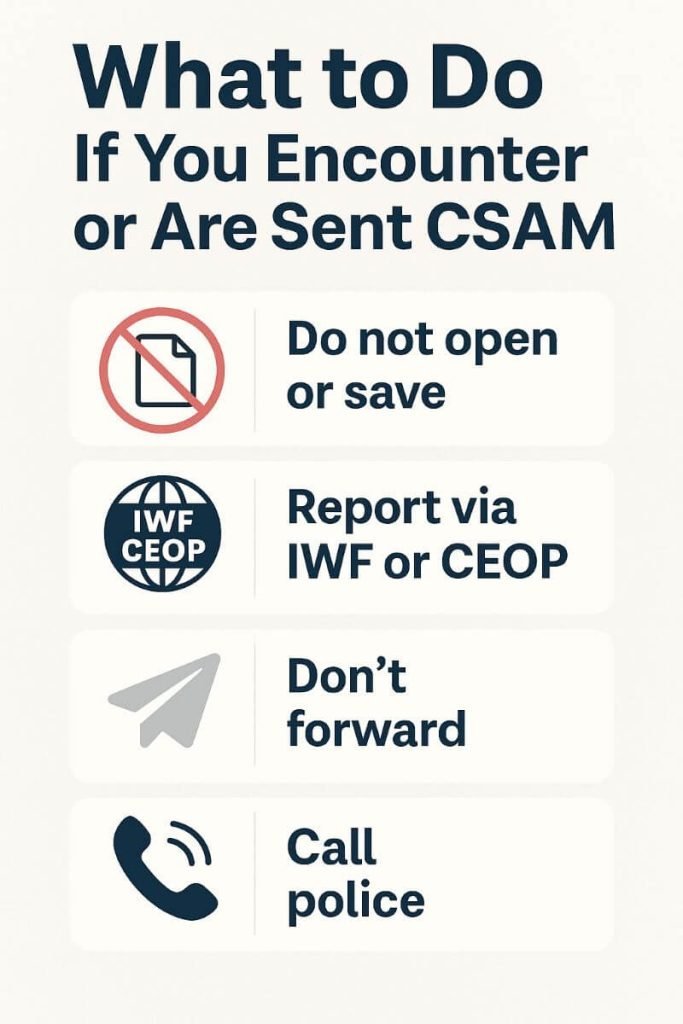
Reporting Suspicious Material
Never share or store suspected CSAM. Instead:
- Report to the Internet Watch Foundation: iwf.org.uk
- Use the CEOP Safety Centre: ceop.police.uk
- Call Thames Valley Police via 101 (or 999 in emergencies)
All reports are confidential and play a vital role in prevention.
Practical Advice for Parents and Guardians
Keeping children safe online is a tough job, especially if you are unaware of their activity, but it starts with proactive communication and the right tools. Education is better than withholding, as it will just happen behind your back.
Here’s how to stay one step ahead:
Talk Early, Talk Often
- Start young: Discuss internet safety before your child has unsupervised access. It’s not a pleasant conversation, but a necessary one.
- Keep it age-appropriate: Use simple language and build on the conversation as they grow.
- Create a no-blame culture: Reassure your child that they can talk to you about anything, even if something goes wrong.
Use Robust Parental Controls
- Install tools like Qustodio, Net Nanny, or Bark to monitor apps, browser history, and screen time.
- Configure built-in safety settings on platforms like YouTube Kids, TikTok, Instagram, and Xbox.
- Use home router settings to block adult or unverified content across all devices.
Monitor Devices and Behaviour
- Keep devices in shared spaces, bedroom use should be supervised, especially at night.
- Be alert for signs of distress, secrecy, or sudden changes in screen use.
- Regularly check installed apps, browser histories, and private message threads.
Teach Digital Critical Thinking
- Help children understand grooming, scams, and deepfakes.
- Discuss how “strangers” online may not be who they claim.
- Explain the permanence of sharing images, even in “private” chats.
Use Trusted Education Resources
- Thinkuknow.co.uk: UK-based learning platform tailored for different age groups.
- InternetMatters.org: Expert guides for parents on current risks and device-specific safety settings.
- Childnet.com: Resources for schools and parents, including family agreements and conversation starters.
Know What to Do If Something Goes Wrong
- Stay calm. Reassure your child they’re not in trouble.
- Take screenshots (if safe to do so) and report content immediately to the Internet Watch Foundation or CEOP.
- Do not delete potential evidence before speaking to law enforcement or a safeguarding professional.
The Tech Behind the Crime, and the Fight Against It
As digital tools become more advanced, so do the tactics used to exploit them. Law enforcement agencies, charities, and tech platforms are locked in a continuous battle to keep up with new methods of distributing child sexual abuse material (CSAM).
Deepfakes & AI-Generated Content
One of the fastest-growing threats is the use of AI to generate synthetic images, including deepfakes. These hyper-realistic, computer-generated images may not feature real children, but if they depict minors in sexual scenarios, they are still illegal under UK law.
According to the National Crime Agency (NCA), around 10% of CSAM reports in 2025 involved AI-generated or manipulated imagery. These materials pose unique legal challenges because they test the boundaries of image authenticity, victim identity, and intent.
Encryption, Anonymity & the Dark Web
Offenders increasingly use end-to-end encrypted messaging platforms such as Telegram or Signal, and access CSAM networks via anonymity-preserving browsers like Tor. This makes content harder to trace and remove, increasing the burden on forensic investigators.
Encrypted apps and private forums complicate the ability of authorities to intercept harmful material or detect grooming behaviours in real time.
Advanced Detection Tools
In response, UK authorities are embracing innovative technologies to combat CSAM:
- Hash-matching tools like PhotoDNA identify known abuse images even if the files have been renamed, cropped, or resized.
- Machine learning algorithms are now used to detect grooming language or risk patterns in chat logs.
- Blockchain forensics helps trace cryptocurrency transactions often linked to the sale or distribution of illegal material on the dark web.
- The Online Safety Act 2023 now requires tech platforms to implement proactive detection and takedown systems for CSAM.
These tools are critical in helping law enforcement stay ahead of perpetrators in an ever-changing digital landscape.
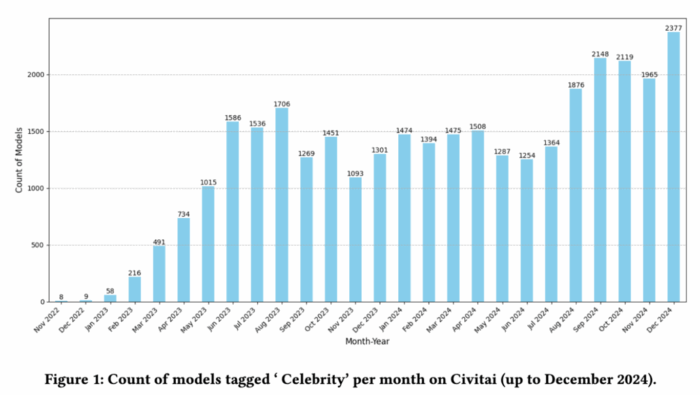
Oxford Study Reveals Alarming Rise in Deepfake Image Tools
A ground-breaking study from the Oxford Internet Institute (OII), published in May 2025, has uncovered a dramatic surge in publicly downloadable AI tools designed to generate deepfake images, including non-consensual intimate imagery (NCII) and sexualised depictions of women and minors.
The research, led by Oxford doctoral student Will Hawkins and accepted for publication at the prestigious ACM FAccT Conference, analysed platforms like Civitai, where nearly 35,000 custom deepfake generators, known as “model variants”, were found available for public download. These tools have been downloaded almost 15 million times since late 2022.
Key Findings:
- Scale: 35,000+ publicly available models for deepfake image generation
- Massive reach: Nearly 15 million total downloads
- Target profile: 96% of deepfakes target identifiable women, including social media users and celebrities
- Ease of creation: Many deepfakes can be made using just 20 images and 15 minutes of processing time on a basic computer
- Intentional abuse: Many models are tagged or described explicitly for pornographic or exploitative use
“There is an urgent need for more robust technical safeguards, clearer and more proactively enforced platform policies, and new regulatory approaches,” said Will Hawkins, lead author of the study.
This research is particularly important in Oxfordshire, where the study was conducted, and reinforces concerns already being acted upon by Thames Valley Police and national bodies. While the tools themselves may not always be illegal, their use to generate deepfake CSAM or NCII is criminal under the Online Safety Act 2023, and may soon be expanded further by upcoming amendments under the UK’s Crime and Policing Bill.
Why This Matters Locally
Oxford is not only a hub for digital research but also home to one of the UK’s highest concentrations of internet users and student populations.
These findings suggest that even non-famous individuals, like school pupils or local social media users, could become targets of synthetic abuse imagery.
National & Global Context
- The IWF removed over 227,000 CSAM URLs in 2024, most hosted overseas
- NCA reported 3,319 CSAM arrests in 2023–2024
- AI-generated CSAM now makes up 10% of reports, presenting a growing challenge
- UK collaborates internationally via Interpol and Europol
If You Suspect Abuse: Act Now
If you suspect a child is at risk, or encounter any concerning material, don’t hesitate.
Report it immediately. You could be stopping harm in real time.
Local Resources
Oxfordshire is proactive in digital safety and child protection:
- Oxfordshire Safeguarding Children Partnership: oscp.org.uk
- Childline: 0800 1111
- NSPCC: nspcc.org.uk