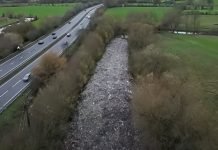
One of England’s most notorious illegal waste dumps has been completely cleared from land beside the A34 near Kidlington, although the criminal investigation into those responsible remains active.
At a glance
| Location | Private land between the A34 and River Cherwell near Kidlington |
| Waste removed | 22,105 tonnes of commercial and household waste |
| Area affected | About 8,000 square metres, larger than the football pitch at Wembley Stadium |
| Waste included | Tyres, shredded plastic and mixed household rubbish |
| Site closed | A court restriction order was granted on 23 October 2025 |
| Clearance began | April 2026 |
| Clearance status | The Environment Agency says all illegally dumped waste has now been removed |
| Investigation | Four people have been arrested; no charges or convictions have been announced |
| Report information | Call the Environment Agency on 0800 807060 or Crimestoppers anonymously on 0800 555111 |
The Environment Agency says 22,105 tonnes of illegally dumped waste have now been excavated and removed from the site near Kidlington ready for disposal.
Specialist teams cleared the health hazard of mixed commercial and household waste including tyres, shredded plastics and general rubbish from land between the A34 and the River Cherwell.
The site has been secured with concrete blocks at its entrance and the main gate has been padlocked to prevent further access.
Although the waste has gone, the land should not be treated as open to the public. No date has been announced for reopening the public footpath that crosses the area, and access remains restricted.
Final total exceeded the original estimate
When the clearance operation began in April, the Environment Agency estimated that the site contained about 21,000 tonnes of waste.
The final total was 22,105 tonnes, more than 1,100 tonnes above that original estimate.
During the later stages of the operation, workers discovered further waste buried beneath soil and the temporary site compound. Some pockets extended around two metres into the ground and were up to ten metres wide.
Waste was also removed carefully from the site perimeter, where heavy machinery had to be used cautiously to avoid damaging tree roots beside the A34.
The piles above ground had reached heights of up to ten metres in places.
Contractors moved as many as 30 lorry loads a day to authorised waste-management facilities for recycling or landfill. By early August, more than 700 loads had already left the site.
Why the site caused such concern
The dump occupied around 8,000 square metres of land, an area larger than the football pitch at Wembley Stadium.
Its position created particular risks because it sat on a floodplain close to the River Cherwell and alongside one of Oxfordshire’s busiest roads.
Fire and rescue specialists warned that a major fire could have caused smoke and air-quality problems, interrupted electricity supplies and forced the A34 to close.
Those findings led the Environment Agency to make an exceptional decision in December 2025 to fund the complete clearance.
The agency does not normally pay to remove illegal waste from private land. Landowners are generally responsible for securing their property and clearing material dumped on it, while investigators pursue the offenders under the polluter-pays principle.
In Kidlington, however, the possible consequences of fire were judged serious enough to justify direct intervention before the criminal case had concluded.
Water sampling found no significant chemical impact
The Environment Agency regularly sampled water near the site while monitoring possible effects on the River Cherwell.
Its latest announcement says there has been no evidence of a significant impact on the local water environment.
Earlier sampling found chemical levels similar to those detected in other rivers across England. The agency described them as very low and not expected to cause environmental harm.
That finding should not be interpreted as meaning the dumping caused no damage. The waste covered and penetrated the land, affected nearby habitats and required months of excavation and reinstatement work.
Protective measures included a wall of large sandbags between the waste and the river, fencing, temperature probes and regular inspections.
The sandbag barrier has since been removed. Its contents and stone used beneath the temporary site compound were sent for cleaning so the material could be reused where appropriate.
How the Kidlington waste site developed
Cherwell District Council was first alerted to suspicious activity in June 2025 following a report from a resident.
Because large-scale illegal waste operations fall outside the district council’s normal fly-tipping enforcement role, the matter was referred to the Environment Agency.
Agency officers attended on 2 July and classified the location as a high-risk illegal waste site.
A later visit found no immediate change, and a cease-and-desist letter was issued. The Environment Agency subsequently became aware of further activity and obtained a court order closing the site on 23 October.
The agency says no further tipping took place after the closure.
Growing concern about the scale of the dump, its proximity to the River Cherwell and the potential fire risk led to calls for an urgent government-backed clearance.
The removal operation began in April 2026 and was carried out by Acumen Waste Services under the direction of the Environment Agency.
Kidlington waste dump timeline
| June 2025 | Cherwell District Council receives a report from a resident and refers the matter to the Environment Agency. |
| 2 July 2025 | Environment Agency officers attend and identify a high-risk illegal waste site. |
| July 2025 | A cease-and-desist letter is issued. |
| 23 October 2025 | A court restriction order closes the site and prevents further tipping. |
| November 2025 | The first arrest is made as part of the criminal investigation. |
| December 2025 | The Environment Agency announces an exceptional decision to clear the site because of the fire risk. |
| January and February 2026 | Three further arrests bring the total to four. |
| April 2026 | The main waste-removal operation begins. |
| August 2026 | The Environment Agency confirms that 22,105 tonnes have been removed and the site fully cleared. |
Criminal investigation remains open
The physical clearance does not bring the enforcement investigation to an end.
The Environment Agency’s National Environmental Crime Unit continues to investigate how such a large quantity of waste came to be deposited on the land and who was responsible.
Four people were arrested between November 2025 and February 2026 as part of the investigation, supported by the South East Regional Organised Crime Unit and several police forces.
The latest announcement does not report that anyone has been charged or convicted in connection with the Kidlington site.
An arrest is not a finding of guilt. Any person suspected of an offence is entitled to the presumption of innocence unless and until a court determines otherwise.
Environment Agency chief executive Philip Duffy said completing the clearance was an important step for the community, but added that the agency was continuing to pursue those responsible.
He said the agency had made several arrests while the wider investigation remained active.
Government says offenders should pay
The Environment Agency has not included the final public cost of the clearance in its latest announcement.
The Government says it intends to strengthen the agency’s ability to trace and confiscate money, vehicles, property and other assets bought with the proceeds of waste crime.
Where offenders are convicted and have recoverable assets, enforcement agencies can seek confiscation orders and pursue the costs associated with their offending.
The Government has also announced plans to increase the maximum fixed penalty for some waste offences from £300 to £5,000.
Serious environmental offences can already result in prosecution, larger fines and imprisonment.
Environment Secretary Dame Angela Eagle said the Kidlington clean-up showed that communities would not be left beside major illegal dumps indefinitely.
She said wider reforms would increase frontline enforcement and make greater use of surveillance technology including drones.
Wider crackdown on organised waste crime
The Kidlington case has become a prominent example of large-scale waste crime, which the Government and Environment Agency say is increasingly connected with organised criminal networks.
Unlike small-scale opportunistic fly-tipping, the material at Kidlington had been mechanically processed and transported in bulk.
The Environment Agency says this indicated an organised operation rather than isolated dumping by individuals.
A new Waste Crime Crackdown Group, chaired by the Environment Secretary, is intended to improve intelligence sharing between regulators, police, local government and other enforcement bodies.
The first phase of the Environment Agency’s Operation Unite included 42 site visits, the suspension or revocation of 17 environmental permits and the opening of more than 30 criminal investigations.
The Government has also announced publicly funded work on other high-priority illegal waste sites, subject in some cases to feasibility assessments.
Further details are available through the Government’s Waste Crime Action Plan.
Site remains secured after clearance
Concrete blocks have been installed at the entrance and the main gate remains locked.
National Highways has been involved in checking drainage, fencing and trees along the A34 boundary, while Oxfordshire County Council has considered the future of the public footpath crossing the site.
The Environment Agency has not announced when the footpath or land will reopen.
Members of the public should not attempt to enter the site to view the cleared area. The locked access and barriers remain in place to protect the land, support the ongoing investigation and prevent further illegal activity.
How to report information
The Environment Agency is still asking anyone with information about the Kidlington dumping to come forward.
| Environment Agency incident hotline | 0800 807060, available 24 hours a day |
| Anonymous information | Call Crimestoppers on 0800 555111 |
| Online reporting | Submit information anonymously through Crimestoppers |
| Case updates | Environment Agency Kidlington site updates |
FAQs
Has all the waste now been removed from Kidlington?
Yes. The Environment Agency says 22,105 tonnes of illegally dumped commercial and household waste have been excavated and removed.
Where was the illegal waste site?
It was on private land between the A34 and River Cherwell near Kidlington. The site remains secured and should not be visited.
How large was the dump?
Waste covered about 8,000 square metres, an area larger than Wembley Stadium’s football pitch. Some piles reached heights of up to ten metres.
What type of waste was removed?
The material included tyres, shredded plastic, household rubbish and other mixed commercial and domestic waste.
Why did the Environment Agency clear it?
The agency made an exceptional decision after advice that a fire could affect air quality, electricity supplies, the local community and the A34. The site’s position beside the River Cherwell also required careful environmental monitoring.
Did the waste pollute the River Cherwell?
The Environment Agency says regular sampling found no evidence of a significant chemical impact on the local water environment. Protective barriers and monitoring remained in place during the clearance.
Has anyone been charged?
Four people have been arrested as part of the investigation, but the latest announcement does not report any charges or convictions.
Is the criminal investigation over?
No. The Environment Agency’s National Environmental Crime Unit is continuing its investigation.
Can the public now enter the site?
No reopening has been announced. The entrance is blocked, the gate remains padlocked and the future of the public footpath is still being considered.
How can people provide information?
Call the Environment Agency’s 24-hour hotline on 0800 807060. Information can be given anonymously to Crimestoppers on 0800 555111.