

















Oxfordshire continues to attract businesses that scale quickly, from university spin-outs and R&D-led firms to hospitality groups and professional services. But growth brings legal complexity that can slow deals, strain relationships, or create liabilities if it is left until the last minute.
This is a practical guide for founders, directors and managers navigating growth: it sets out practical legal checkpoints for growing firms in Oxfordshire, especially those operating around innovation clusters such as Oxford, Oxford North, the science parks, Harwell and Milton Park. It is not legal advice, and businesses should take professional advice for their specific circumstances.
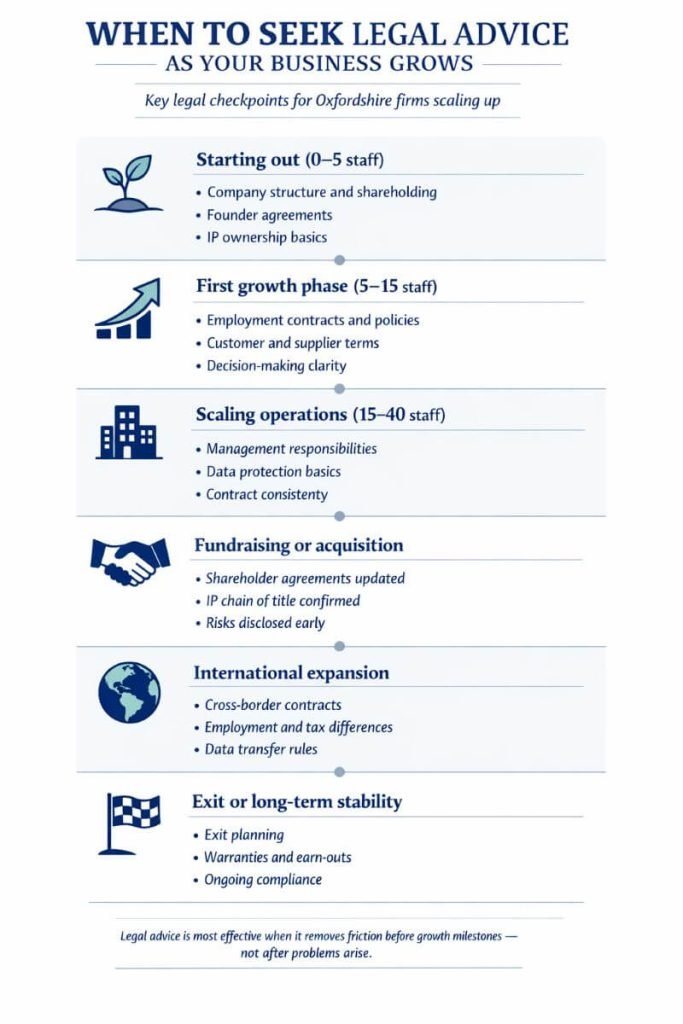
Corporate law vs business law: what’s the difference?
As companies grow, founders often hear terms like “business lawyer” and “corporate lawyer” used interchangeably. In practice, they usually cover different stages and needs.
Business law typically focuses on the day-to-day legal needs of running a company. This includes contracts with customers and suppliers, employment agreements, workplace policies, commercial disputes, leases, and compliance with general regulations. Many small and early-stage businesses rely on this type of support as they establish operations.
Corporate law, by contrast, tends to come into play when a business reaches key structural milestones. Corporate lawyers advise on company structure, shareholder arrangements, investment rounds, mergers and acquisitions, governance, and exits. Their work often centres on ownership, control, and how value is protected or transferred as a company grows.
For many Oxfordshire firms (particularly spin-outs, technology companies and professional services businesses) the shift from business law to corporate law happens gradually rather than all at once. Day-to-day legal support may continue alongside more specialist advice when raising investment, restructuring ownership or planning an acquisition.
A simple rule of thumb:
- If the issue affects how the business operates, business law support is usually relevant.
- If it affects who owns the business, how it is funded, or how it might be sold, advice from corporate law experts is often needed.
Understanding the difference can help firms seek the right advice at the right time, and avoid paying for specialist input before it is actually required.
Once you know which type of support you need, the next step is to prioritise the legal checks that typically matter at each growth stage.
1) Start with the basics: structure that can survive growth
Many firms start with a simple setup and only revisit it when a bank, investor, landlord or acquirer asks uncomfortable questions.
What to check early
- Company structure and shareholding: Are the share classes and voting rights fit for future investment?
- Articles and shareholder agreements: Do they cover decision-making, exits, and disputes?
- Director responsibilities: Directors’ duties and record-keeping matter more as risk increases.
Useful links
- Companies House: running a limited company (start here)
- Companies House guidance and filing requirements
Oxfordshire lens: If you anticipate grant funding, university-linked IP, or rapid hiring, your structure needs to cope with multiple stakeholders and a higher compliance load.
2) Governance: reduce “decision friction” before it becomes a crisis
Fast-growing businesses often rely on informal decision-making until they can’t. That is when internal disagreements start to delay hiring, pricing, fundraising and product decisions.
Governance upgrades that prevent chaos
- A clear list of reserved matters (what requires board/shareholder approval)
- Updated delegations (who can sign what, and up to what value)
- Board cadence: agenda discipline and recorded decisions
- A shareholder agreement that covers leavers, non-competes, drag/tag rights, and disputes
Practical tip: If you are about to raise funding, change ownership, or expand internationally, do a governance tidy-up before you start negotiations. It improves speed and credibility.
3) Contracts: growth multiplies risk faster than revenue
When a business scales, the number of contracts scales faster than anyone’s ability to read them. Poor templates and inconsistent terms are one of the most common sources of later disputes.
A simple contract “upgrade” plan
- Replace ad-hoc templates with standard terms for:
- customers (including payment, liability, service levels)
- suppliers (delivery, quality, termination)
- partners (IP, confidentiality, exclusivity)
- Build a light system: contract register + renewal dates + owner
Useful links
- GOV.UK guidance on business and consumer rights (useful for terms and refunds)
4) IP and universities: get ownership clear early
Oxfordshire firms often collaborate with universities, research institutions and contractors. That makes intellectual property (IP) central — and mistakes here can be expensive.
IP questions to resolve before you scale
- Who owns code, designs, data, and inventions created by:
- employees?
- contractors?
- collaborators?
- Are your NDAs and IP clauses strong enough?
- Do you have a plan for trademarks and brand protection?
Useful links
- UK Intellectual Property Office (IPO): protect your ideas
- Trademarks and patents overview
5) Hiring and employment: the “10 staff” tipping point
Legal risk tends to rise sharply as headcount grows. Once you have managers, hybrid working, performance issues, and payroll scale, policies need to mature.
Employment checklist for scaling teams
- Contracts that match reality (hours, overtime, confidentiality, IP)
- Clear policies: grievance/disciplinary, sickness, family leave, data handling
- Training and documentation for managers
- Worker status clarity (employee vs contractor)
Useful links
- GOV.UK: employment contracts and workplace policies
6) Data protection: don’t wait for a breach
Data protection and cyber resilience are growth multipliers — not just compliance tasks. If you store customer data, run marketing systems, or operate internationally, this matters early.
What “good enough” looks like for SMEs
- A named data owner (even if part-time)
- Clear retention rules and access controls
- Contracts with processors (CRM, email platforms, analytics)
- A basic incident response plan
Useful links
7) M&A, fundraising and investment: prepare for diligence
If you plan to raise investment, acquire a business, or exit, the biggest legal win is being “diligence-ready”.
Diligence-ready checklist (the stuff buyers and investors ask for)
- Corporate documents: cap table, articles, shareholder agreements
- Key contracts: customers, suppliers, leases, licences
- IP chain of title: assignments, contractor agreements
- Employment documents and policy pack
- Compliance: data protection and any regulated permissions
- Any disputes, claims, or past regulatory issues (better disclosed early than discovered late)
Oxfordshire lens: For science/tech firms, the diligence focus is often IP, data, regulatory exposure, and research collaborations. For hospitality/retail, it is leases, staffing, licensing, and supplier agreements.
8) Cross-border growth after Brexit: plan for friction
For firms selling into Europe or the US, the legal work is often not “bigger” — just more fragmented.
What to plan for
- Contract jurisdiction and enforcement
- VAT/tax structuring implications
- Data transfers and privacy regimes
- Employment law differences in overseas hiring
Practical tip: The most common mistake is treating a first overseas deal like a domestic one “with shipping”. It usually isn’t.
How to choose legal support without overspending
Not every business needs a large firm. But every business needs clarity.
Practical ways Oxfordshire SMEs manage cost
- Fixed-fee packages for specific milestones (fundraising, contracts, employee pack)
- A light retainer for quick questions + annual document review
- Specialist advice only where needed (IP, employment, regulated sectors)
The best time to engage legal support
- Before you sign your first “big” customer contract
- Before you hire managers and scale headcount
- Before fundraising, acquisitions, or international expansion
At a glance: the five legal checks that prevent most growth headaches
- Update articles/shareholder agreement before investment discussions
- Standardise contract templates and track renewals
- Lock down IP ownership across staff/contractors/collaborators
- Build an employment policy pack as headcount grows
- Put basic data protection and breach response in place
Bottom line
The most valuable legal work for growing Oxfordshire firms is not firefighting. it is removing friction from decisions, hiring, deals and partnerships. If you treat legal as part of operational readiness, growth becomes faster, calmer and easier to finance.














