Oxfordshire wildlife watchers spotted 18,040 butterflies and day-flying moths this summer as part of Butterfly Conservation’s annual Big Butterfly Count, the world’s largest citizen-science survey of its kind.
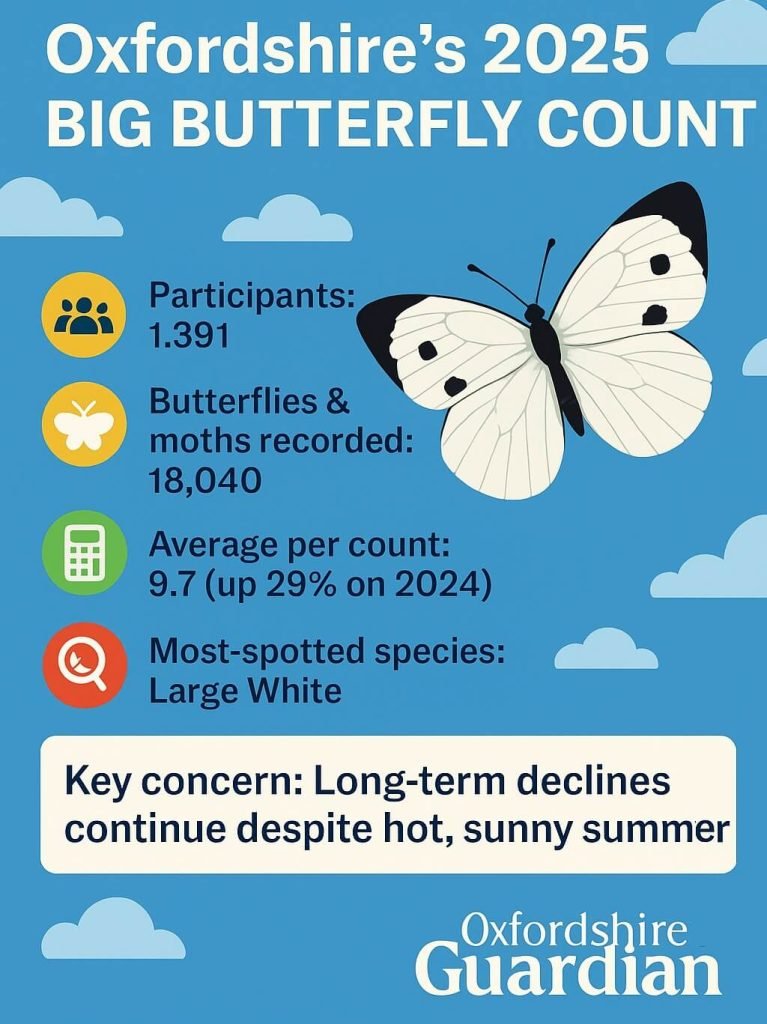
Across three weeks in July and August, 1,391 people across the county took part, logging sightings in gardens, parks and countryside. On average, Oxfordshire participants saw 9.7 butterflies or moths per 15-minute count, a 29% increase on last year’s record lows. The Large White (main image) was the most frequently spotted butterfly in the county.
National picture
The results reflect a broader UK trend. Nationwide, more than 125,000 people joined the Count, recording 1.7 million butterflies and moths. The five most commonly seen species were the Large White, Small White, Gatekeeper, Red Admiral and Meadow Brown.
While 2025 brought the sunniest spring and hottest summer on record (conditions that should have favoured butterflies) scientists warn the apparent recovery masks long-term declines., the consequences of these declining key pollinators and bioindicators is a concern.
Participants across the UK recorded an average of 10.3 butterflies per count, up from just 7 last year, but still only average by modern standards.
“A pretty average year”
Dr Richard Fox, Head of Science at Butterfly Conservation, said:
“We may feel like we’ve seen lots of butterflies this summer, but that’s only because last year was so awful.
Whilst numbers were higher, the figures suggest it’s actually been a pretty average year by modern standards. The 15-year Big Butterfly Count trends show that more than twice as many widespread species have declined significantly than have increased.”
Butterflies, he added, need two things to thrive: good weather and a healthy environment. Habitat loss, climate change and pesticide use continue to put pressure on populations.
Winners and losers
Some species had an exceptional summer. Both the Large White and Small White recorded their best ever Big Butterfly Count results, while the Jersey Tiger moth was seen in more locations and numbers than ever before.
Others fared poorly. The Holly Blue had its second worst year on record, the Common Blue its third worst, and the Meadow Brown its fourth worst. The Small Tortoiseshell, which had collapsed to its lowest level in 2024, staged a partial recovery but remains 60% down since 2011.
What Oxfordshire residents can do
Butterflies are considered a key indicator species of Britain’s biodiversity and environmental health. Monitoring their populations helps track the impacts of climate change, land use and conservation.
Butterfly Conservation is urging local people to take action by:
- Creating butterfly-friendly spaces in gardens and community areas with nectar-rich flowers.
- Avoiding the use of synthetic pesticides, which the charity says are devastating to pollinators.
- Supporting its rescue mission by signing an open letter calling on retailers to remove toxic pesticides from sale (www.butterfly-conservation.org).
Dr Fox said:
“We’ve reached a critical moment. Even in good weather, the environment now supports far fewer butterflies than it once did. We must do more to restore habitats and stop the sale of butterfly-killing pesticides.”
Butterfly Conservation is also calling on councils, landowners and gardeners to prioritise wildflower planting, reduce mowing during peak nectar months, and phase out domestic pesticides to give butterfly populations the best chance of recovery.
Looking ahead
The Big Butterfly Count will return in 2026, running from 17th July to 9th August. Butterfly Conservation hopes even more Oxfordshire residents will take part to help monitor and protect the county’s pollinators. It would be amazing more of the other 99.8% of Oxfordshire’s population joined in.
At a glance: Oxfordshire’s 2025 Big Butterfly Count
- Participants: 1,391
- Butterflies & moths recorded: 18,040
- Average per count: 9.7 (up 29% on 2024)
- Most-spotted species: Large White
- Key concern: Long-term declines continue despite hot, sunny summer
| Species | Abundance | Average Per Count (APC) | % change from 2024 (APC) | 15 year trend % |
| Large White | 396510 | 2.449 | 131.42 | 46.74 |
| Small White | 318762 | 1.969 | 128.27 | 7.49 |
| Gatekeeper | 236425 | 1.46 | 0.31 | -21.87 |
| Red Admiral | 166289 | 1.027 | 185.17 | 51.54 |
| Meadow Brown | 133025 | 0.822 | -39.57 | -18.02 |
| Peacock | 96155 | 0.594 | 52.78 | 12.24 |
| Speckled Wood | 53423 | 0.33 | 43.33 | -35.14 |
| Comma | 43062 | 0.266 | 42.01 | -1.13 |
| Common Blue | 39602 | 0.245 | 227.97 | -57.4 |
| Green-veined White | 39272 | 0.243 | 67.42 | -54.3 |
| Small Tortoiseshell | 37186 | 0.23 | 141.65 | -59.68 |
| Small Copper | 20925 | 0.129 | 21.08 | 93.89 |
| Holly Blue | 20685 | 0.128 | 135.7 | 10.19 |
| Ringlet | 18386 | 0.114 | -66.45 | -42.51 |
| Painted Lady | 15856 | 0.098 | 207.19 | 14.24 |
| Jersey Tiger | 11876 | 0.073 | 174.44 | _ |
| Brimstone | 9149 | 0.057 | -14.27 | -6.6 |
| Six spot Burnet | 5943 | 0.037 | -73.48 | _ |
| Marbled White | 2125 | 0.013 | -90.42 | -17.49 |
| Silver Y | 1940 | 0.012 | -61.78 | _ |
| Scotch Argus | 1376 | 0.008 | 122.78 | _ |
| TOTAL | 1667972 |
| Year | Average per count |
| 2016 | 12.2 |
| 2017 | 10.9 |
| 2018 | 11.2 |
| 2019 | 16.2 |
| 2020 | 10.7 |
| 2021 | 9.2 |
| 2022 | 9.0 |
| 2023 | 12.0 |
| 2024 | 7.2 |
| 2025 | 10.3 |