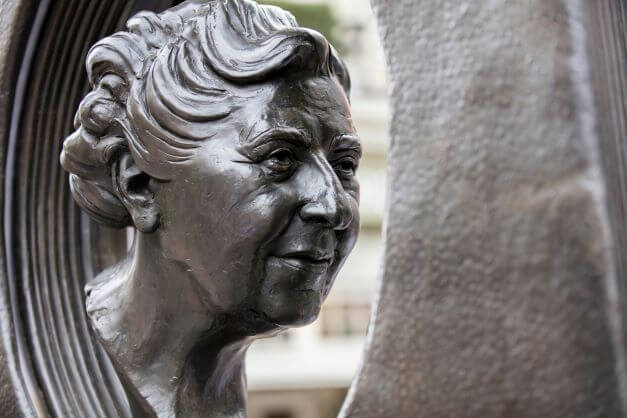
Dame Agatha Christie is one of the most famous people to live in Oxfordshire, living in Winterbrook House in Wallingford for 40 years until her death in 1976, where she now lies buried with her husband in the churchyard at her parish church in Cholsey.
The Queen of Crime, creator of fictional super-sleuths Hercule Poirot and Miss Marple, wrote 66 murder mysteries in total, but perhaps her 11 day disappearance in 1926 was the biggest mystery of all. At the height of her fame, the renowned author vanished without a trace from her home in Sunningdale, Berkshire in the middle of the night, her crashed Morris Cowley car was found abandoned overhanging a quarry in Guildford.
Speculation was rife, and it sparked the largest nationwide manhunt with police, concerned citizens, literary figures such as Sir Arthur Conan Doyle and airplanes. But what happened that night?
Background Of Agatha Miller
Agatha Miller was born in 1890 in Torquay, and despite her interest in writing qualified as a pharmacy dispenser. She met her first husband Archie Christie in 1912, and they married in 1914 while he was on leave from the First World War. Her time working in the hospital pharmacy, gave her an in-depth of deadly toxins she would later utilise in her crime fiction.
Their daughter Rosalind Margaret Clarissa was born in Torquay in 1919, and the young family moved to London in 1920.
It was her sister Madge who pushed Christie to write her first publication in 1921, the Poirot The Mysterious Affair at Styles, and swiftly followed up by The Murder of Roger Ackroyd, Death on the Nile, and And Then There Were None.
In January 1926, the family moved to a large house in Sunningdale, Berkshire. And it was in April of that year, that Agatha’s mother died which prompted a move back to her childhood home in Ashfield.
In August, her husband Colonel Archie Christie came to see her at Ashfield and told her he wanted a divorce as he had fallen in love with his mistress (who he married in 1928) Nancy Neele.
The Disappearance of Agatha Christie
On 3rd December 1926, after an argument, Agatha kissed their seven year old daughter Rosalind, and disappeared without a trace.
After one of the largest searches of the time, her Morris Cowley car was eventually found abandoned in Newlands Corner, Guildford. Prompting a media frenzy and intense speculation of suicide, murder, publicity stunts, and other ill-doings.
There was suggestions that she could be in a small village near Oxford called Godstow, or that she could have gone to an inn located near Chipping Norton.
But it was eye-witness sightings up in Harrogate Railway Station that alerted police to search that area. Bob Tappin, a banjo player at the Swan Hydropathic Hotel in Harrogate recognised her, and she was discovered to be a guest staying under the name of Mrs Theresa Neele.
The police report surmised Christie was driving to London when she crashed the car, then took a train to Harrogate.

Aftermath And Return Home
Christie claimed she was suffering from amnesia from when she crashed the car. As a notoriously private person, this narrative meant she could conveniently not talk about details. Some experts claimed she was in a fugue state, much like a psychogenic trance.
Psychogenic amnesia caused by a mental breakdown would be completely understandable with her mother’s death and her husband’s infidelity. Her marriage had collapsed, and the pressures of being in the public eye a great weight.
You could forgive her for wanting some anonymity. In her 1965 autobiography, she wrote about feeling overwhelmed by life and struggling to cope with emotions of anguish and despair. This suggests that she may have been struggling with depression or another form of psychological distress.
And in her books written afterwards were laden with increased emotional depth. While writing under the pseudonym of Mary Westmacott, in 1934’s semi-autobiographical Unfinished Portrait, the lead character Celia tellingly contemplates suicide after her husband leaves her.
The later years
After her divorce to Archie, she met and married archaeologist Max Mallowan. Her life’s travels to Cairo and to Baghdad on the Orient Express inspired Novels Death on the Nile and Murder on the Orient Express, and she bought the holiday home Greenway in her native Devon.