Most parents do not arrive with the right vocabulary. They arrive with a pattern they have noticed: a child who is not coping, not progressing, avoiding school, struggling with communication, or becoming exhausted by things that seem easier for other children.
The important thing to know is that you do not need to understand the whole SEND system before asking for help. You also do not normally need to wait for a formal diagnosis before a nursery, school or college begins assessing and supporting your child’s needs.
This guide explains the first steps for families in Oxfordshire, how SEN Support should work, when an Education, Health and Care Plan may be appropriate, and where parents can get impartial advice.
Oxfordshire’s main directory for families is the Oxfordshire SEND Local Offer, which brings together support and services for children and young people with additional needs from 0 to 25.
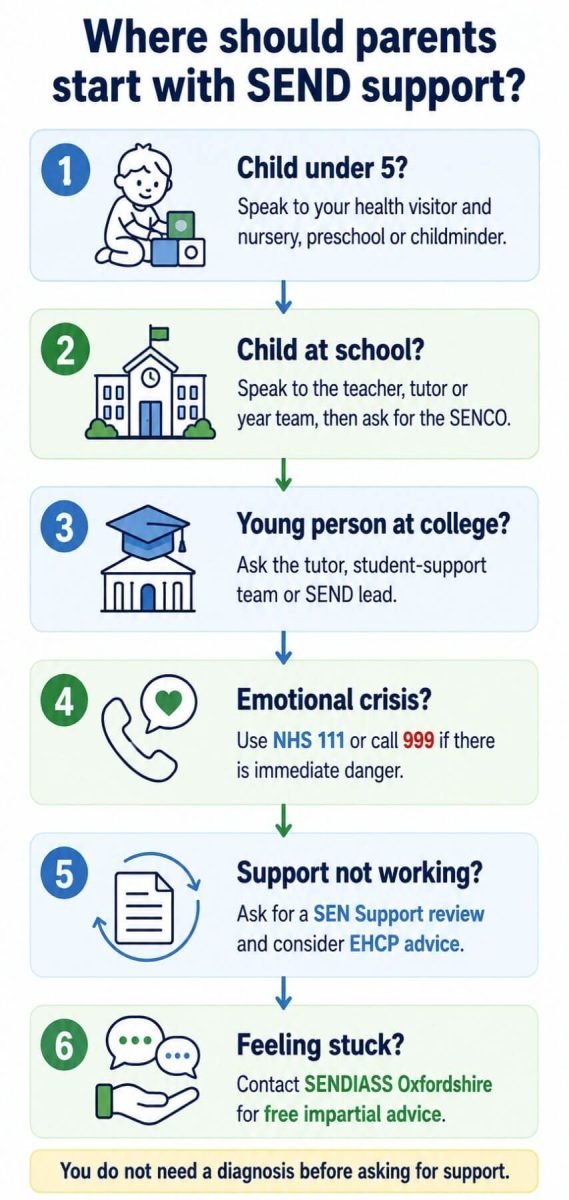
Quick start: where should parents begin?
| If your child is… | Start here |
|---|---|
| Under 5 | Speak to your health visitor and the nursery, preschool or childminder key person. Ask whether the setting’s SENCO can be involved. |
| At primary or secondary school | Speak to the class teacher, form tutor or year team first, then ask for a meeting with the SENCO. |
| At college or sixth form | Ask the tutor, student-support team or SEND lead for a discussion about learning needs and reasonable adjustments. |
| In emotional crisis | Use NHS 111 or the relevant crisis route; call 999 if there is immediate danger. |
| Not making progress despite support | Ask for a SEN Support review and consider whether advice about an EHC needs assessment is needed. |
| You feel stuck | Contact SENDIASS Oxfordshire for free, impartial information, advice and support. |
A SENCO, or special educational needs co-ordinator, is the member of staff who helps co-ordinate SEND provision in a school or setting. Parents do not have to wait until a problem becomes severe before asking to speak to them.
What does SEND mean?
SEND stands for special educational needs and disabilities. A child or young person may have SEND if a learning difficulty or disability means they need educational support that is additional to, or different from, what is normally available to children of the same age.
Needs can affect one or more areas, including:
- communication and interaction
- learning and understanding
- social, emotional or mental health
- physical or sensory development
SEND can include conditions such as autism, ADHD, dyslexia, developmental language disorder, hearing or visual impairment and physical disability. But a child does not need a named diagnosis before concerns can be taken seriously.
Do parents need to wait for a diagnosis?
No. A formal diagnosis can be useful, but it is not the gateway to SEN Support.
Schools should respond to a child’s identified needs and the effect those needs have on learning, participation and daily school life. A child may receive adapted teaching, communication support, visual resources, movement breaks, small-group work or other adjustments while a health or neurodevelopmental assessment is still pending.
GOV.UK tells parents to speak to the teacher or SENCO if they think their child needs SEN Support, and says a child may need an EHC plan if they need more support than the school can provide.
What parents should tell the school
When you contact the school, try to give specific examples rather than a general statement that your child is “struggling”.
Useful examples include:
- difficulty following instructions
- delayed speech or communication difficulties
- sensory distress
- problems with reading, writing or maths
- anxiety about school
- exhaustion or distress after the school day
- difficulty making friends
- poor attendance or school avoidance
- problems with dressing, eating, movement or personal care
- behaviour that seems linked to overwhelm, communication or unmet need
Ask whether the school has noticed the same pattern, what assessment has already been done and what support can be put in place now.
Every school must publish a SEN Information Report on its website. This should explain how the school identifies and supports pupils with SEND, how parents are involved, which specialist services it uses and how complaints can be made.
What is SEN Support?
Most children with SEND have their needs met through SEN Support in their nursery, school or college. They will not need an Education, Health and Care Plan.
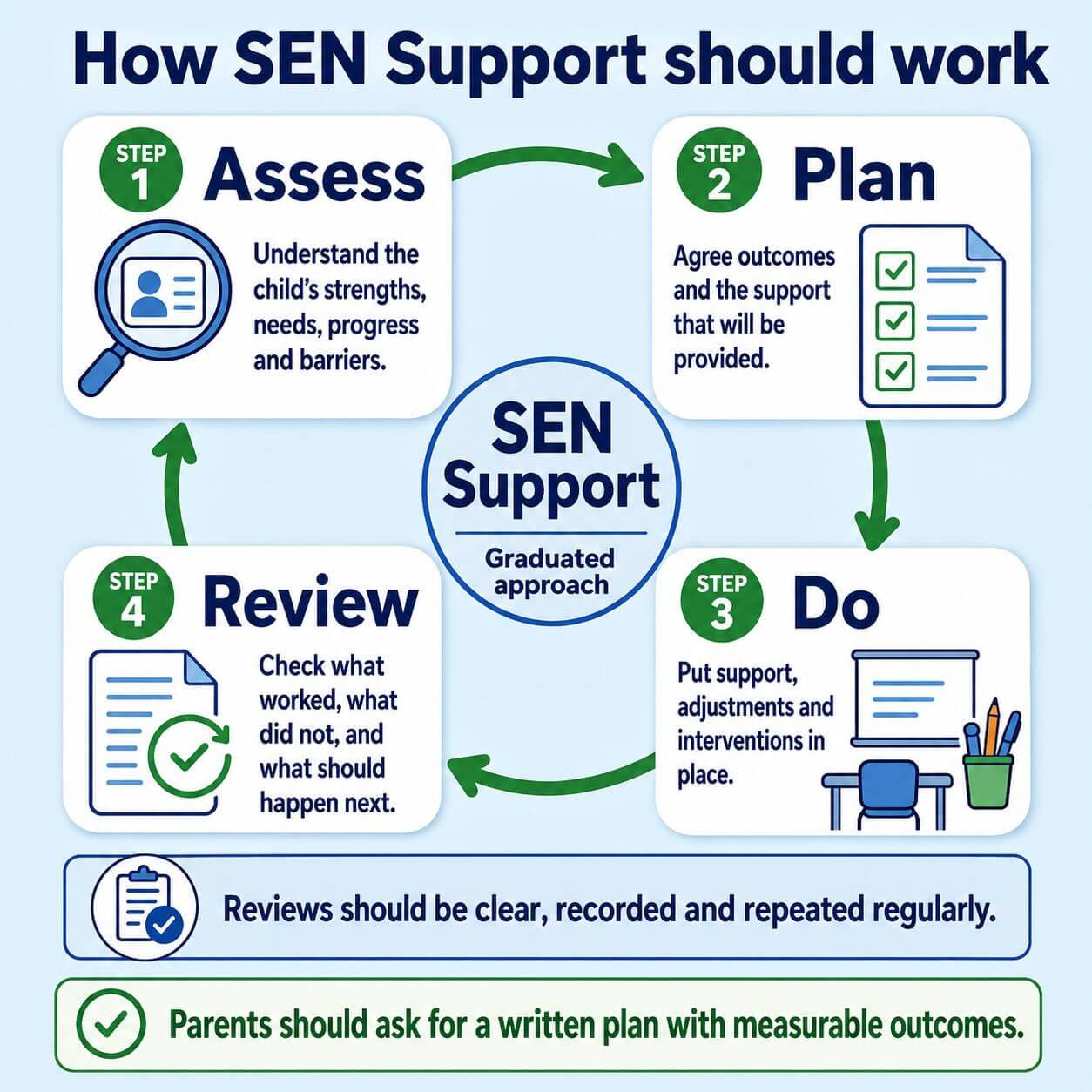
Oxfordshire schools use a graduated approach known as:
- Assess – understand the child’s strengths, needs, progress and barriers.
- Plan – agree outcomes and support with parents and the child or young person where appropriate.
- Do – put the support and adjustments in place.
- Review – check what has worked, what has not worked and what should happen next.
Oxfordshire Schools describes this graduated response as a four-step cycle of Assess, Plan, Do and Review, and says reviews should be structured, focused and held at least three times a year.
SEN Support might include:
- adapted teaching
- visual timetables
- individual or small-group intervention
- communication strategies
- sensory or movement breaks
- specialist equipment
- advice from an educational psychologist, specialist teacher, speech and language therapist or another professional
- changes to routines, environment or expectations
- support with social communication or emotional regulation
Teaching assistants and specialists may be involved, but the class or subject teacher remains central to the child’s day-to-day learning.
Oxfordshire’s Ordinarily Available SEND Provision
Oxfordshire uses the Ordinarily Available SEND Provision toolkit to describe support that mainstream schools and settings should usually be able to provide through high-quality teaching, reasonable adjustments and SEN Support.
This matters because parents can ask how the support being offered matches the child’s needs and what ordinarily available provision has already been tried.
Oxfordshire’s SEN Support page says schools use the SEND ordinarily available toolkit and SEND indicators tool to help decide what support a child may need.
What should parents ask for?
In a meeting with the teacher, SENCO or SEND lead, ask:
- What needs have been identified?
- What assessments have been completed?
- Is my child recorded as receiving SEN Support?
- What provision will be delivered?
- How often will it happen?
- Who will deliver it?
- What outcomes are being worked towards?
- How will progress be measured?
- When will the plan be reviewed?
- Is specialist advice needed?
- What can we do at home that links with the school plan?
Try to secure a written plan. Provision should be clear. Phrases such as “regular support” or “help when needed” are harder to review than specific wording such as “three 20-minute phonics sessions a week” or “daily visual timetable check-in”.
After a meeting, send a short email confirming what you understand was agreed, who will take each action and when the next review will happen.
What to bring to a SENCO meeting
You do not need a perfect evidence file, but it helps to bring:
- your main concerns in writing
- examples of what happens at home or school
- school reports or assessment results
- attendance records
- behaviour, suspension or exclusion letters if relevant
- previous SEN Support plans or reviews
- health visitor, GP, therapy or paediatric reports
- examples of schoolwork
- emails and meeting notes
- your child’s views, strengths and hopes
- questions you want answered
A short diary can be useful where difficulties fluctuate. Record dates and specific examples rather than trying to write down everything.
Education, health and social care: how the routes fit together
SEND support can involve education, health and social care at the same time.
| Area | Examples | Where to start |
|---|---|---|
| Education | SEN Support, adapted teaching, specialist advice, EHCPs, school transport | Teacher, SENCO, tutor, college support team, Oxfordshire SEND Local Offer |
| Health | Speech and language therapy, occupational therapy, physiotherapy, community paediatrics, CAMHS | Health visitor, GP, school, nursery, relevant Oxford Health referral route |
| Social care | Short breaks, disabled children’s support, family support, equipment, adaptations, carer’s assessment | Oxfordshire social care routes, Local Offer, school or family-support professional |
You do not have to wait for one process to finish before starting another. For example, a school can put SEN Support in place while a health referral is pending.
Accessing health and therapy services
Oxfordshire’s health offer includes speech and language therapy, occupational therapy, physiotherapy, community paediatrics and mental-health support.
Parents concerned about speech, language, motor skills, sensory processing, emotional wellbeing or daily functioning should speak to the school, nursery, health visitor, GP or another involved professional. Referral routes vary by service.
Oxford Health’s Children’s Integrated Therapies referral page says occupational therapy referrals are accepted from health, education, social care and community services, and currently states that occupational therapy does not offer input or assessment where the only concern is sensory regulation.
Mental-health support and CAMHS
If emotional or mental-health difficulties are persistent and significantly affect everyday life, speak to the GP, school nurse, teacher, SENCO or another professional about the right route.
Oxford Health publishes information about the Oxfordshire CAMHS referral route and gives 01865 902515 as the Oxfordshire Single Point of Access number. Families and young people should check the current referral page before contacting the service because referral routes vary by age and need.
Call 999 if someone is in immediate danger. For urgent help that is not a 999 emergency, use NHS 111 or the relevant local mental-health crisis route.
When might an EHCP be needed?
An Education, Health and Care Plan, usually shortened to EHCP, is a legal document. It describes a child or young person’s special educational needs, the outcomes being pursued and the provision that must be made.
An EHC needs assessment might be considered where:
- a child is making limited progress despite sustained and relevant SEN Support
- needs are complex or long term
- several education, health or social-care services need to coordinate support
- the provision required may be beyond what the setting can ordinarily provide
- specialist provision may be needed
A school or college will often make the request after gathering evidence through SEN Support. However, parents can apply directly and do not need the school’s permission. A young person aged 16–25 can also request an assessment. GOV.UK says an EHC plan is for children and young people up to 25 who need more support than is available through SEN Support.
How to request an EHC needs assessment in Oxfordshire
Oxfordshire allows families to start an EHC needs assessment request through the Children’s Portal. The council says it will tell families within six weeks if it will carry out an EHC needs assessment.
Useful evidence may include:
- current SEN Support plans
- reviews showing what has and has not worked
- information about progress and attainment
- attendance or exclusion records
- reports from teachers and specialists
- therapy, medical or psychology reports
- evidence of support already tried
- the child or young person’s views
Oxfordshire also asks families to create an All About Me profile, which can describe the child’s strengths, difficulties, support needs and hopes for the future.
An EHC needs assessment does not automatically lead to an EHCP. The council may decide the child’s needs can be met through SEN Support or other services.
If an EHCP is issued, Oxfordshire says the whole process can take up to 20 weeks from the point of requesting an assessment.
Reviewing an EHCP
Once an EHCP is issued, it must be reviewed regularly.
Oxfordshire says an EHC plan is formally reviewed each year, with informal but important termly review with the school or college. For children under five, the plan should be reviewed at least every three to six months to check whether provision remains appropriate.
Reviews should consider whether the plan still describes the child’s needs accurately, whether provision is being delivered, whether outcomes are still right and whether changes are needed.
Preparing for adulthood
For young people with an EHCP, preparing for adulthood becomes a key part of reviews from Year 9.
Oxfordshire says preparing for adulthood starts in Year 9, or earlier, and should cover life after school.
Planning should consider:
- further education or training
- employment
- independent living
- friendships and community participation
- health and wellbeing
- travel and independence
- adult social-care pathways where relevant
Families may also need to think about benefits, supported employment, travel training, adult health services and how the young person will take part in future decisions.
Help beyond education
SEND support is not limited to lessons and exams.
Depending on the child’s needs and family circumstances, support may include:
- early help
- disabled children’s social care
- short breaks
- leisure and activity support
- equipment or adaptations
- help preparing for adulthood
- support for young carers or parent carers
Oxfordshire’s social-care overview for children aged 5–15 describes routes into social care, including short breaks, equipment and adaptations, and specialist care. It says short breaks aim to give children and young people with SEND opportunities to spend time away from families, meet others and have fun.
Parents caring for a disabled child can also ask for their own needs to be considered as part of a family assessment or through a separate carer’s assessment. Oxfordshire’s carers assessment page says if you care for a child with a disability, your needs can be considered as part of the family assessment or through a separate carer’s assessment.
Does an EHCP provide free school transport?
No. An EHCP does not automatically entitle a child to free school transport.
Oxfordshire says travel support may be considered where a child’s mobility challenges or health and safety issues related to SEND mean they cannot reasonably walk to school, provided the school is the nearest school that meets their needs.
This matters when parents express a preference for a school. If a parent chooses a school further away even though a nearer school can meet the child’s needs, the parent may be responsible for travel arrangements. Oxfordshire’s phase-transfer guidance says most children with SEND do not receive local-authority transport assistance and that choosing a more distant setting may require parents or carers to arrange their own transport.
Transport support can include arranged transport, help with public transport or, in some cases, a personal travel budget or direct travel payment. The details depend on eligibility and the child’s circumstances.
What if support is not working?
Try to identify exactly what has gone wrong, because different problems have different routes.
If the concern is about school support, start with the teacher and SENCO. If the issue continues, ask for the headteacher or follow the school or academy trust complaints process.
If the concern is about a council service, use the relevant Oxfordshire County Council complaints process.
If the disagreement is about an EHC needs assessment, the decision not to issue an EHCP, the contents of a plan or the named setting, mediation and the SEND Tribunal may be relevant.
GOV.UK says that, in most cases, parents or young people must speak to a mediation adviser before appealing an EHC plan decision. It also says the tribunal must normally receive an appeal within two months of the local authority’s decision letter or one month from the date of the mediation certificate, whichever is later.
You do not have to consider mediation if the appeal is only about the school or other institution named in Section I of the EHC plan.
Decision letters contain important deadlines. If you are considering mediation or appeal, get advice promptly.
Where can parents get independent SEND advice?
SENDIASS Oxfordshire provides free, confidential and impartial information, advice and support to parents, carers, children and young people.
SENDIASS Oxfordshire says it supports parents and carers of children and young people with SEND, and children and young people themselves, to become equal partners in decision-making.
Current published contact details include:
- Telephone: 01865 810516
- Text: 07786 524294
- Telephone hours on the council contact page: weekdays, 9.30am–2.30pm, with answerphone outside those hours
The county council’s SENDIASS contact page lists the phone number, text number and postal contact details.
SENDIASS can help families understand SEN Support, prepare for meetings, think about an EHC needs assessment, understand annual reviews and consider options when there is a disagreement.
A parent’s ten-step starting checklist
- Write down your concerns with specific examples.
- Speak to the health visitor, key person, teacher or tutor.
- Ask for a meeting with the SENCO or SEND lead.
- Read the setting’s SEN Information Report.
- Ask what needs have been identified and what assessments are planned.
- Ask whether your child is recorded as receiving SEN Support.
- Agree a written support plan with measurable outcomes.
- Set a review date and keep copies of every document.
- Pursue relevant health referrals in parallel where needed.
- Contact SENDIASS if you need impartial advice.
Frequently asked questions
Does my child need a diagnosis for SEN Support?
No. A diagnosis can help, but SEN Support should be based on the child’s identified needs and the effect those needs have on learning and participation.
Who should I speak to first about SEND in Oxfordshire?
For a child under five, start with the health visitor and early-years setting. For a child at school, start with the teacher or tutor and ask for the SENCO. For a young person at college, ask the tutor, student-support team or SEND lead.
What is SEN Support?
SEN Support is help provided by a nursery, school or college when a child or young person needs support that is additional to, or different from, what is normally available. In Oxfordshire, schools use the graduated Assess, Plan, Do, Review approach.
When should parents ask for an EHC needs assessment?
Parents may consider an EHC needs assessment where a child is not making progress despite sustained and relevant SEN Support, has complex or long-term needs, or may need provision beyond what the education setting can ordinarily provide.
Can parents request an EHCP assessment themselves?
Yes. Parents can request an EHC needs assessment directly. A young person aged 16–25 can also request an assessment. Oxfordshire requests can be started through the Children’s Portal.
How long does an EHC needs assessment decision take?
Oxfordshire says it will tell families within six weeks whether it will carry out an EHC needs assessment. If the process leads to an EHCP, the whole process can take up to 20 weeks from the point of requesting an assessment.
Does an EHCP mean free school transport?
No. An EHCP does not automatically mean free transport. Oxfordshire considers transport support where SEND-related mobility, health or safety needs mean the child cannot reasonably walk to school, and the school is the nearest suitable school.
Where can Oxfordshire parents get SEND advice?
SENDIASS Oxfordshire provides free, confidential and impartial information, advice and support to parents, carers, children and young people.
Useful official links
- Oxfordshire SEND Local Offer
- Oxfordshire guidance on whether a child has SEND
- Oxfordshire SEN Support in mainstream schools
- Oxfordshire Ordinarily Available SEND Provision
- Request an EHC needs assessment in Oxfordshire
- Reviewing an EHC plan
- Oxfordshire SEND transport guidance
- Oxfordshire social care and short breaks information
- SENDIASS Oxfordshire
- GOV.UK SEND guide for parents and carers
- GOV.UK SEND Tribunal appeal guidance
The bottom line
Parents in Oxfordshire do not need to wait for a diagnosis, know every acronym or solve the whole system before asking for help.
Start with the person closest to your child’s learning: the health visitor, early-years key person, teacher, tutor or SENCO. Ask what has been noticed, what support can start now, how progress will be reviewed and what should happen next.
If the support is not enough, keep records, ask for reviews and seek advice early. For many children, SEN Support will be the right route. For others, an EHC needs assessment may be needed. The first step is not to know the answer — it is to get the conversation started.