There is no research-backed birthday at which every child becomes ready for a smartphone. The more useful question is what the child needs the device to do, and which functions they can manage safely.
That distinction matters as families prepare for a significant change in schools. From 1st September 2026, schools in England should begin following statutory guidance that says they should be mobile-phone-free by default throughout lessons, breaktimes, lunchtime and the time between classes.
The guidance applies to Oxfordshire schools, but it does not ban children from owning phones or necessarily prevent them from carrying one on the journey to school. Each school or trust remains responsible for deciding how phones are stored, how its policy is enforced and when an exception or reasonable adjustment is needed.
The main points for parents
- No clinical or scientific body has established one universally safe age for a first smartphone.
- A basic phone, a managed smartphone and a social-media account are three separate decisions.
- A child may need calls, maps or a health app without needing unrestricted browsing, an app store or algorithmic social feeds.
- Keeping phones outside bedrooms overnight is one of the clearest practical ways to protect sleep.
- The Smartphone Free Childhood ages of 14 for smartphones and 16 for social media are voluntary campaign goals, not medical thresholds.
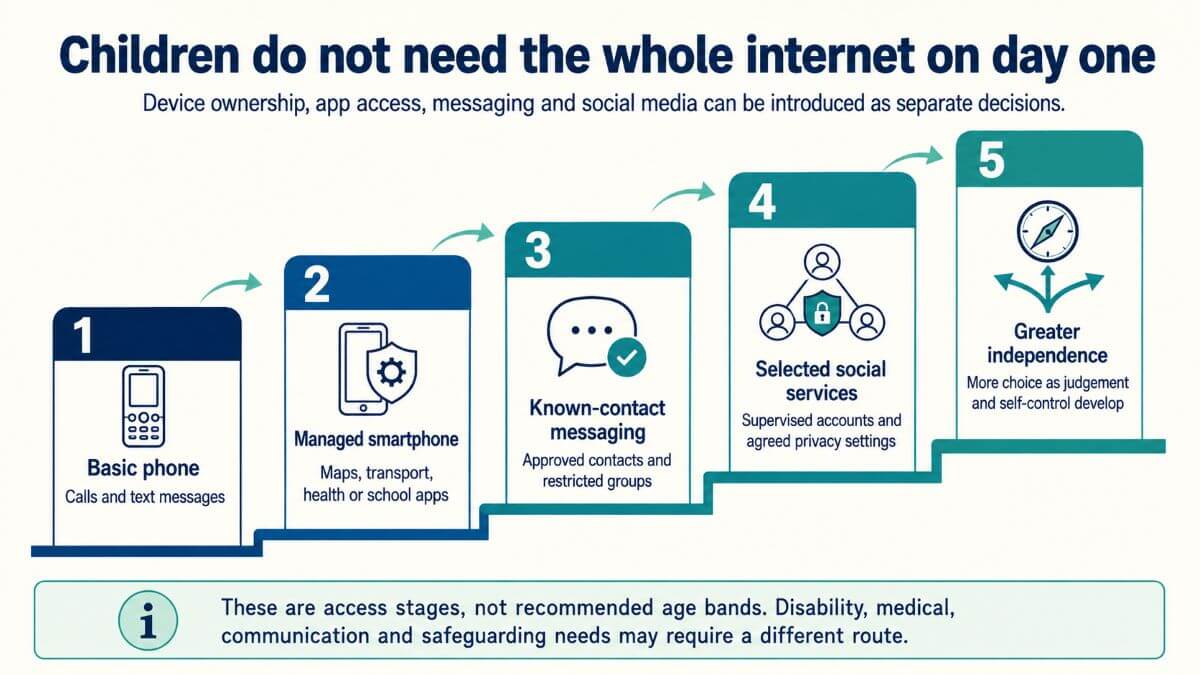
- Families should begin with the minimum access that meets the child’s need and expand it gradually.
Exceptions may be necessary where a child uses a connected device for disability, communication, medical monitoring, safeguarding or caring responsibilities.
What changes in English schools from 1 September 2026?
The Department for Education’s mobile-phone guidance became statutory on 29 June 2026 and applies in England. It says schools should begin following it from 1 September.
Schools are expected to develop a policy that prevents pupils from accessing mobile phones and similar smart technology throughout the school day. This includes lessons, movement between lessons, breaktimes and lunch.
The guidance does not prescribe one storage system. A school may require phones to remain switched off and inaccessible, place them in lockers or collect them at the start of the day. Parents who need to contact a child during school hours should normally do so through the school office.
Schools must still meet their legal duties towards individual pupils. A disabled child may require phone access as a reasonable adjustment, while a pupil with diabetes may use a phone linked to a continuous glucose monitor. Schools should also consider individual circumstances such as young caring responsibilities and the safety of journeys to and from school.
For Oxfordshire parents, the practical first step is therefore to check the school’s own policy. It should explain:
- Whether pupils may bring a phone onto the site
- Where the phone must be kept
- What happens if it rings or is used
- How parents can contact children during the day
- How medical, disability and safeguarding exceptions are handled
- Whether sixth-form pupils have different arrangements
What is happening in Oxfordshire?
There is no Oxfordshire-wide ban on children owning smartphones. Local schools come under the new guidance for England, but each school or academy trust decides how to put it into practice.
Oxfordshire also has local activity connected with Smartphone Free Childhood, a parent-led movement that encourages families to delay smartphones and social media together. St Swithun’s CE Primary School in Kennington, for example, publicly supports the movement and provides parents with school-specific information and resources.
Oxford City Council has not adopted a city-wide school smartphone ban. Motions proposing council support for stronger restrictions were brought forward in March and July 2025, but neither was debated because the meetings ran out of allocated time.
The county also has a direct connection to the research debate. Work by researchers associated with the Oxford Internet Institute has challenged sweeping claims about screen use. One large 2019 analysis of 355,358 adolescents found a negative but small association between digital-technology use and wellbeing, accounting for no more than 0.4% of the variation examined.
What age should a child get a smartphone?
There is no single age that is right for every child.
Readiness depends on why the device is needed, the child’s self-control and vulnerability, the services that will be available and the level of supervision a family can realistically provide.
Parents can make a better decision by separating the device from its individual functions.
| What the child needs | Lowest-access option to consider | Access that can wait |
|---|---|---|
| Calling or texting home | Basic call-and-text phone | Browser, app store and social media |
| Help on an independent journey | Basic phone, managed watch or restricted smartphone | Public profiles and unrestricted downloads |
| Maps or transport information | Managed smartphone with approved apps | Algorithmic feeds and open web access |
| Medical or accessibility support | Device configured around the required service | Unrelated entertainment and social apps |
| Contact with known friends | Approved contacts or a restricted messaging service | Public posting and contact from strangers |
| Homework or school platforms | School-provided technology or supervised family device | A personal social-media account |
A phone that can make calls is not automatically a smartphone. A smartphone does not need to contain social media. Allowing a messaging app does not require allowing public profiles, live streaming or recommendation feeds.
This staged approach gives parents more options than a simple choice between total prohibition and unrestricted access.
Why so many children get a phone at secondary-school age
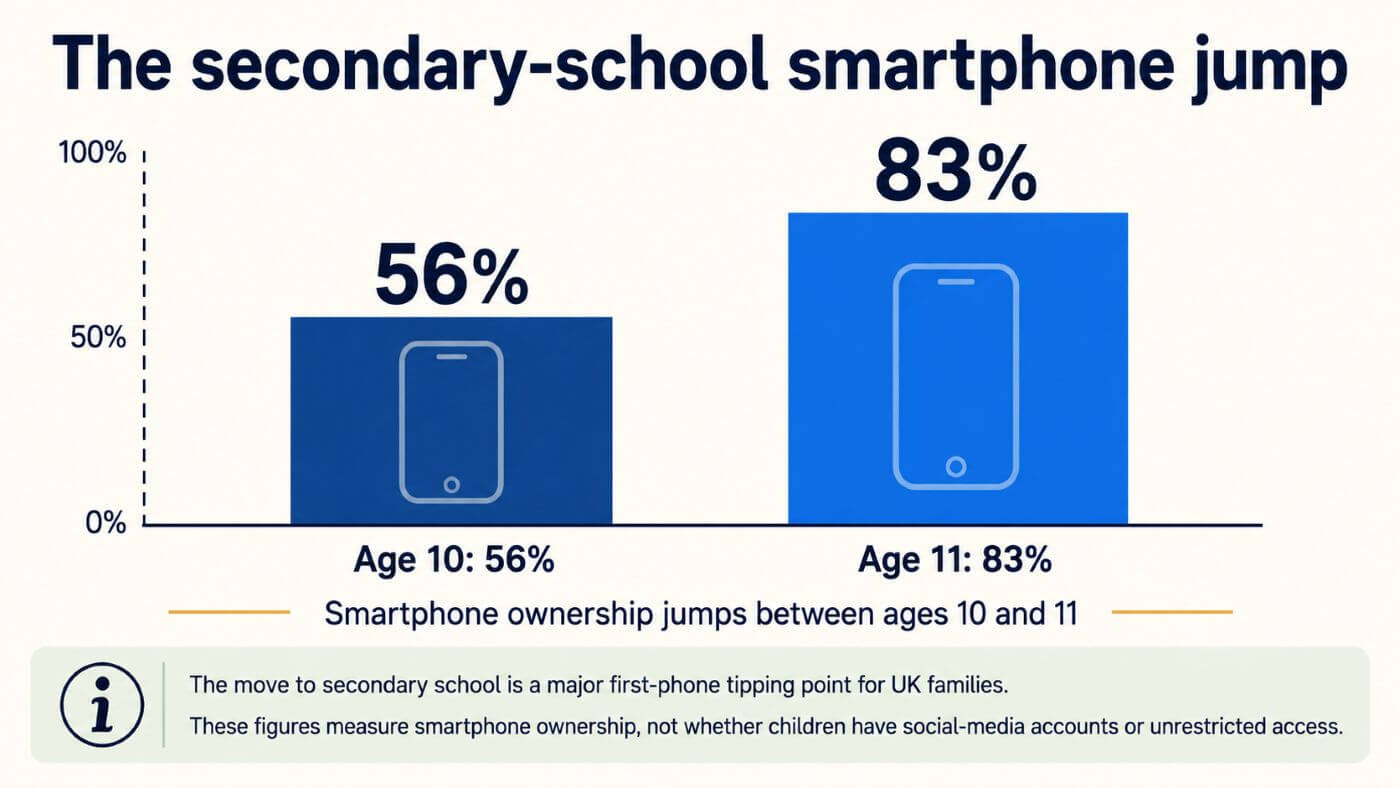
Ofcom’s 2026 research found that smartphone ownership rose from 56% among 10-year-olds to 83% among 11-year-olds. The move to secondary school remains a major tipping point.
Part of that rise reflects practical need. Children may travel further, use public transport and spend more time away from their parents.
Peer pressure matters too. A family may buy a smartphone earlier than planned because class arrangements, parties and friendship groups are moving onto messaging apps. This creates a collective problem: parents may privately prefer to delay while fearing that their child will be the only one left out.
That tension helps explain the appeal of parent pacts and school-wide agreements. They attempt to change the group expectation rather than leaving every family to resist it alone.
What kind of evidence are we looking at?
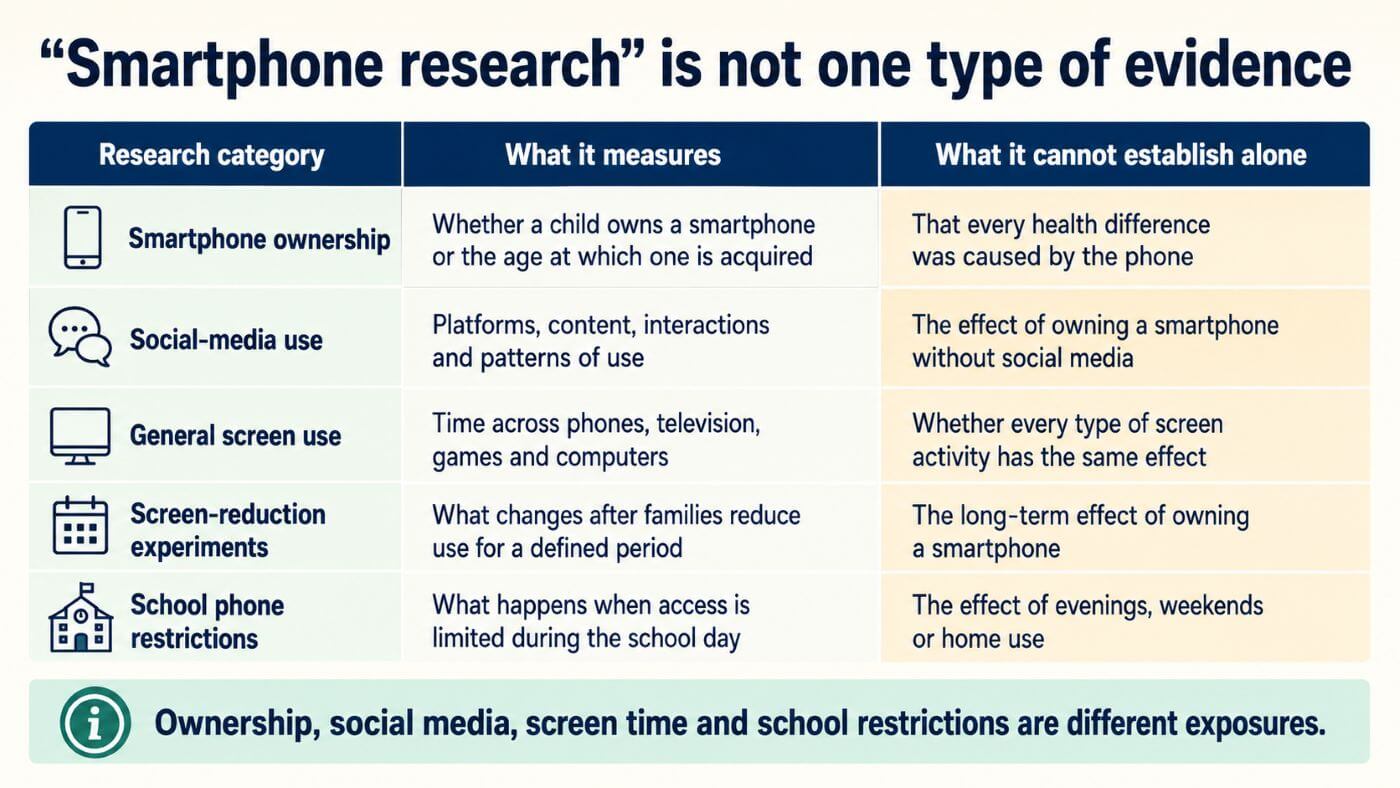
“Research on smartphones” is not one body of evidence. Different studies investigate different exposures and cannot be treated as though they answer the same question.
| Research subject | What it examines | Main limitation |
|---|---|---|
| Smartphone ownership | Whether having a device, or acquiring one earlier, is associated with health or behaviour | Usually observational; families are not randomly assigned phones |
| Social-media use | Content, interactions, platform features and patterns of use | Effects differ by child, platform and type of activity |
| General screen use | Time spent across phones, computers, games and television | Does not isolate smartphones or distinguish every activity |
| Family screen reduction | What changes when households reduce leisure screen use | Experiments are usually short and intensive |
| School phone policies | What happens when access is restricted during the school day | Does not establish the effect of ownership or out-of-school use |
This distinction helps explain why apparently conflicting findings can all be credible. A study of owning a smartphone at age 12 is not testing the same thing as a study of total screen time, late-night social-media use or a phone-free school day.
What does research say about mental health?
The evidence supports caution, but not a claim that smartphones alone caused the deterioration in adolescent mental health.
A consensus review by the US National Academies concluded that the published evidence did not support a population-level causal conclusion about social media and adolescent health. It also rejected the idea that social media is uniformly harmless. Online experiences can provide support, information and connection while also exposing young people to harassment, harmful comparisons, disrupted sleep and compulsive platform features.
The American Psychological Association takes a similarly conditional position. It advises parents to consider the child, the content being viewed, the platform’s design and the way social media is used. It recommends closer adult monitoring in early adolescence and limits that protect sleep and physical activity.
Newer evidence has added reasons for concern. A 2026 Pediatrics study found that smartphone ownership was associated with depression, obesity and insufficient sleep in early adolescence. Because the research was observational, it cannot establish that ownership caused each outcome or rule out all alternative explanations.
This does not necessarily contradict the Oxford study that found a small average association between broad digital-technology use and wellbeing. The studies measured different exposures and outcomes. One examined smartphone ownership during a specific developmental period; the other examined digital use more broadly across a very large population.
The reasonable conclusion is neither “phones are harmless” nor “phones inevitably cause mental illness”. Risk is likely to depend on the child, the timing of access, what the device is used for and whether it begins to displace important parts of life.
Problematic use can matter more than a single time limit
Total screen time is a blunt measure.
Video-calling a grandparent, creating music, reading about a hobby and scrolling an appearance-focused feed may all count as screen use, but they are not equivalent experiences.
The World Health Organization’s Health Behaviour in School-aged Children study surveyed almost 280,000 young people across 44 countries and regions. It found that signs of problematic social-media behaviour increased from 7% in 2018 to 11% in 2022. Girls reported it more frequently than boys, at 13% compared with 9%.
The WHO describes problematic use through addiction-like signs such as loss of control, withdrawal, neglect of other activities and continued use despite negative consequences.
Parents should therefore look beyond an hourly total and ask whether the child:
- Repeatedly uses an app for longer than intended
- Becomes distressed when unable to check it
- Lies or hides activity to retain access
- Gives up hobbies, exercise or face-to-face friendships
- Continues despite harm to sleep, schoolwork or relationships
- Says they want to stop but feels unable to do so
Sleep is one of the clearest practical concerns
Digital-device use has been linked with later bedtimes, shorter sleep and poorer sleep quality, particularly where use is problematic or continues late at night. A 2025 umbrella review synthesised seven reviews covering 127 primary studies and more than 867,000 participants. It found an overall negative association, while also noting substantial variation between studies and heavy reliance on self-reported data.
Several mechanisms may operate at once. A device can delay bedtime, generate notifications after lights-out or provide emotionally stimulating content that makes disengagement difficult.
The simplest household protection does not require a complicated monitoring system: charge phones outside bedrooms overnight. That removes the opportunity for a late-night message, argument or feed to interrupt sleep.
Can reducing screen use improve wellbeing?
Some experimental evidence suggests it can, although the evidence remains limited.
In a two-week Danish randomised trial involving 89 families and 181 children and adolescents, participating households reduced leisure screen-media use to no more than three hours a week per person and handed over smartphones and tablets. The intervention group showed improvements in behavioural difficulties, particularly internalising symptoms and positive social behaviour.
The study provides evidence that an intensive short-term family reduction can produce benefits. It does not show whether the effects persist, whether a smaller and more practical reduction would work as well or which part of the intervention made the greatest difference.
It also studied general leisure screen media rather than smartphone ownership alone.
Smartphones can provide genuine benefits
A connected device may help a child navigate, contact family, manage a medical condition, learn, create and maintain friendships. Online communities can be particularly valuable for some disabled young people, young carers, children with uncommon conditions and teenagers who feel isolated in their immediate surroundings.
The National Academies review noted that social media can provide support, education and opportunities to develop interests, while the WHO found that heavy but non-problematic users reported stronger peer support and social connections.
The question is therefore not whether smartphones are universally good or bad. It is whether a particular service is helping or harming a particular child, at a particular time, under particular conditions.
Do school phone restrictions work?
Phone-free school policies can create a clear boundary around lessons and social time. They can remove interruptions, reduce opportunities to record other pupils and make it harder for group-chat disputes to follow children into every part of the day.
Evidence that restrictions alone improve attainment or mental health is less conclusive.
A 2024 scoping review identified 22 studies from 12 countries. It found no rigorous randomised controlled trials and concluded that the existing evidence did not establish that one standard type of ban consistently improves academic outcomes, wellbeing or cyberbullying. Definitions and enforcement varied substantially between schools.
The English SMART Schools study compared pupils at 30 secondary schools. Restrictive policies reduced phone and social-media use during school, but were not associated with lower use across the whole week or with better mental wellbeing, sleep, physical activity, classroom behaviour or English and maths attainment. The study was cross-sectional, so it cannot supply the final answer either.
A phone-free school day may still be worthwhile as a learning and behavioural boundary. It should not be presented as a complete treatment for compulsive use, poor sleep or adolescent distress outside school.
Governments around the world are nevertheless moving in this direction. UNESCO reported in March 2026 that 114 education systems—58% of those monitored—had a national school-phone ban or restriction. The policies range from lesson-only rules to full-day collection and national requirements for individual schools to adopt their own restrictions.
What is changing for social media in the UK?
The Government announced in June 2026 that social-media companies would be prevented from offering designated services to children under 16.
The restriction is not yet in force. The Government intends to lay the first regulations before Parliament by the end of 2026 and expects the under-16 restrictions to take effect in spring 2027. The final regulations will determine which services and functions are covered and how age assurance will work.
Separate default protections are planned for 16- and 17-year-olds. These include restrictions between midnight and 6am, muted overnight notifications, and autoplay and personalised feeds switched off by default. Young people aged 16 and 17 would be able to change those settings.
This planned regime concerns access to designated social-media services. It is not a clinical finding that every child becomes ready at 16, and it is not a general ban on under-16s owning phones.
Should parents wait until 14?
Smartphone Free Childhood asks parents to delay smartphones until at least 14 and social media until 16. Its Parent Pact is designed to help families act together and reduce the fear that one child will be excluded while everyone else receives a phone.
Those ages are a campaign position, not a medical rule. Research has not established that 14 is universally safe or that every child below 14 will be harmed.
The pact may still provide a useful precautionary social norm. Parents should understand what it represents: a voluntary collective commitment, rather than a diagnosis of individual readiness.
Five questions to ask before buying
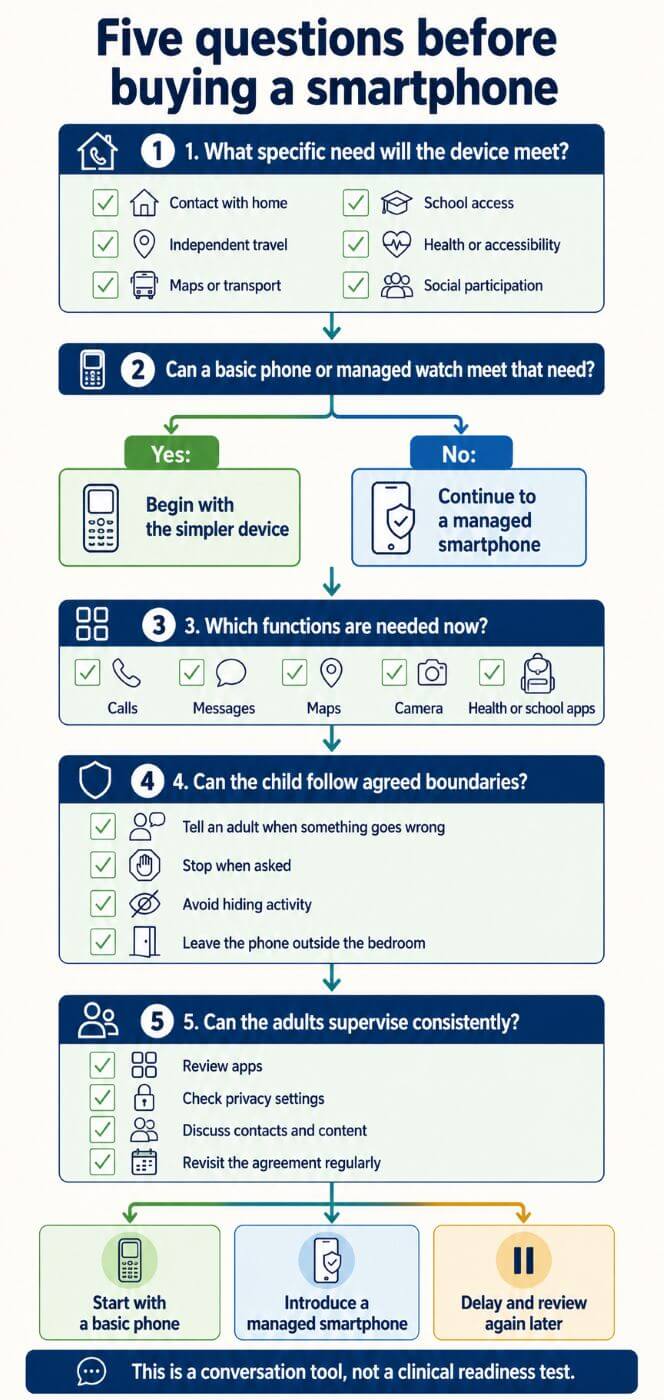
1. What problem will the device solve?
Write down the specific need. “Everyone else has one” may be a real social concern, but it is different from needing emergency contact, maps or health monitoring.
2. Can a simpler device meet that need?
A basic phone or restricted watch may provide contact without an app store, unrestricted browser or algorithmic social feeds.
3. Can the child follow agreed boundaries?
Consider whether the child can stop an activity, tell an adult when something goes wrong and use the device without repeatedly hiding behaviour.
4. Can the phone stay outside the bedroom?
A child who cannot yet tolerate overnight separation from the device may not be ready for unrestricted access.
5. Can the adults provide consistent supervision?
Parental controls are not a substitute for conversation. Families need enough time and confidence to review apps, privacy settings, contacts and emerging problems.
These questions should guide discussion rather than produce a pass-or-fail score.
A practical staged approach
Before handing over the device
Agree what the phone is for, who owns it, who can install apps and what would trigger a review. Check the school policy and decide how the child will contact home during school hours.
Begin with essential functions
Enable calls and messages to approved contacts. Add maps, transport, school or health services only where needed. Keep unrestricted browsing, independent app installation and public social-media accounts disabled initially.
Use a child account with suitable content, privacy and purchase controls. Turn off non-essential notifications, autoplay and personalised recommendations where possible.
Set household rules in advance
Keep phones outside bedrooms overnight and protect meals, homework and family conversations from interruptions.
Discuss photographs, forwarding private messages, adding people to groups, location sharing and contact with strangers. Adults should follow visible rules too; children will notice if every family conversation competes with a parent’s screen.
Make it safe for a child to report a mistake or frightening contact. An automatic threat to confiscate the device indefinitely can encourage secrecy when disclosure matters most.
Review access as the child develops
Ask what the child enjoys, which interactions create pressure and whether they feel in control. Greater independence can be added in stages when the existing arrangements are working.
The aim is not permanent surveillance. It is to help a child develop judgement before all safeguards are removed.
Signs that phone use may be becoming harmful
Take a closer look when use is:
- Delaying sleep or causing night-time checking
- Replacing exercise, hobbies or in-person friendships
- Producing repeated conflict, secrecy or deception
- Exposing the child to bullying, sexual contact or harmful material
- Driving distressing appearance or status comparisons
- Damaging concentration, schoolwork or attendance
- Continuing despite the child saying they want to stop
A sudden change in mood or behaviour should not automatically be blamed on the phone. Bullying, family difficulties, school pressure and underlying physical or mental-health conditions may also be involved.
Speak with the child calmly, ask open questions and involve the school, GP or another suitable professional where necessary.
Where families can get urgent help
CEOP accepts reports concerning online sexual harm or grooming involving a child. A young person who needs confidential support can contact Childline free on 0800 1111. UK under-18s can also use Childline’s Report Remove service to seek the removal of sexual images shared online.
Where a child may be about to harm themselves or has seriously harmed themselves, call 999 or go to A&E. For urgent mental-health help that is not an immediate emergency, contact a GP for an emergency appointment or use NHS 111.
The bottom line
Parents do not need to identify a perfect birthday. They need to decide what access their child needs now, what can wait and what safeguards must come first.
For many younger children, a basic phone will be enough. Where a smartphone is justified, it can begin as a restricted tool rather than an unrestricted gateway to the internet.
Protect sleep, separate smartphones from social media, take the school’s rules seriously and expand access only when the child shows that they can manage what they already have.
Key sources and further reading
- Ofcom: Children’s online and media use, 2026
- National Academies: Social Media and Adolescent Health
- American Psychological Association health advisory
- WHO Europe: problematic social-media use among adolescents
- Orben and Przybylski: digital technology and adolescent wellbeing
- Pediatrics: smartphone ownership and early-adolescent health outcomes
- Danish randomised screen-reduction trial
- International scoping review of school phone bans
- SMART Schools study
- UNESCO global school-phone policy update, March 2026
- Department for Education: statutory mobile-phone guidance
- UK Government response on under-16 social-media restrictions
- Smartphone Free Childhood Oxfordshire Parent Pact