With Halloween coming up we explore Oxfordshire’s most haunted places. Ranging from a prisoner said to linger around Oxford Castle, a vanished nobleman beside the Windrush and a Banbury hotel with a supposedly cheerful resident ghost: Oxfordshire has no shortage of unsettling stories.
Some are attached to documented deaths and disappearances. Others belong to folklore passed between generations. There is no reliable league table of hauntings, but these six places offer some of the county’s most interesting ghost stories and supernatural legends, with the history and visiting arrangements to go with them.
Map of Oxfordshire’s haunted places
Explore the six locations on the map. Select a pin for the ghost story and visitor information.
Open the haunted Oxfordshire map in a larger window
Oxford Castle and Prison: Mary Blandy’s restless reputation
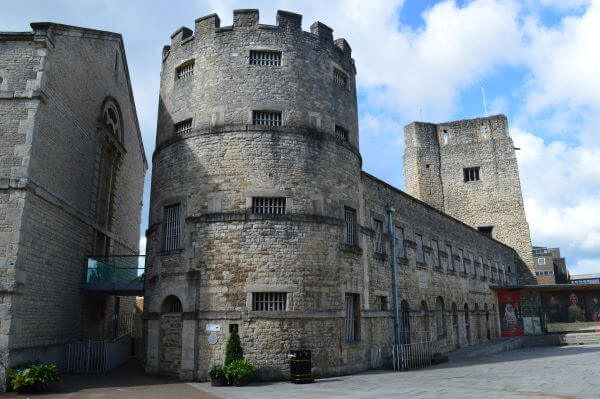
Mary Blandy’s story gives Oxford Castle a connection to one of the county’s best-known murder cases. She was imprisoned there after poisoning her father, Francis, and was convicted and executed in 1752.
According to the castle’s account of her life and legend, Blandy maintained that the powder supplied by her lover was intended to win her father’s approval of their marriage. It was arsenic.
The attraction records stories of her ghost appearing around the castle, including its mound. Her conviction and execution belong to the historical record; the later sightings are part of the castle’s haunted reputation. That distinction makes the story no less absorbing when set against the surviving prison buildings.
Visiting: Oxford Castle and Prison is a ticketed attraction in central Oxford. Use the official booking page to check tours and current admission options. The castle’s visitor information includes travel guidance.
Minster Lovell Hall: the lord who disappeared
The ruined hall beside the River Windrush has a mystery that does not need a ghost to make it compelling. Francis Lovell, an ally of Richard III, disappeared after the Yorkist defeat at Stoke Field in 1487.
In the version of the legend collected by Dark Oxfordshire, he returned to Minster Lovell and hid in a concealed room. A servant kept him supplied with food, but died before revealing the hiding place, leaving his master trapped.
Later stories tell of a skeleton discovered inside the building, while ghost accounts add footsteps, groans and the rustle of papers. The details vary between tellings, and the secret-room story should not be mistaken for an established explanation of Lovell’s fate.
The setting is real enough: English Heritage dates the hall to the 1430s and identifies Francis as one of its later residents.
Visiting: Entry is free during reasonable daylight hours. The dovecote can be viewed only from outside. Do not climb the ruins. There is no parking or turning at the end of the narrow access lane; check English Heritage’s directions before travelling.
Whately Hall, Banbury: a ghost with a friendlier manner
Not every Oxfordshire ghost is described as threatening. At Whately Hall on Horse Fair, the figure known as Father Bernard is said to move through the building smiling, humming or chuckling.
A Countrywide Hotels account, credited to The Banburian, connects the story with hidden staircases and the building’s association with priests seeking concealment. It also acknowledges uncertainty over how Father Bernard supposedly died.
That uncertainty matters. The hotel’s old interiors and stories of concealed passages provide the setting, but the priest’s identity, death and subsequent appearances belong to the legend rather than a securely established biography.
Visiting: Whately Hall is a working hotel, rather than a freely accessible historic house. Its current programme includes dining and seasonal events. Book the experience you want and ask staff about any historical areas you hope to see; guest rooms and service areas are not open for casual exploration.
St John’s College, Oxford: Archbishop Laud and the library footsteps
The most extravagant version of this college tale has Archbishop William Laud, beheaded in 1645, disturbing readers by kicking his own head along the library floor.
A 2017 Oxford University Press article makes an important qualification: library staff had not reported that spectacle in living memory. Instead, it describes readers’ accounts of footsteps advancing and retreating through the Laudian Library.
The result is a quieter story than the headless-archbishop version, and an example of how an old institution’s folklore can grow beyond what its staff actually report. The article’s recollections are historical accounts, not evidence of a newly investigated haunting.
Visiting: College visitor access does not automatically include the library. St John’s library admissions information sets out access by prior arrangement, including exhibitions and tours. Check the University’s college visitor guide before planning a visit.
Exeter College, Oxford: the ghost supposedly shut in a box
Exeter has a particularly unusual addition to Oxford’s ghost stories: a damaged stone figure said to have brought a haunting to an end.
Writing in the college’s Autumn 2009 magazine, home bursar Eric Bennett recounted a legend about a ghost that wandered the college at night. A stone figure was discovered during building work and placed in a sealed, glass-sided box in the chapel. After that, the ghost supposedly stopped appearing.
Bennett also supplied a more practical historical explanation: the damaged object was probably a tomb figure from the earlier Jacobean chapel. The tale works because the object and the supernatural explanation sit side by side, without one proving the other.
Visiting: Exeter’s current visitor policy restricts general public sightseeing to pre-booked tour groups outside term time. Contact the Porters’ Lodge before travelling. The 2009 article records the object’s location then; its present display has not been confirmed.
The Rollright Stones: a witch, a king and an impossible count
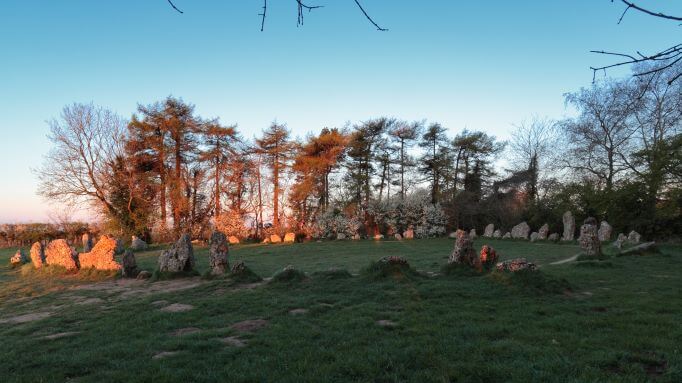
On the Oxfordshire–Warwickshire border, the Rollright Stones offer witchcraft folklore rather than a conventional resident ghost.
The Rollright Trust’s account tells of a king challenged by a witch to take seven strides and look for Long Compton. When a rising mound blocked his view, the witch turned him and his followers to stone.
Other traditions claim that the King’s Men cannot be counted three times with the same result, or that stones leave their places to drink. These stories explain the monuments through imagination. The prehistoric remains themselves comprise a stone circle, burial chamber and standing stone created at different times, as English Heritage explains.
Visiting: The Trust currently lists admission at £2 for adults and £1 for children aged seven to 16. Small private visits do not normally need booking, but organised activities require permission. Read its access conditions.
Autumn 2026 travel update: The Stones remain open, but the approach from the A44 is closed until 6 November 2026. Follow the Trust’s current diversion guidance.
Planning a visit to Oxfordshire’s haunted places
For a straightforward historic outing, Oxford Castle offers bookable tours, while Minster Lovell is a free daylight visit. The Rollright Stones combine an outdoor heritage site with a substantial body of folklore. The colleges and hotel need more advance planning because their everyday use takes priority over sightseeing.
Check the linked visitor information before setting out. A ghost story is an invitation to explore a place’s history, not permission to enter closed buildings, private rooms or restricted grounds.