

















From workshops and warehouses to cafés, schools and visitor venues, Oxfordshire employers still have legal duties around safety signs, PPE reminders and clear site layout. In a county with more than 32,000 enterprises and strengths in sectors including manufacturing, food and farming, visitor economy and future mobility, this is not a niche issue. It is a practical one for thousands of workplaces.
The key point is simple. Safety signs matter, but they are not the first line of defence. The Health and Safety Executive says signs are required only where a significant risk remains after other relevant control measures have been put in place. It also says signs must be clear and legible, and that using too many can cause confusion.
Key Details at a glance
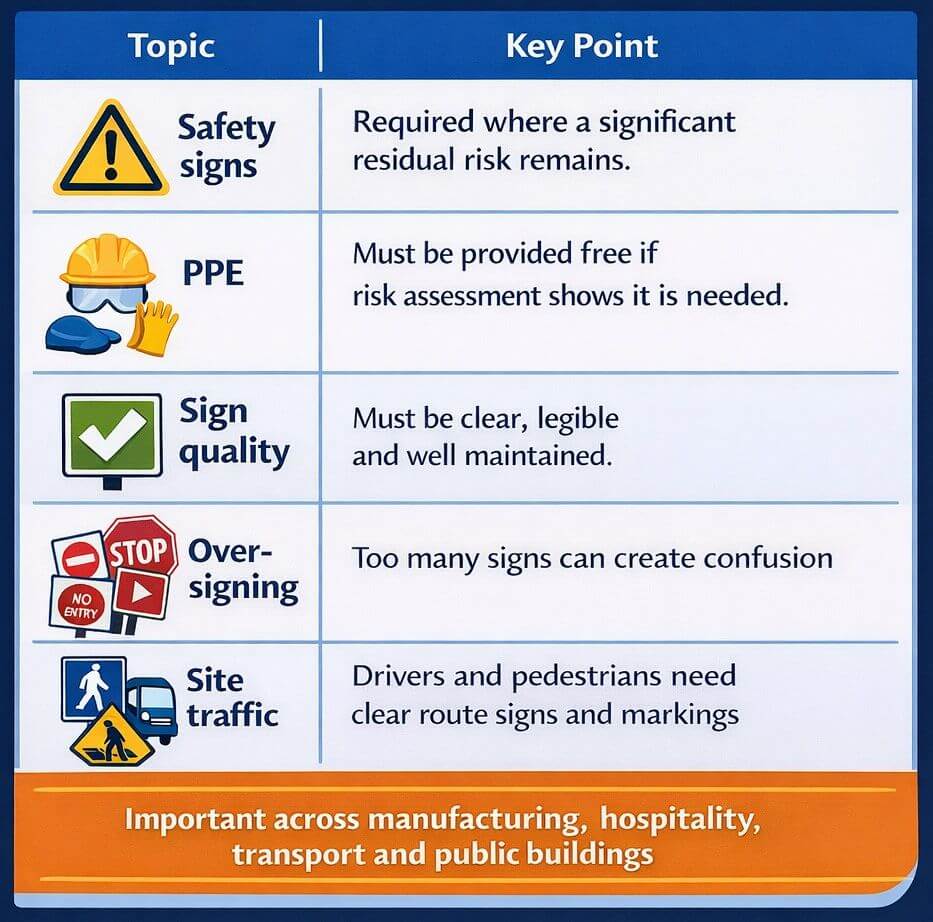
| Topic | Key point |
| Safety signs | Required where a significant residual risk remains |
| PPE | Must be provided free if risk assessment shows it is needed |
| Sign quality | Must be clear, legible and well maintained |
| Over-signing | Too many signs can create confusion |
| Site traffic | Drivers and pedestrians need clear route signs and markings |
| Oxfordshire relevance | Important across manufacturing, hospitality, transport and public buildings |
When safety signs are actually required
For many small businesses, this is where confusion starts. A sign is not a substitute for fixing a hazard, changing a layout or improving a safe system of work. Under HSE guidance, signs are there to support risk control where a meaningful risk still remains.
That means an employer should not think in terms of putting up more notices just to “cover” a problem. The real question is whether the sign helps people avoid harm after other controls have already been considered.
The four main types of safety signs most workplaces use
HSE guidance says workplace signs are commonly used to show prohibited actions, mandatory actions, warnings about hazards, and directions to fire exits, fire equipment or first-aid equipment. In practice, that means signs such as “No access”, “Hearing protection must be worn”, hazard warnings and clearly marked escape routes.
For Oxfordshire businesses, the relevance will vary by sector. A hospitality venue may need clear fire exit, cleaning chemical and kitchen warning signs. A warehouse may need forklift, pedestrian-route and loading-area signs. A school or public building may rely more on evacuation, first-aid and restricted-access signage. Those details will differ, but the principle is the same: the sign must be necessary, visible and easy to understand.
PPE signs are reminders, not the whole safety system
PPE signs are another area where employers sometimes get the balance wrong. HSE says employers must provide PPE free of charge if a risk assessment shows it is needed. That can include items such as helmets, gloves, eye protection, hearing protection, high-visibility clothing, safety footwear and respiratory protective equipment. Employers must also make sure PPE is properly assessed, maintained, stored and used correctly, with workers given the right information and training.
That means a “Wear eye protection” or “Hearing protection must be worn” sign is only one part of the picture. It may be an important reminder, but it does not remove the employer’s wider duties around assessment, provision and training.
Why route signs and markings matter in yards, depots and mixed-use sites
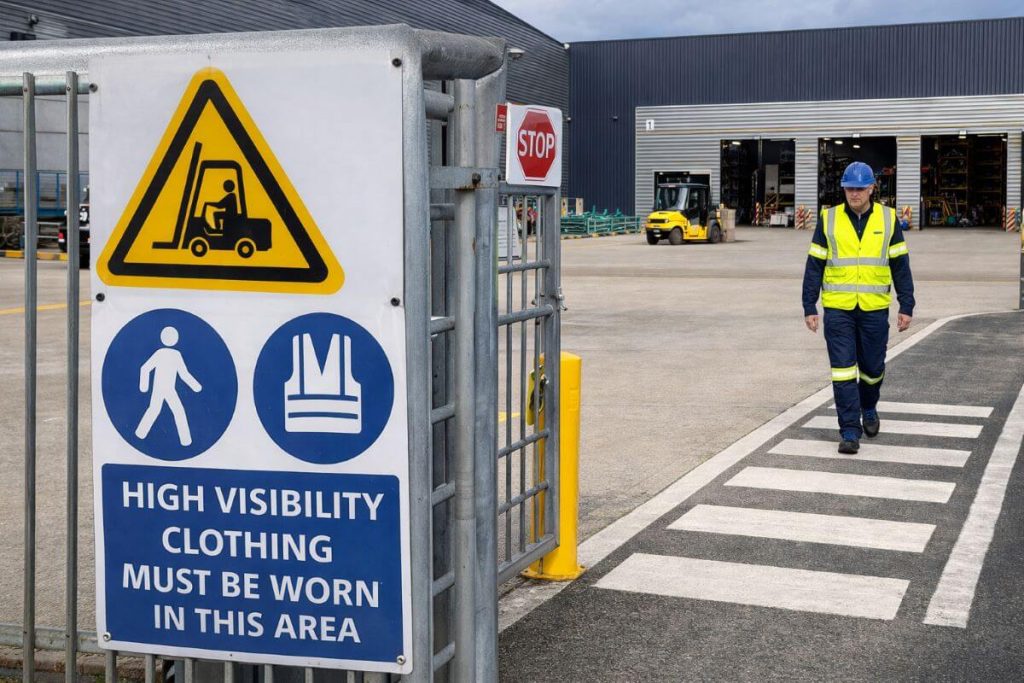
One of the most practical areas of safety signage is workplace transport. HSE says signs are needed to tell drivers and pedestrians which routes to use and how to behave safely, and route markings should show traffic lanes, route edges, junction priorities, stop lines, no-parking areas and pedestrian crossings. In private workplaces, road signs used to warn or inform drivers and pedestrians should match those used on public roads wherever a suitable sign exists.
That is especially relevant for Oxfordshire sites where vehicles and people move through the same space, including farm yards, industrial estates, logistics yards, school service roads, hospitality loading areas and visitor attractions. HSE also says signs should be positioned so people have time to see and understand them, and should be kept clean, well maintained and visible.
Common mistakes small employers still make
The most common error is treating signs as a substitute for proper risk control. The second is clutter. HSE explicitly warns against using too many signs, because an overload of notices can reduce clarity rather than improve it.
Other frequent problems include faded or damaged signs, notices positioned where people do not see them in time, and missing route signage where vehicles and pedestrians mix. In practical terms, a small number of well-placed, well-maintained signs is usually more effective than walls covered with warnings.
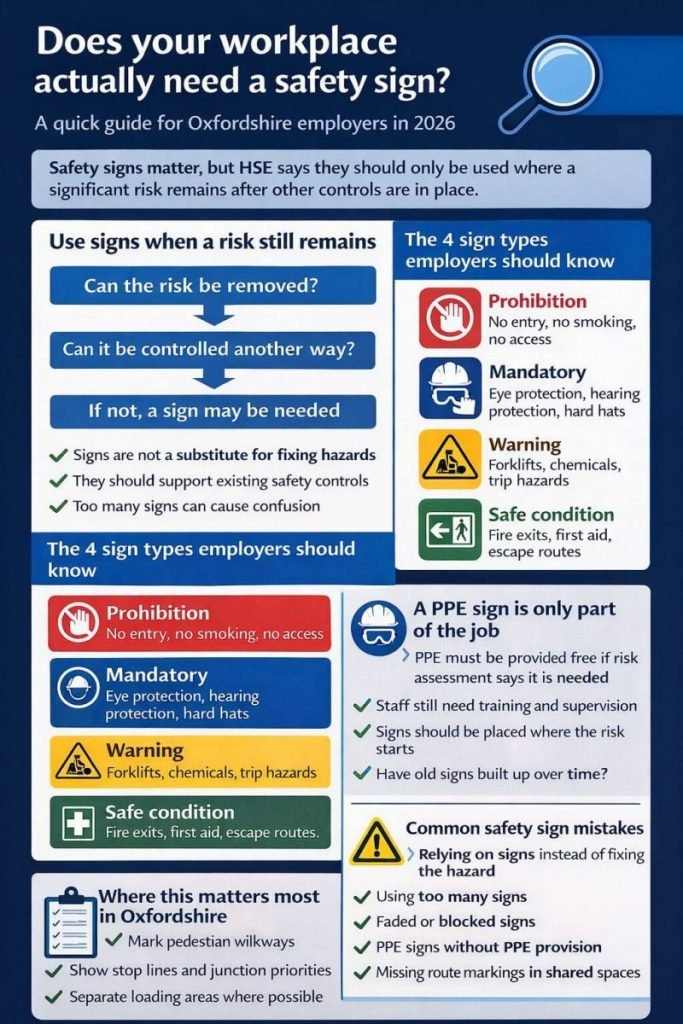
What Oxfordshire employers should check this year
If you run or manage a workplace in Oxfordshire, the most useful questions are straightforward:
- Is there a significant risk that still needs a sign after other controls are in place?
- Are your signs clear, legible and easy to see?
- Are PPE reminders placed where the risk begins, not after it?
- Are drivers and pedestrians clearly separated and routed on site?
- Have old, duplicated or irrelevant signs built up over time?
- Can staff and visitors understand what the signs require them to do?
Where employers can look for examples
Employers reviewing workplace signage, labels and PPE reminders may want to compare different types of compliant products and formats before making changes. One place to do that is expert safety products at Seton UK, alongside the official legal and practical guidance published by the HSE.
Frequently asked questions
When are safety signs legally required at work?
HSE says they are required where a significant risk remains after other relevant control measures have been put in place.
Do employers have to provide PPE for free?
Yes. HSE says employers must provide PPE free of charge if a risk assessment shows it is needed.
Are PPE signs enough on their own?
No. Signs are reminders. Employers still have wider duties to assess risk, provide suitable PPE, maintain it and train workers in how to use it safely.
What signs are needed where vehicles and pedestrians mix?
HSE says workplaces should use signs and route markings to show drivers and pedestrians which routes to use, where to stop, and how to behave safely. In private workplaces, road signs should match public-road signs where suitable equivalents exist.
Can you have too many safety signs?
Yes. HSE warns that too many signs can cause confusion.














