

















For a long time, maintenance in many organisations meant paper checklists, spreadsheets, a wall calendar and a lot of institutional memory. In 2026, that approach is becoming harder to sustain.
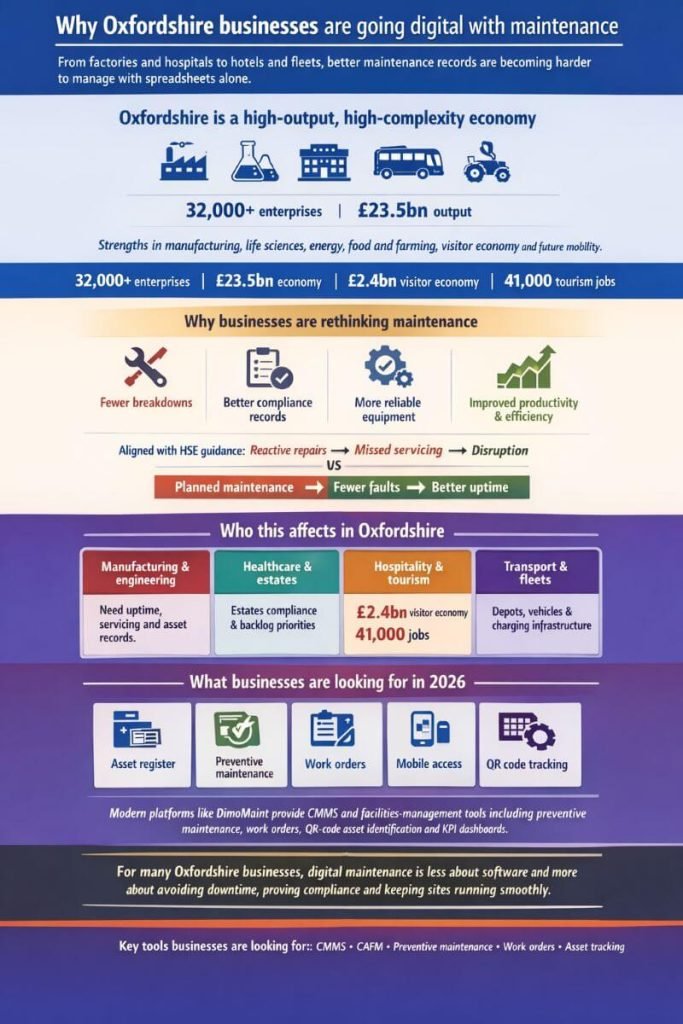
In Oxfordshire, that matters because the county’s economy is broad, complex and heavily dependent on sectors where equipment, buildings and infrastructure have to keep working. Oxfordshire’s latest strategic economic plan says the county generates £23.5 billion in output from more than 32,000 enterprises, with strengths in areas including energy, food and farming, visitor economy, health and life sciences, and future mobility.
In sectors like those, missed servicing, weak asset records or poor visibility over repairs can quickly become more than an inconvenience. The Health and Safety Executive says an effective maintenance programme makes plant and equipment more reliable, reduces breakdowns and improves productivity and efficiency.
What does “digitising maintenance” actually mean?
At its simplest, it means replacing scattered records and reactive fixes with a system that tracks assets, schedules work and records what has been done.
Two terms come up often:
CMMS stands for Computerised Maintenance Management System. It is mainly focused on the maintenance of equipment and infrastructure, whether preventive, corrective or reactive.
CAFM stands for Computer-Aided Facilities Management. It covers a broader set of building and occupant services, including areas such as space, security and energy management.
That distinction matters. A factory, bus depot or workshop may need something more CMMS-led. A school, office, leisure venue or multi-site property portfolio may need a broader CAFM-style system.
Why 2026 feels different
Several pressures are pushing maintenance higher up the agenda.
The first is reliability. Unplanned downtime is expensive, whether it affects production, building operations or customer service. HSE’s guidance is clear that maintenance is not just a compliance issue; it is also tied directly to productivity and efficiency.
The second is traceability. More organisations want clear records of inspections, repairs, checks and contractor activity. That is especially important in regulated or safety-sensitive environments.
The third is scale. As businesses grow, or manage more than one building or site, it becomes harder to rely on one person remembering what needs servicing and when.
The fourth is sustainability and asset performance. As more organisations invest in electric fleets, lower-carbon buildings and energy systems, they also need better tools to track how those assets are maintained.
Which Oxfordshire sectors are most likely to care?
Manufacturing, engineering and future mobility
Oxfordshire’s economy includes strong advanced manufacturing and future mobility activity, both of which depend on well-maintained equipment and planned servicing. The county’s economic strategy explicitly identifies future mobility and engineering-adjacent sectors as strengths.
For these businesses, digital maintenance tools can help teams move from reactive repairs to planned maintenance, while also creating a clearer history for each asset.
Healthcare and large public estates
Large public estates in Oxfordshire already show how significant maintenance can be in practice.
Oxford University Hospitals says it spent around £6.5 million on estates compliance and backlog maintenance in 2024/25, and commissioned an independent review to help prioritise limited capital funds on estates compliance and backlog work.
The University of Oxford’s estate is also unusually complex. Its Estates Services team says it manages more than 270 buildings used for teaching, research and administration, plus another 200 commercial properties, and that it is focusing on preserving the value of buildings and systems through maintenance and investment.
That does not mean every business needs enterprise-scale software. But it does show how quickly maintenance becomes strategic when the estate is large, mixed or ageing.
Hospitality, tourism and leisure
Oxfordshire’s visitor economy is also a useful example. Experience Oxfordshire says tourism in the county generated £2.4 billion in 2024 and supported around 41,000 jobs.
For hotels, venues, attractions, food businesses and leisure operators, maintenance is closely tied to customer experience. Faulty HVAC, broken refrigeration, lift failures or lighting issues can all hit trading, reputation and compliance.
Transport and fleets
Fleet and depot operations are another obvious case. Transport operators increasingly have to maintain not only vehicles but also charging infrastructure, workshops and associated site assets. As operations become more electrified and more data-rich, manual tracking becomes harder to justify.
What businesses are looking for in a maintenance system
The key question for most firms is not whether maintenance matters. It is what a modern system should actually do.
The most useful functions usually include:
- a clear asset register with service history
- preventive maintenance scheduling
- digital work orders
- mobile access for engineers and contractors
- checklists and audit trails
- QR code or barcode-based asset identification
- reporting through KPIs and dashboards
- support for subcontractor management
Those are the same broad features now being marketed by many maintenance platforms. For example, DimoMaint says its software includes asset logbooks, QR-code identification, subcontractor management, scheduled maintenance, compliance tracking and KPI dashboards.
CMMS or CAFM: which fits which business?
A simple rule of thumb is this:
- If your main problem is keeping equipment and infrastructure running, you are probably closer to CMMS territory.
- If your main problem is managing buildings, services, spaces and facilities across sites, you may need something closer to CAFM.
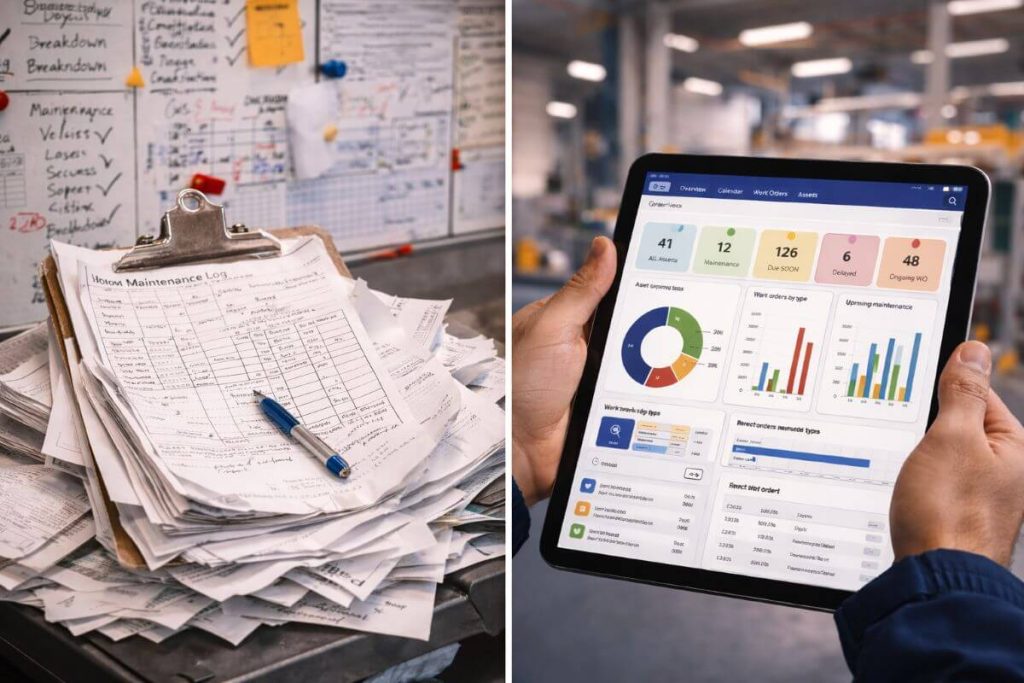
That distinction is one reason organisations often outgrow spreadsheets. A single spreadsheet can list jobs, but it struggles to act as a live record of assets, people, contractors, deadlines and performance.
What to ask before moving away from spreadsheets
For smaller organisations in particular, the right first step is often not buying software immediately, but asking a few practical questions:
- How many assets or sites are we trying to manage?
- Are we missing planned servicing or inspections?
- Do we rely too heavily on one person’s memory?
- Can engineers update jobs while on site?
- Can we quickly prove what work was done and when?
- Are we spending too much time on reactive fixes?
- Do we need equipment-focused maintenance, or broader facilities management?
The clearer those answers are, the easier it becomes to judge whether a digital system is likely to save time or money.
Why this matters for Oxfordshire readers
For local businesses, the issue is less about software jargon and more about resilience.
Whether it is a manufacturer trying to avoid breakdowns, a hospitality venue trying to protect service standards, a healthcare estate managing compliance, or a growing company juggling multiple sites, maintenance is becoming a more visible part of how organisations manage risk, costs and day-to-day operations.
That is why digital maintenance tools are getting more attention in 2026. Not because they are fashionable, but because the old ways of tracking repairs and servicing are increasingly hard to defend.
At a glance
| Topic | Why it matters |
| CMMS | Best suited to equipment and infrastructure maintenance |
| CAFM | Better for broader building and facilities management |
| Oxfordshire economy | More than 32,000 enterprises and £23.5bn in output |
| High-impact sectors | Manufacturing, healthcare, visitor economy, transport |
| Main business benefit | Better reliability, fewer breakdowns, clearer records |
| Common trigger for change | Moving beyond spreadsheets and reactive repairs |
Frequently asked questions
What is CMMS software?
CMMS stands for Computerised Maintenance Management System. It is software used to plan, schedule and record maintenance work on equipment and infrastructure.
What is the difference between CMMS and CAFM?
CMMS is mainly focused on maintenance tasks, while CAFM covers wider building and occupant services as well as maintenance.
Why are businesses moving away from spreadsheets?
Because spreadsheets are hard to scale across multiple assets, contractors and sites, and they do not provide the same live tracking, work order control or audit history as dedicated systems.
Which Oxfordshire sectors benefit most from digital maintenance?
Manufacturing, healthcare, hospitality, transport and multi-site estates are all strong candidates because they depend on reliable assets and documented maintenance records.














