

















Factory safety isn’t only about big machines and big budgets. Small tweaks to trolleys, carts and castors can cut risk, ease manual handling and reduce downtime, often without shutting the line.
This guide turns the principles into practical steps you can act on today, to ensure you can utilise space with moveable industrial furniture.
1) The hidden risks in day-to-day movement
Worn or poorly specified castors make routine moves harder and less predictable. Flat spots, cracked treads, seized bearings or overloaded brackets lead to instability, higher push/pull forces, noise and near-misses. Upgrading to purpose-made, high-quality wheel castors (chosen for load, floor and environment) restores smooth control and lowers strain.
For manual handling risk assessment of pushing/pulling, see the HSE RAPP tool and Manual Handling guidance.)
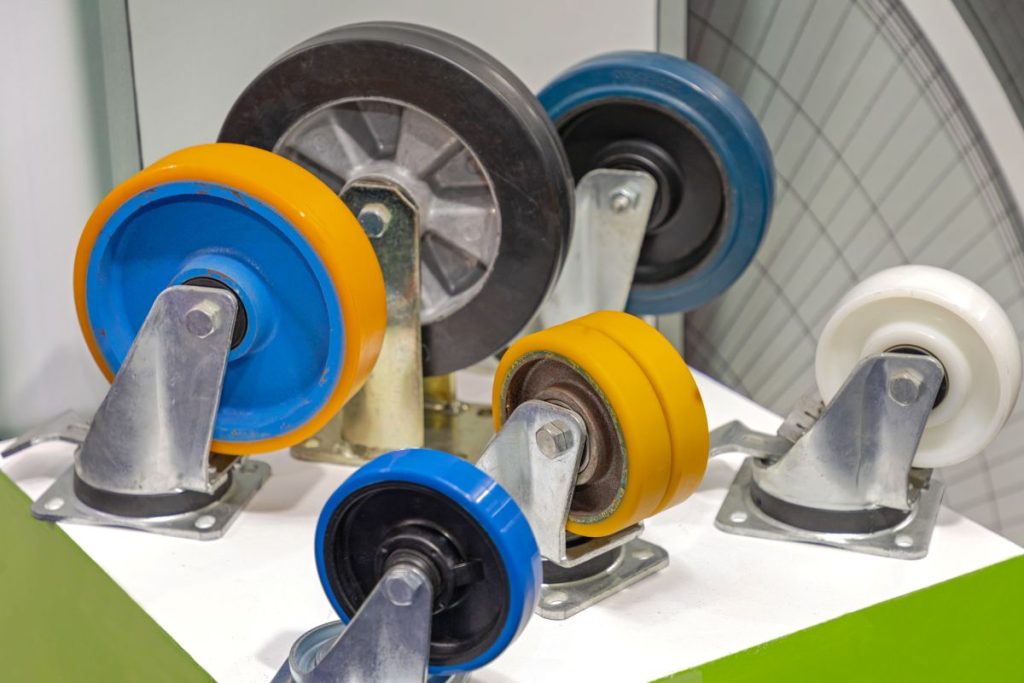
2) Choose the right castor in 3 steps
Step A: Calculate the minimum load rating (with safety)
Per-castor load = (Max load on trolley + trolley weight) × safety factor ÷ (number of castors − 1)
Use 1.3–2.0 as a safety factor and subtract one castor to allow for uneven floors.
Example: 400 kg load + 40 kg trolley, 4 castors, SF 1.5 → (440×1.5)/(4−1) = 220 kg per castor (minimum).
Step B: Match wheel & tread to the job
| Situation | Wheel / tread | Bracket & locks | Notes |
| Expansion joints / rough floors | Polyurethane (PU) on cast-iron or nylon core | Swivel; add directional lock at one end | Larger diameter cuts push force and rolls over debris |
| Quiet areas / comms critical | Rubber or soft PU | Total-stop brake | Lowers rolling noise; helps audibility of alarms/voice |
| Food / cleanroom / washdown | Stainless housings, sealed bearings; PU or nylon | — | Hygienic design; chemical/steam compatible |
| ESD sensitive | Conductive/antistatic wheels | Grounding provisions as needed | Prevents static build-up near electronics |
| Heat / cold | High-temp phenolic/nylon or low-temp elastomer | — | Specify temperature range to avoid flat-spotting |
Environment specifics (quick picks):
- Caustic washdown: choose stainless housings + sealed bearings; PU/nylon wheels tolerate detergents better than many rubbers.
- Cold store to −20 °C: specify low-temperature elastomer; avoid standard PU which can stiffen and flat-spot.
Step C: Pick ergonomic details
- Precision bearings for smooth starts/stops (less “snatch”).
- Wider brackets/robust forks to prevent flex under load.
- Wheel diameter matters: upsizing from ~100 mm to 125–160 mm typically reduces starting effort and helps traverse joints/thresholds.
- Guards & bumpers where impacts are common.
Brake types: when to use which
- Total-stop brake: locks wheel and swivel; best for parking and safe loading/unloading.
- Wheel brake only: locking stops rolling but still swivels; use where you need to hold position yet re-align quickly.
- Directional lock: converts a swivel castor to fixed for long straight runs; add one per end to track straight and reduce steering effort.

3) Reduce strain with better ergonomics
Well-chosen heavy-duty castors lower push/pull effort and cut awkward body positions. PU or rubber treads reduce starting resistance; precision ball bearings prevent jarring; shock-absorption lowers vibration, helping staff stay comfortable and alert across a shift. Fit checks should sit inside your manual-handling risk assessment (see HSE guidance) and, where possible, be measured with a force gauge.
4) Make the floor quieter (and safer)
Excessive rolling noise masks alarms and shouted warnings. Swapping stainless steel metal wheels for PU/rubber treads, keeping bearings lubricated and aligning brackets can increase the glide, trimming noise and improving communication. Frame your programme against the Control of Noise at Work Regulations 2005, aim to keep exposure below action values where practicable.
5) Maintenance that actually prevents failures
Monthly quick-check (adapt to duty)
- Wheels: no flat spots, cracks or embedded swarf.
- Swivel head/bearings: free rotation; no play; lubricate to schedule.
- Fasteners: axle bolts and fixings tight; forks not deformed.
- Brakes/locks: hold firmly on level ground.
- Replace units that still wobble, drag or squeal after cleaning/lube.
Frequency: daily in food plants/high-traffic hubs; weekly in lighter-duty areas. Match cleaning to materials (e.g., detergent wash for stainless; avoid harsh solvents on rubber/PU).
Compliance cues (PUWER & workplace transport): keep records of inspection dates, findings/defects, corrective actions, serials/specs of replacements, and next due date. This supports PUWER duties and internal audits.

6) Show the ROI
Safer mobility isn’t just compliance, it boosts output. Track: push/pull force, near-misses, noise readings, unplanned maintenance/castor life, and throughput time for standard moves.
Simple ROI = (reduced injuries + time saved + replacements avoided) − (upgrade cost). Payback often appears within one maintenance cycle.
Buying cheap plastic swivel castors rarely pays off, it’s worth paying extra for durable castors with cast iron centre.
7) Build a safety habit
Safety sticks when it’s routine. Encourage reports of stiff/damaged castors, schedule floor walks, and keep approved-spec spares on site. Small, visible fixes (new locks, quieter wheels, better bearings) show the workforce you mean it, incidents fall and flow improves.
Encourage standard safety practises like never standing on office furniture with castor wheels, not exceeding load capacity, etc.
FAQs
How many castors should a trolley have?
Four is standard; six can spread load on long or heavy frames. Always calculate per-castor load with the formula above.
Do larger wheels really help?
Yes. Bigger diameter rolls over joints/debris more easily and reduces push force, often the cheapest ergonomic win.
Which brake should I choose?
Total-stop for parking/safe loading; wheel brake when you need a quick hold; directional lock to track straight over distance.
Is it caster or castor?
Caster is American English, we use castor in the UK, but obviously both are the same thing.














