Crowded skies, tight turnarounds and increasingly changeable weather mean even the best-laid travel plans can wobble subject to unavoidable problems. The trick isn’t to assume the worst, it’s to travel resiliently: book with a little strategy, know your rights, and what to do in the moment so you’re not out of pocket if the airline falls short.
Here’s a practical, non-legal guide for UK travellers heading into busy travel seasons.
Build resilience into your itinerary (before you book)
- Favour morning departures. Early flights are less exposed to the day’s knock-on delays and more likely to be on schedule.
- Add buffer time to connections. For terminal changes or different carriers, choose a layover that’s generous, not just legal.
- Keep tickets on one booking. A through-ticket usually makes the operating airline responsible for re-routing you if the first leg slips.
- Stick to alliance/interline partners. Partners can often rebook you faster than unrelated carriers.
- Avoid tight last-mile plans. Wedding at 2pm? Aim to arrive the day before.
- Screenshot everything. Fare rules, boarding passes, “flight delayed” notifications and airline messages become evidence later.
- Check card/insurance perks. Before you buy, confirm any Travel Inconvenience benefits on your credit card or packaged account (delay cash payouts, lounge access, baggage-delay allowances), register flights if required, and make sure your travel insurance (and ATOL/ABTA for packages) fits your trip.
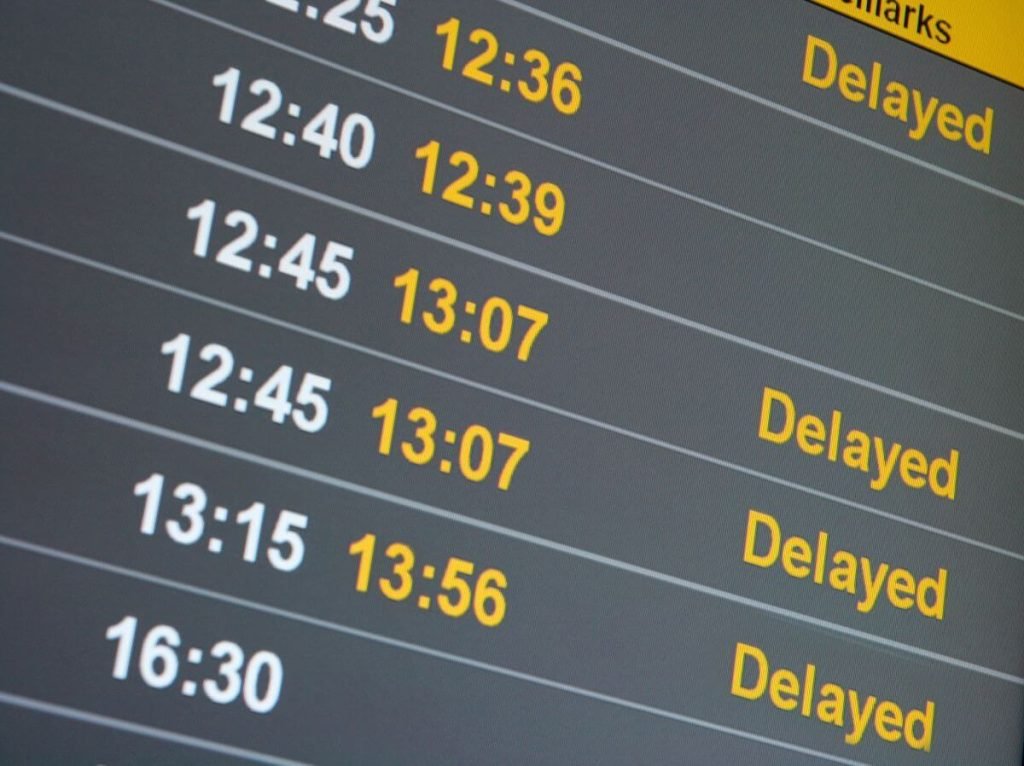
When disruption hits: what to do, step by step
- Check the airline/app first. Gate changes, revised ETAs and self-service rebooking tools often appear there before the desk queue moves.
- Work two lines at once. Join the service-desk queue and call the airline; whoever answers first wins.
- Know your immediate entitlements (“duty of care”). For long delays/cancellations, airlines must provide meals/refreshments, two communications, and hotel + transfers if overnight. Keep receipts if you pay and claim back.
- Ask for re-routing that works for you. Earliest opportunity, a later date that suits you, or a refund.
- Stay polite but precise. Quote your booking ref, the delay, and the solution you want (“earliest arrival into BOS today; alliance partners OK”).
- Collect proof. Photos of boards, app notifications, emails, and delayed-baggage tags help any claim.
Your passenger rights in a nutshell (UK/EU flights)
Under UK261 (and EU261 when applicable), airline obligations fall into two buckets:
1) Care and assistance (regardless of fault)
- Meals/refreshments appropriate to the wait, two free communications.
- Hotel and transfers if an overnight stay is required.
- Re-routing at the earliest opportunity or a later date that suits you, or a refund.
2) Compensation (when the airline is at fault)
If you arrive 3+ hours late or your flight is cancelled and the cause wasn’t an “extraordinary circumstance” (e.g., severe weather or ATC strikes), flat-rate compensation may be due based on flight distance and duration:
- £220 — Short-haul (≤ 1,500 km / ≤ 930 miles)
Typical routes: within the UK & Ireland; France (Paris), Netherlands (Amsterdam), Belgium (Brussels), Germany (Frankfurt/Cologne), Denmark (Copenhagen), Spain (Barcelona). - £350 — Medium-haul (1,500–3,500 km / 930–2,175 miles)
Typical routes: Portugal (Lisbon/Faro), Spain (Málaga, Canary Islands), Greece (Athens), Cyprus (Larnaca), Turkey (Istanbul), Iceland (Reykjavík), Morocco (Marrakesh), Poland (Warsaw), Romania (Bucharest), Baltics (Riga/Vilnius). - £520 — Long-haul (> 3,500 km / > 2,175 miles)
Typical routes: USA/Canada (New York, Toronto), Middle East (Dubai, Doha), India (Delhi), East/Southern Africa (Nairobi, Johannesburg), Caribbean (Barbados), East & Southeast Asia (Singapore, Bangkok), South America (São Paulo).Notes:
- Distance band and arrival delay determine the amount.
- Extraordinary circumstances remove compensation but not your right to care/re-routing.
- One ticket with connections is treated as a single journey to your final destination for delay-compensation timing.
- Codeshares: claim against the operating carrier (who flew you), not the marketing airline on the ticket.
Flight compensation claim time limits
- England & Wales: generally 6 years to bring a UK261 claim (Limitation Act 1980).
- Scotland: generally 5 years (prescription).
- ADR vs court timing: Airline ADR schemes have their own deadlines and do not pause court limitation periods. If you’re close to the limit, seek legal advice before relying on ADR.
DIY claims vs getting help
Plenty of travellers succeed with a DIY claim: write to the airline’s customer-relations team, attach evidence (booking, boarding passes, delay proof, receipts) and keep a log of responses. If you’re rejected and still believe you qualify, escalate to the airline’s ADR scheme or the CAA process.
If you’d rather avoid the paperwork or want to guarantee success, independent services such as AirHelp can pursue claims on your behalf for a success-based fee. With over 200k positive reviews on Trustpilot they are a market leader, and have helped more than 3 million passengers compensation whenever their flight was delayed or cancelled.
Either way, the basics are the same: evidence, timelines, persistence.
What to use when
| Scenario | Best first route | Back-ups |
|---|---|---|
| Airline cancels & won’t refund | UK261 refund from airline | Chargeback; Section 75 (credit card) |
| Airline insolvency | Section 75 / End-Supplier Failure (if insured) | ATOL (if a package) |
| Missed self-connection (separate tickets) | Travel insurance (missed connection) | — |
| Big delay out-of-pocket costs | UK261 duty-of-care claim | Insurance if airline refuses/caps |
| Downgrade to lower cabin | UK261 partial fare refund | Section 75/chargeback if refused |
Tip: Paying even a small deposit (£100+) on a credit card directly to the supplier can engage Section 75 for the entire contract value.
Accessibility / PRM assistance (free support)
If you have a disability or reduced mobility:
- Book assistance at least 48 hours in advance via your airline (or airport). You’re entitled to free support from arrival at the airport to your seat, during connections, and on arrival (including baggage and ground transport to a designated point).
- If assistance fails or is inadequate, complain to the airline/airport in writing and escalate to the CAA Passenger Advice and Complaints Team (PACT) if unresolved.
- Assistance is in addition to your UK261 rights; it doesn’t affect compensation or care.
DIY claim mini-template
Subject: UK261 compensation/refund request – [Booking Ref], [Flight No & Date]
Hello [Airline],
My flight [Flight No] on [Date] from [Origin] to [Destination] arrived [X:XX] late / was cancelled. Under UK261, I’m requesting [compensation of £220/£350/£520] / [a refund] / [re-routing].
Attachments: booking confirmation, boarding pass, arrival-delay proof, receipts (duty of care).
Please confirm within 14 days.
Kind regards,
[Name] | [Contact]
Baggage quick facts (Montreal Convention)
- Liability cap: ~1,288 SDR (per passenger) for lost/damaged/delayed baggage. SDR converts to GBP at prevailing rates; ask the airline which rate/date was used.
- Deadlines:
- Damage: write within 7 days of receiving your bag.
- Delay: write within 21 days of receiving delayed baggage.
- Loss: usually presumed after 21 days or when the airline declares it lost.
- File a PIR (Property Irregularity Report) at the airport, keep receipts for essentials, and submit a written claim on time.

Payment & insurance protections (UK)
Section 75 (credit cards, UK Consumer Credit Act)
- Pay any part (£100–£30,000 total contract value) by credit card directly to the merchant and your card issuer is jointly liable with the supplier for breach of contract/misrepresentation (e.g., airline fails, refund refused).
- Paying via some e-wallets/marketplaces can break the “debtor-creditor-supplier” chain.
- You can claim from the airline or your card provider (or both).
Chargeback (credit & debit cards)
- A card-scheme remedy (Visa/Mastercard/Amex), not law. Useful for non-delivery or services not as described.
- Typical windows: within ~120 days of travel/service date (schemes vary).
Travel insurance still matters
- Trip cancellation/curtailment: Recovers non-refundable hotels, tours, connections for insured reasons.
- Missed connection / travel disruption extensions: Key if you self-connect.
- Travel delay benefits: Fixed cash sums after set delays.
- Baggage: Separate limits for delay/loss; keep PIRs, receipts, photos.
- Airline failure (ESF/SAFI): Often an add-on, worth considering.
Packages booked with a UK organiser
- ATOL (packages with flights): Refunds or repatriation if the tour operator fails.
- ABTA (non-flight packages): Financial protection for covered bookings.
- Ask for the organiser’s ATOL/ABTA number on your certificate.
Travel Inconvenience (from premium cards & packaged accounts)
Many UK credit cards and packaged bank accounts include Travel Inconvenience cover (sometimes called Travel Delay / Missed Connection). It pays fixed cash amounts (and/or gives lounge access) when you’re delayed, miss a connection, are denied boarding, or your bags are delayed, separate from UK261 and your travel insurance.
Typical triggers & benefits
| Trigger (examples) | Typical benefit | Common conditions to check |
| Flight delay (e.g., 4–6+ hrs) | Fixed cash payment per insured person; some policies add lounge access after a set delay | Trip paid with the card / account active; delay threshold; max per trip |
| Missed connection due to a delay/cancellation | Fixed cash payment; sometimes reimburses extra transport to catch up | Proof that the first leg caused the miss; time thresholds |
| Denied boarding (overbooking) | Fixed cash payment | Same-day written confirmation from airline |
| Baggage delay (e.g., 4–6+ hrs) | Allowance for essentials (toiletries/clothes) | Receipts + Property Irregularity Report (PIR) |
| Baggage loss/damage | Lump sum up to policy limit | PIR within airline time limits; itemised evidence |
Stacking rule: You can claim UK261 care/compensation and Travel Inconvenience and insurance, just don’t double-recover the same expense from multiple sources.
Good to know
- Payment requirement: Many policies require you to pay for the trip with the card; some packaged accounts cover you regardless once the policy is “on”.
- Who’s covered: Cardholder, partner/spouse, dependent children (age limits differ).
- Trip limits: Max trip length/distance from home; UK residents only; age caps.
- Exclusions: Pre-existing medical conditions, certain strikes, alcohol-related incidents, non-compliance with airline instructions.
- Evidence: Boarding passes, airline delay/denial note or app screenshots, PIR for bags, itemised receipts, and a simple delay timeline.
- Claim window: Often 30–60 days from return or incident (policy dependent).
- Lounge access services: Some cards include SmartDelay / Flight Delay Pass (auto-issued lounge passes after qualifying delays).
How to use it (3 steps)
- Confirm eligibility in your card/account policy (search “Travel Inconvenience”, “Delay”, “Baggage”).
- Save proof in real time: delay notices/screens, PIR, receipts.
- Submit the claim via your card’s insurer portal; pursue UK261 with the airline in parallel (DIY or via a specialist), and use Section 75/chargeback if refunds are refused or suppliers fail.
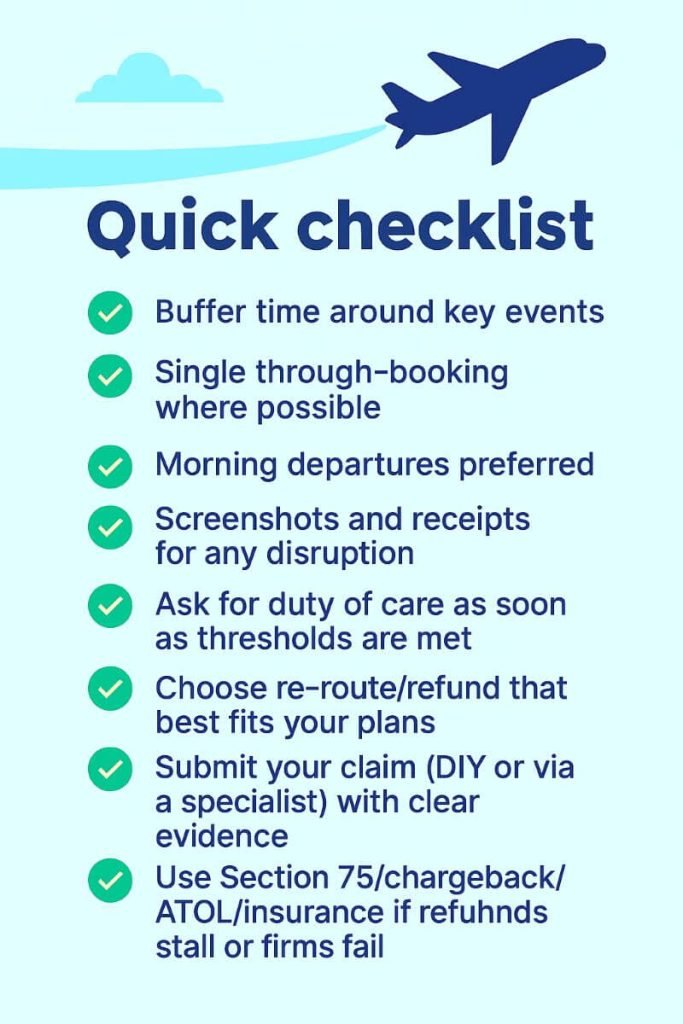
Travel Tips
- For first-wave departures (often 06:00–08:00), consider an overnight airport hotel, it cuts disruption risk dramatically.
- Oxford has direct coach links to Heathrow and Gatwick from the city centre; factor coach frequency and journey time into buffers.
- If you’re parking in Oxford and coaching to the airport, allow extra time for park-and-ride transfers at peak times.
Pack and plan for smoother days
- Carry-on essentials: meds, a change of clothes, chargers, key toiletries.
- Offline copies: passports, visas, boarding passes, insurance, hotel confirmations.
- Travel apps: airline + airport apps, a flight-status tracker, your insurer’s claims app.
- Payment flexibility: a credit card with travel-friendly limits can bridge costs while you claim reimbursements later.
Editor’s note: This guide is general information, not legal advice. Always seek FCA-authorised financial advice for regulated products and tax/legal advice for your circumstances.