From Oxfordshire, the Lake District is a realistic three or four-night break rather than a sensible day trip. The first question is not whether to take the train or drive, it is which part of the Lake District you want to visit.
Look at a map before booking. Windermere, Ambleside and Grasmere suit a South or Central Lakes trip, while Keswick, Derwentwater and Buttermere belong in a northern itinerary. Choosing the right base at the start prevents a lot of unnecessary driving once you arrive.
The direct road journey from Oxford to Windermere is roughly 230 miles. Although a clear-road calculation may come in below four hours, a practical plan should allow longer for a break, traffic around Birmingham and the slower roads inside the national park. That makes the Lakes a strong long-weekend destination from Oxfordshire, but not somewhere most people should attempt as an out-and-back day trip.
This guide will hopefully help you plan your trip to the Lake District.
At a glance
| Decision | Best starting point |
|---|---|
| Minimum sensible stay | Three nights |
| Best length for a relaxed visit | Four nights |
| Simplest rail arrival | Windermere railway station |
| Best low-car bases | Windermere, Bowness-on-Windermere or Ambleside |
| Best quieter central base | Grasmere |
| Best northern base | Keswick |
| Best for Buttermere and Borrowdale | Keswick |
| Main South Lakes rail gateway | Oxenholme Lake District |
| Main North Lakes rail gateway | Penrith (North Lakes) |
| Main road approach for South Lakes | M6 Junction 36, then A590 |
| Main road approach for North Lakes | M6 Junction 40, then A66 or A592 |
| Current Central Lakes bus single-fare cap | £3 on participating journeys |
| Current 599 frequency | Every 20 minutes between Bowness and Grasmere |
National Rail lists bookable journeys from Oxford to both Oxenholme Lake District and Windermere. Lake District National Park guidance directs South Lakes traffic through M6 Junction 36 and North Lakes traffic through Junction 40. Stagecoach currently advertises the 599 every 20 minutes and promotes the £3 capped single fare.
Why the Lake District works for an Oxfordshire break
The Lake District is in North West England and is the country’s largest national park, covering 2,362 square kilometres. It is also a UNESCO World Heritage Site. Its scale is part of the attraction, but it is also why visitors need to choose their destinations carefully rather than treating the entire region as one compact resort.
A Lake District experience can mean very different things: an adventure on the fells, quiet time beside the water, family activities, literary tourism, scenic boat tours, traditional pubs or simple relaxation in nature. No single base suits everyone.
For a short trip from Oxfordshire, resist the urge to see a lot of locations. One well-chosen base and two focused days usually produce better experiences than repeatedly crossing the park by car.
Choose which part of the Lake District you want to visit
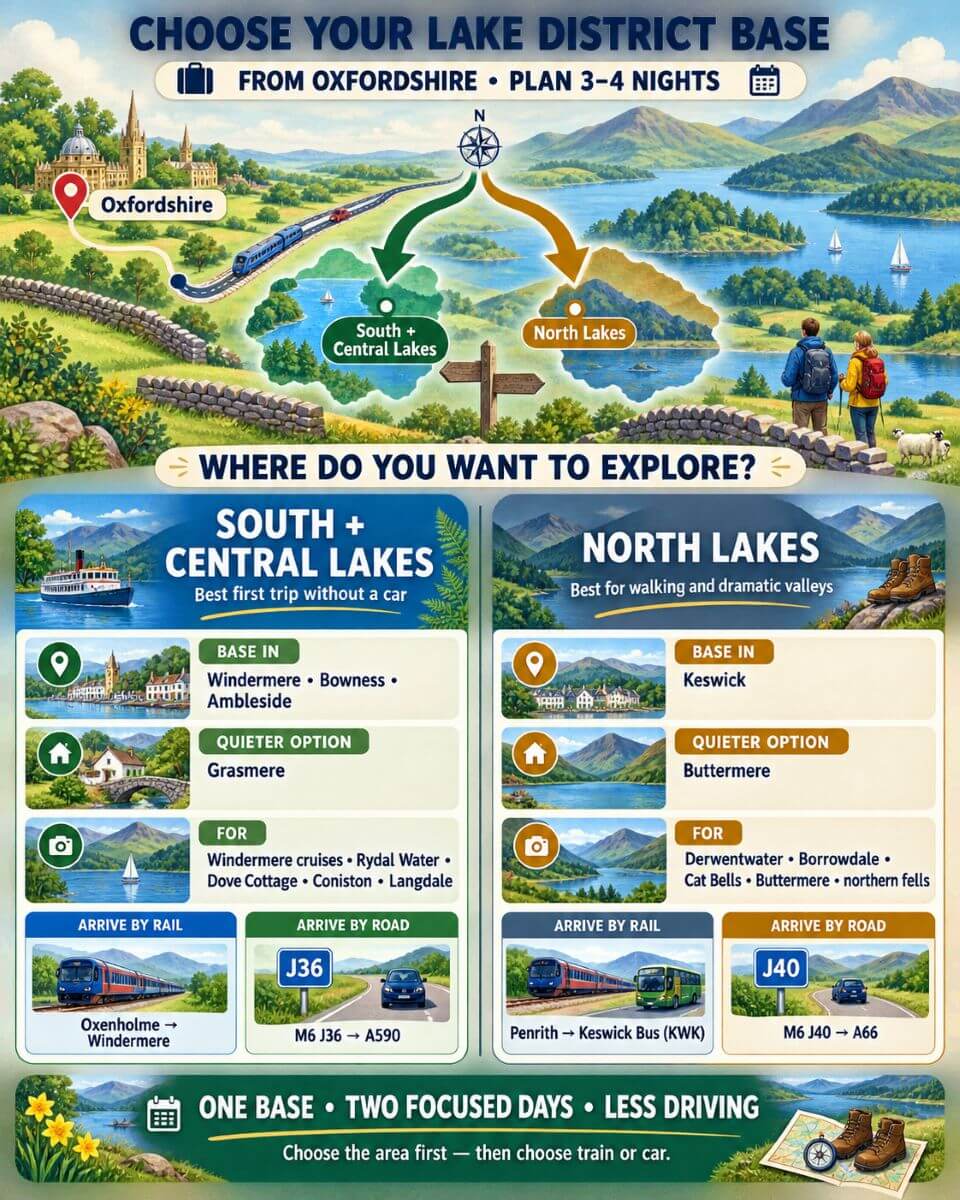
South and Central Lakes
Choose the South or Central Lakes for:
- Windermere and Bowness-on-Windermere
- Ambleside and Waterhead
- Rydal and Grasmere
- Hawkshead, Coniston and Langdale
- Regular buses and boat trips
- A first visit without a car
The principal rail route runs through Oxenholme Lake District, where local trains continue to Windermere. This is usually the easiest area for visitors who want transport, accommodation, restaurants and activities close together. The National Rail route map shows the Oxenholme–Windermere branch clearly.
North Lakes
Choose the North Lakes for:
- Keswick and Derwentwater
- Borrowdale and Cat Bells
- Buttermere and Honister
- Bassenthwaite
- The northern fells
- A more walking-focused holiday
Penrith (North Lakes) is the main rail gateway. An integrated ticket now allows travellers to book rail travel to Penrith and the connecting X4 or X5 bus to Keswick as one journey. The arrangement became available all year from 27 April 2026.
Travelling by train from Oxfordshire
From Oxford city
The most common route from Oxford city is:
Oxford → Birmingham New Street → Oxenholme Lake District → Windermere
CrossCountry says its direct Oxford–Birmingham New Street journey takes just over an hour. From Birmingham, West Coast Main Line services continue north towards Oxenholme, with a local connection for Lake Windermere. Exact timings, operators and changes vary by date, so search the whole journey rather than booking each stage separately.
For Keswick, search for:
Oxford → Keswick Bus (KWK)
The booking system should build the journey through Penrith and include the X4 or X5 bus to Keswick Bus Station. Avanti advises searching for “Keswick Bus (KWK)” as the destination.
From Banbury, Bicester and Didcot
Travellers from Banbury or Bicester should compare routes through Birmingham rather than automatically travelling south to Oxford. From Didcot, the best route can vary depending on engineering work and whether the journey planner sends you through Oxford, Reading or London.
There is no need to memorise a permanent route. Use the National Rail Journey Planner for the exact date, increase the interchange allowance when carrying luggage and set up alerts on your phone for delays or platform changes. National Rail can provide journey alerts by email, SMS or WhatsApp.
Reading railway maps and departure boards
On a wider UK map, the Lake District sits north of Manchester and south of Carlisle, with Glasgow farther up the West Coast Main Line. Those city names can appear in route planning or on departure boards, but do not choose a train solely from its final destination. Confirm that the service calls at Oxenholme Lake District or Penrith (North Lakes).
Practical train-booking tips
Book to the place where you actually want to finish:
- Windermere for the South and Central Lakes
- Keswick Bus (KWK) for Keswick
- Penrith only when arranging the onward journey separately
Leave a bit more interchange time if you are travelling with children, walking equipment or several bags. The shortest possible connection is not always the most comfortable one.
Save the ticket, itinerary and accommodation address offline. A screenshot is useful if the booking app loses signal.
Lake District facts for children
It is England’s biggest National Park: The Lake District covers 2,362 square kilometres, which is much bigger than Oxfordshire families might expect on a first visit.
It has 16 big lakes and bodies of water: Windermere is the best known, but there are many others to explore, including Ullswater, Derwentwater, Coniston Water and Bassenthwaite Lake.
There are more than 350 fells: A fell is a hill or mountain. Some are gentle enough for shorter family walks, while others need proper walking gear and planning.
England’s highest mountain is there: Scafell Pike is in the Lake District and stands 978 metres high.
It is a World Heritage Site: UNESCO recognised the Lake District in 2017 because of its special mix of mountains, lakes, farming, villages, writers and artists.
People helped shape the landscape: The stone walls, sheep farms, paths and villages are part of what makes the Lake District look the way it does today.
It is linked to famous writers: William Wordsworth lived in Grasmere, and Beatrix Potter, who created Peter Rabbit, also had strong links with the Lakes.
The weather can change quickly: A sunny morning can turn wet and windy, especially on the fells, so families should pack layers and waterproofs.
Driving from Oxfordshire to the Lake District
The normal route from Oxfordshire follows the M40, M42 and M6. The appropriate motorway exit depends on your base:
- M6 Junction 36 and A590: Windermere, Bowness-on-Windermere, Ambleside, Hawkshead and Coniston
- M6 Junction 40 and A66: Keswick, Derwentwater, Borrowdale and Buttermere
- M6 Junction 40 and A592: parts of Ullswater
These are the principal approaches identified by the Lake District National Park.
Do not rely on navigation alone
Before leaving Oxfordshire:
- Save the main driving directions.
- Download offline maps.
- Charge your phone and take a cable or power bank.
- Note the correct M6 junction.
- Save a second car park or arrival point.
Digital navigation is useful, but it can suggest narrow lanes or apparent shortcuts that save very little time. Use a road map to check whether the route still makes sense, particularly around mountain passes and remote valleys.
The difficult part of the journey is rarely the motorway. It is the final section through busy villages, narrow roads and car parks with limited capacity.
Getting around after you arrive
For a first visit, the least stressful strategy is often to park once and use buses, boats and short walks for at least one complete day.
The Central Lakes have the strongest public-transport corridor. Stagecoach’s open-top 599 currently connects Bowness, Windermere, Ambleside and Grasmere every 20 minutes. The operator also advertises USB charging, space for buggies and bikes, and audio commentary on the service.
Ambleside is currently around 11 minutes from Windermere by bus, while Keswick can be reached from Ambleside on the 555. Timetables change, so these figures should be treated as planning guidance rather than a promise for every journey.
Boat trips can also function as transport rather than simply tours. Windermere, Derwentwater and Ullswater all support itineraries that combine water travel with walks, villages or attractions. Check operating stops and the final sailing before setting out.
Where to stay
Base comparison
| Base | Best for | Main advantage | Main trade-off |
|---|---|---|---|
| Windermere town | Simplest rail arrival | Station, buses, shops and accommodation | It is not directly on the lakeshore |
| Bowness-on-Windermere | Cruises and first-time sightseeing | Boats, restaurants and plenty of things to do | Busy during peak tourism periods |
| Ambleside | Walking, pubs and local transport | Strong bus links and a lively centre | No railway station |
| Grasmere | A quieter literary break | Village walks and central bus connections | Fewer evening choices |
| Keswick | Adventure, Derwentwater and northern fells | Excellent walking base and integrated ticketing | Poor base for repeated South Lakes trips |
| Buttermere | Scenery and seclusion | Direct access to a dramatic valley | Limited services and seasonal transport |
| Pooley Bridge or Glenridding | Ullswater and relaxation | Lake access and slower-paced stays | More dependent on bus and boat timetables |
Windermere town
Windermere is the easiest base for travellers arriving by rail. The station, bus interchange, shops and accommodation are close together, making it a practical choice for a short break or a late arrival.
Be aware that Windermere railway station is in Windermere town rather than beside the lake. Continue to Bowness-on-Windermere for the main lakeside promenade and cruise departure points.
Bowness-on-Windermere
Bowness suits visitors who want boat trips, restaurants and low-effort sightseeing. It has a wide selection of accommodation and enough activities to fill an afternoon without returning to the car.
Its disadvantage is popularity. Book parking with the accommodation where possible and expect the centre and waterfront to be busy during school holidays.
Ambleside
Ambleside offers a strong balance of walking, transport and evening choices. Stagecoach describes it as a market town with cafés, climbing shops, traditional pubs and restaurants, while Waterhead provides access to the lake.
Check the precise accommodation location. Central Ambleside and Waterhead are connected, but they are not the same place when you are carrying luggage.
Grasmere
Grasmere is a bit quieter and works well for Wordsworth-related attractions, village walks, Rydal Water and travellers who are content to plan around the bus timetable.
Choose it when you want somewhere calmer than Bowness or Ambleside without becoming completely dependent on a car.
Keswick
Keswick is the strongest all-round base for Derwentwater, Borrowdale, Cat Bells and the northern fells. Derwentwater is about a 10-minute walk from the town centre, while the town supports outdoor activities like hiking, independent shops, restaurants and several low-level alternatives for poor-weather days.
Travellers who prefer a kitchen, extra living space and flexible meal times can use the self-catering cottages Keswick collection to compare stays in Keswick, Borrowdale and Glenridding. This type of accommodation can be particularly useful for families, groups, dog owners or walkers who need somewhere to store and dry equipment.
Keswick also works for visitors seeking a mixture of adventure and relaxation. A day might combine a fell walk with a boat trip, or a scenic lakeshore route with time in the town’s cafés, galleries and pubs.
Buttermere
Buttermere is one of the most scenic destinations in the northern Lake District. The National Trust describes a roughly 4.5-mile round-the-lake walk, while Lake District National Park information highlights its setting beneath the surrounding fells.
It is better treated as a focused day out or quiet retreat than as a transport hub. Seasonal 77 and 77A services connect Keswick with Cat Bells, Honister, Buttermere and Whinlatter, but visitors should check the operating dates before building a car-free itinerary around them.
Ullswater
Pooley Bridge and Glenridding suit visitors who want nature, water and a slower pace. They work well for walking and cruise-based activities but are less convenient for people hoping to move repeatedly between the North and South Lakes.
Confirm the final bus and boat times before booking dinner or an activity in another location.
Hotel, cottage or self-catering rental?
The best accommodation type depends on the trip.
Choose a hotel for a short stay, an included breakfast, on-site facilities and minimal planning.
Choose a cottage for a family or group, a longer stay, flexible meals, outdoor-equipment storage or evenings spent together.
Choose a central guesthouse or B&B when you want personal service without the cost or space of a full rental.
UK booking sites usually use the terms “holiday cottage” or “self-catering cottage”. International platforms may describe a similar property as a “vacation rental”. Whatever the label, check:
- Exact location rather than the town name alone
- Distance from the nearest station or bus stop
- Parking arrangements
- Steps and accessibility
- Check-in time
- Dog restrictions
- Cooking and laundry facilities
- Whether pubs, shops and restaurants are within walking distance
A three-night car-free itinerary
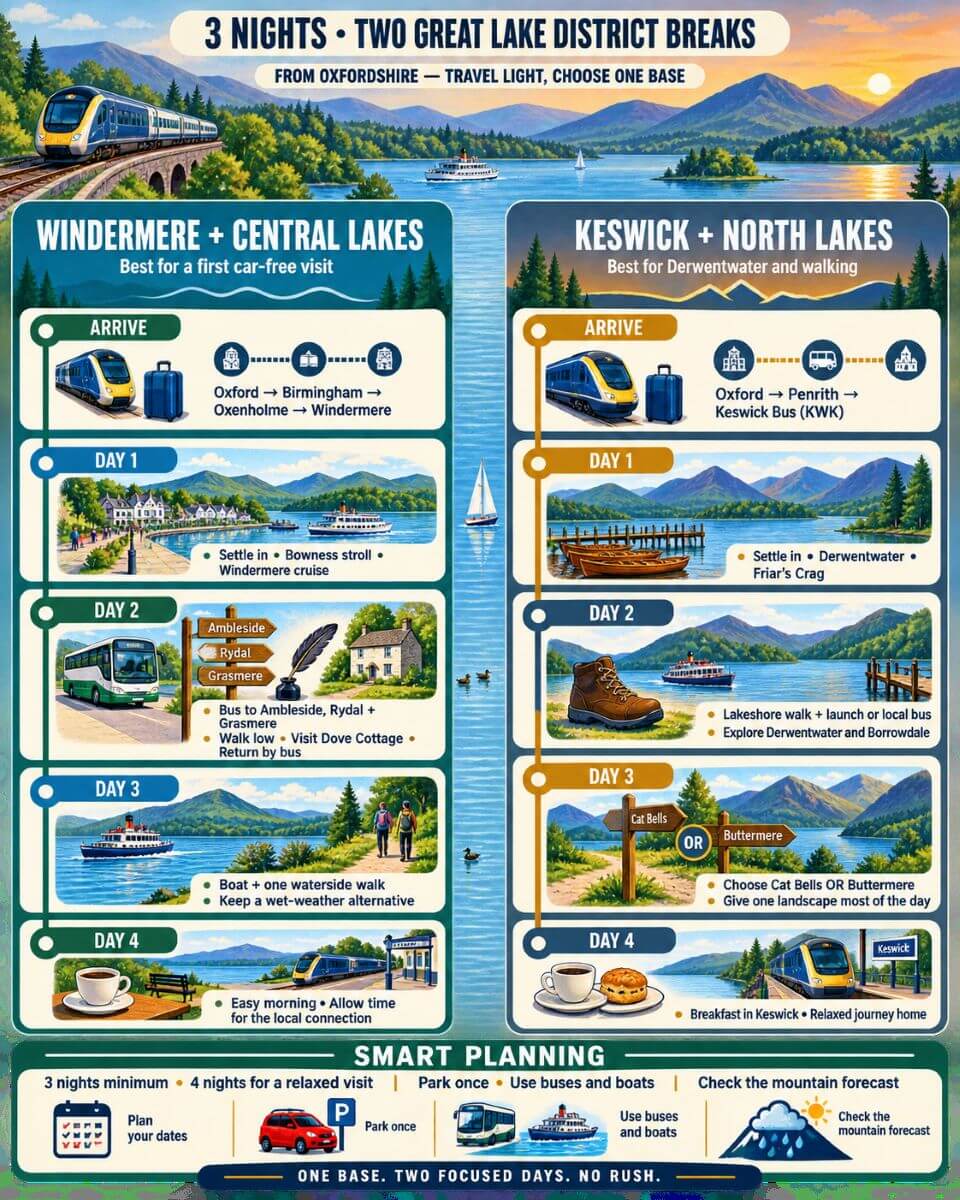
This version assumes a base in Windermere, Bowness-on-Windermere or Ambleside.
Day one: travel and settle in
Travel from Oxfordshire to Windermere, leave your luggage and keep the afternoon simple.
Take a bus to Bowness or Ambleside, have a short walk and consider a lake cruise. Do not place the trip’s most demanding activity immediately after several hours of rail travel.
Day two: Central Lakes by bus
Use the 599 or 555 corridor to visit Ambleside, Rydal and Grasmere. Choose one main experience rather than trying to complete several unrelated things.
Possible activities include:
- A low-level walk between Rydal and Grasmere
- A visit to Dove Cottage
- A village lunch
- A short guided walking tour
- A return journey on the open-top bus
Day three: water and walking
Combine a boat trip with one walk. From Bowness, use Windermere services to build a day around Ambleside or Brockhole.
Keep a wet-weather alternative. A covered boat journey, museum or long lunch is a better decision than forcing a high walk in unsuitable conditions.
Day four: return to Oxfordshire
Stay close to the accommodation in the morning and leave enough time for the local connection. Missing the first bus can affect the entire journey home.
A three-night Keswick itinerary
Day one: travel through Penrith
Book to Keswick Bus (KWK), travel by train to Penrith and continue on the included X4 or X5 bus. Leave the luggage and walk to Derwentwater or Friar’s Crag.
Day two: Derwentwater and Borrowdale
Combine a lakeshore walk with the launch or a local bus. This delivers a strong North Lakes experience without needing to move a car.
Day three: Cat Bells or Buttermere
Choose Cat Bells in suitable conditions, or use the seasonal bus connection for Buttermere and Honister.
Do not attempt both simply to cover more destinations. Each deserves most of a day.
Day four: a relaxed departure
Have breakfast in Keswick and use the integrated bus-and-rail journey back to Oxfordshire.
A three-night driving itinerary
Day one: drive to one base
Decide between the South, Central or North Lakes before joining the M6. Check in and choose an activity within walking distance.
Day two: leave the car parked
Use the bus, a boat tour or both. This often becomes the most relaxing day of the break.
Day three: choose one larger landscape
From Ambleside, choose Grasmere, Langdale or Coniston.
From Keswick, choose Derwentwater, Borrowdale or Buttermere.
From Ullswater, combine a lakeside walk with an operating steamer or bus service.
Day four: keep the return simple
Avoid a major walk before the drive home. Sunday traffic can turn a manageable journey into a tiring one.
Walking, weather and maps
The Met Office publishes a dedicated Lake District mountain forecast for walkers, mountaineers and other people taking part in outdoor activities. It covers wind, rain, temperature, visibility and hazards and is more useful for a fell day than a standard town forecast.
Check it on the morning of the walk. Conditions on the summits can be very different from those beside the lake.
For higher or remote routes:
- Carry an appropriate paper map and know how to use it.
- Do not depend entirely on phone navigation.
- Save offline maps before leaving.
- Carry enough power for emergencies.
- Tell someone which route you intend to take.
- Keep a lower-level alternative.
Visitors seeking more accessible experiences can use the National Park’s Miles Without Stiles routes, which include lakeshores, riversides, woods and some higher viewpoints.
Parking and peak-time tourism
Popular car parks can fill early, especially near well-known walking routes and villages. Always save a second location rather than circling one full car park.
Payment methods vary. Lake District National Park guidance notes that card payment is not possible at some car parks; several accept coins or app-based payment, while a small number are coins-only or cards-only. Check the individual car park page and carry an alternative means of payment.
Do not obstruct gateways, passing places or emergency access. Rural tourism creates significant pressure on small communities and narrow roads, so parking legally is part of visiting responsibly.
When is the best time to visit?
Late spring and early summer offer long days and more time for walking. Autumn can provide quieter trails and strong colour, although daylight shortens quickly. Winter can be peaceful, but some buses, boats, tours and attractions operate reduced schedules.
There is no reliably dry season in the Lake District. Check the mountain forecast, pack waterproof clothing and build enough flexibility into the itinerary to change the main activity.
Avoiding school holidays and arriving on a weekday can make accommodation, parking and public transport easier.
Key things to do on a first Lake District visit
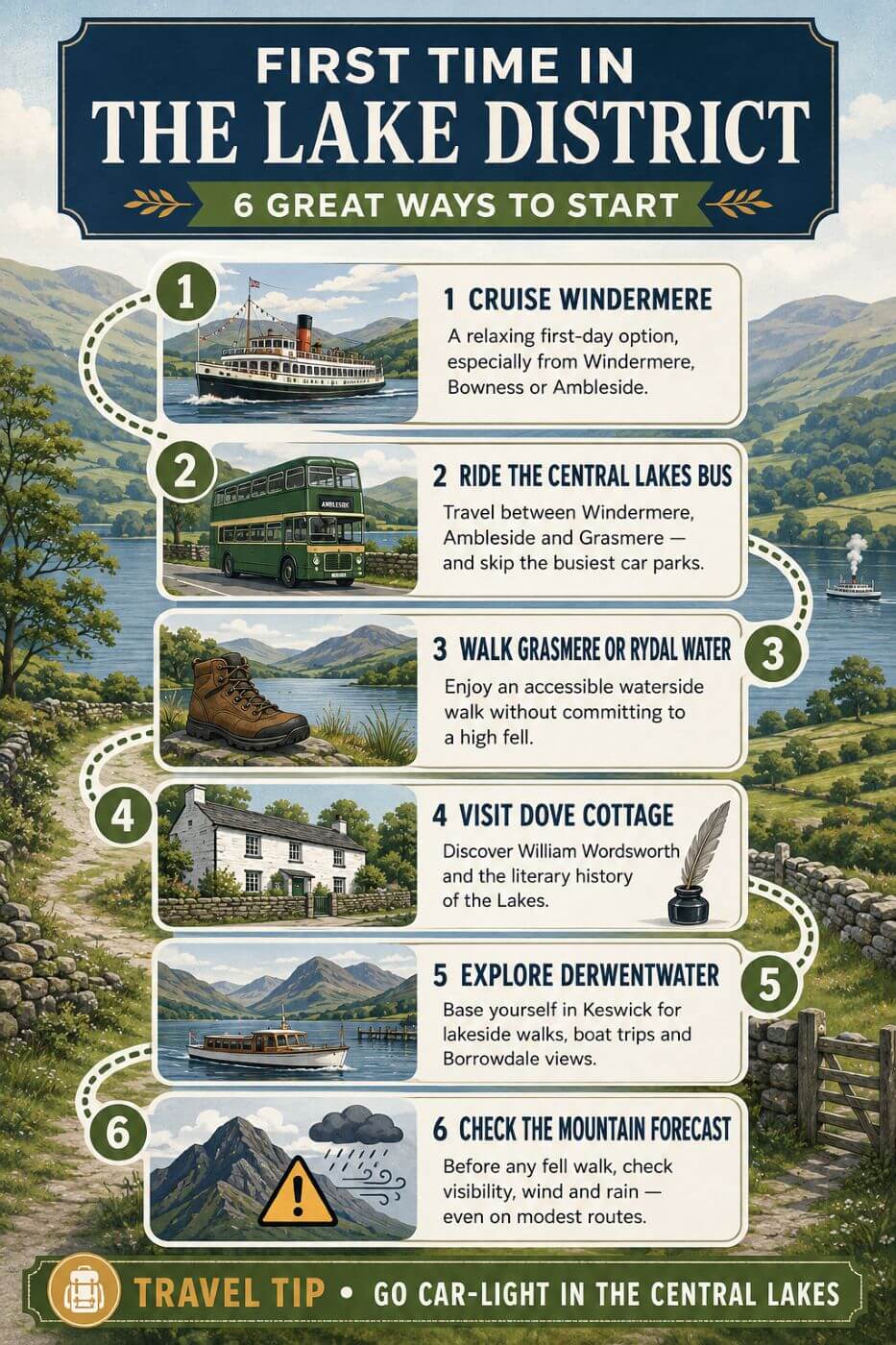
Take a Windermere lake cruise: A good first-day option after travelling from Oxfordshire, especially if staying in Windermere, Bowness or Ambleside.
Use the bus between Windermere, Ambleside and Grasmere: It avoids some of the busiest parking spots and gives visitors an easy way to see the Central Lakes without moving the car.
Walk around Grasmere or Rydal Water: A manageable way to enjoy the landscape without committing to a high fell walk.
Visit Dove Cottage: A useful stop for readers interested in William Wordsworth and the literary history of the Lakes.
Spend time at Derwentwater: Keswick and Derwentwater are ideal for a second visit or a northern Lakes base, with lakeside walks, boat trips and views towards Borrowdale.
Check the mountain forecast before any fell walk: Even modest-looking routes can feel very different in poor visibility, wind or rain.
Verdict
The Lake District is well worth the journey from Oxfordshire, provided you plan it as a proper break rather than a rapid tour.
For the easiest first visit, take the train to Windermere and stay in Windermere town, Bowness-on-Windermere or Ambleside.
For Derwentwater, Buttermere and the northern fells, book through to Keswick and stay there for the whole trip.
When driving, choose the base before choosing the motorway exit. Park once, keep one day car-free and allow the landscape, not a checklist, to set the pace.
Frequently asked questions
Can you visit the Lake District from Oxfordshire without a car?
Yes. Travel through Oxenholme to Windermere for the South and Central Lakes, or book an integrated journey through Penrith to Keswick. Central Lakes buses connect Windermere, Bowness, Ambleside and Grasmere, while Keswick provides access to Derwentwater and Borrowdale.
Which station should I use?
Use Windermere for Windermere, Bowness, Ambleside and Grasmere. Use Penrith (North Lakes), or book directly to Keswick Bus (KWK), for Keswick and the North Lakes.
Oxenholme Lake District is principally the main-line interchange for the Windermere branch.
Is Keswick a good place for a first visit?
Yes, especially for walkers and visitors interested in Derwentwater, Borrowdale, Cat Bells and Buttermere. It has a substantial town centre, public transport, accommodation and poor-weather alternatives. It is less suitable for a short trip focused mainly on Windermere and the South Lakes.
Is the Lake District a day trip from Oxfordshire?
It is technically possible but poor value for most people. The road journey consumes much of the day, while a rail day trip leaves little margin for delays or onward local transport. Three nights is a much more practical minimum.
Should I choose a cottage or a hotel?
Choose a hotel for convenience and a shorter stay. Choose a self-catering cottage for extra space, flexible meals, group travel or a longer walking holiday. In either case, check the actual distance from transport, restaurants and the activities you intend to do.
Can I visit Buttermere without driving?
Seasonal bus services connect Keswick with Honister and Buttermere. They do not operate identically throughout the year, so check the timetable for the exact date before booking accommodation or a walking plan around them.
Can I rely on digital maps and card payments?
No. Download maps and directions before leaving, but carry a suitable paper map for serious walks. Some car parks do not accept cards, so take coins or confirm that app payment is available.