Moving there as a British family or retiree needs a different kind of judgement. A holiday tells you about the beaches, peak weather and food. It tells you far less about school places, residence permits, prescription access, winter ferries, property paperwork, fire evacuation routes or how long it really takes to reach a hospital from the house you are thinking of buying.
And there are two Greeces when you live outside of the cities. The first is the tourist heavy peak season April to September alive with activity and people. The other, is the quiet winter period where it’s noticeably quieter where places close due to lack of demand. Most Greeks have a summer job in the tourism sector, then a second job in the winter or don’t work at all.
For most British families, the question is not simply whether Greece is safe enough to call home. It usually is. The better question is whether a particular Greek location works legally, medically, financially and practically for the life you intend to lead there.
If you are relocating to Greece as a British family or retiree, check five things before committing to a property: your residence route, healthcare access, tax position, children’s schooling and whether the location works outside the summer season.
Official guidance used: This article should be checked against GOV.UK’s Living in Greece guidance, FCDO Greece safety and security advice, the Greek Ministry of Migration and Asylum, GOV.UK healthcare guidance for UK nationals living in Greece, EOPYY, AADE tax identification guidance and Greek Civil Protection guidance. Rules can change, so check official sources before making legal, tax, healthcare or property decisions.

Start with residence, not property
Property should not lead the move. Residence should.
British citizens no longer have automatic freedom of movement in Greece unless they also have relevant EU citizenship or rights under the Withdrawal Agreement. GOV.UK says British nationals who want to live in Greece should usually apply for a visa before arrival, typically Type D national visas, and then apply for a temporary residence permit after arrival. New residents must also register their address in person with the regional branch of the Hellenic Police within 90 days of arrival.
This matters because the property plan and the residence plan can easily diverge. A home may be affordable but unsuitable for the visa route. A coastal apartment may work for retirement but not for a family needing schools. A property may support an investment-residence strategy but still be impractical for everyday life.
British nationals should settle the broad route before paying a large deposit: retirement, work, digital nomad, study, family residence or investment. GOV.UK lists several visa purposes, including work, digital nomad, study, family and retirement routes. It also notes that permanent residency may be possible after five years of living in Greece with a temporary residence permit.
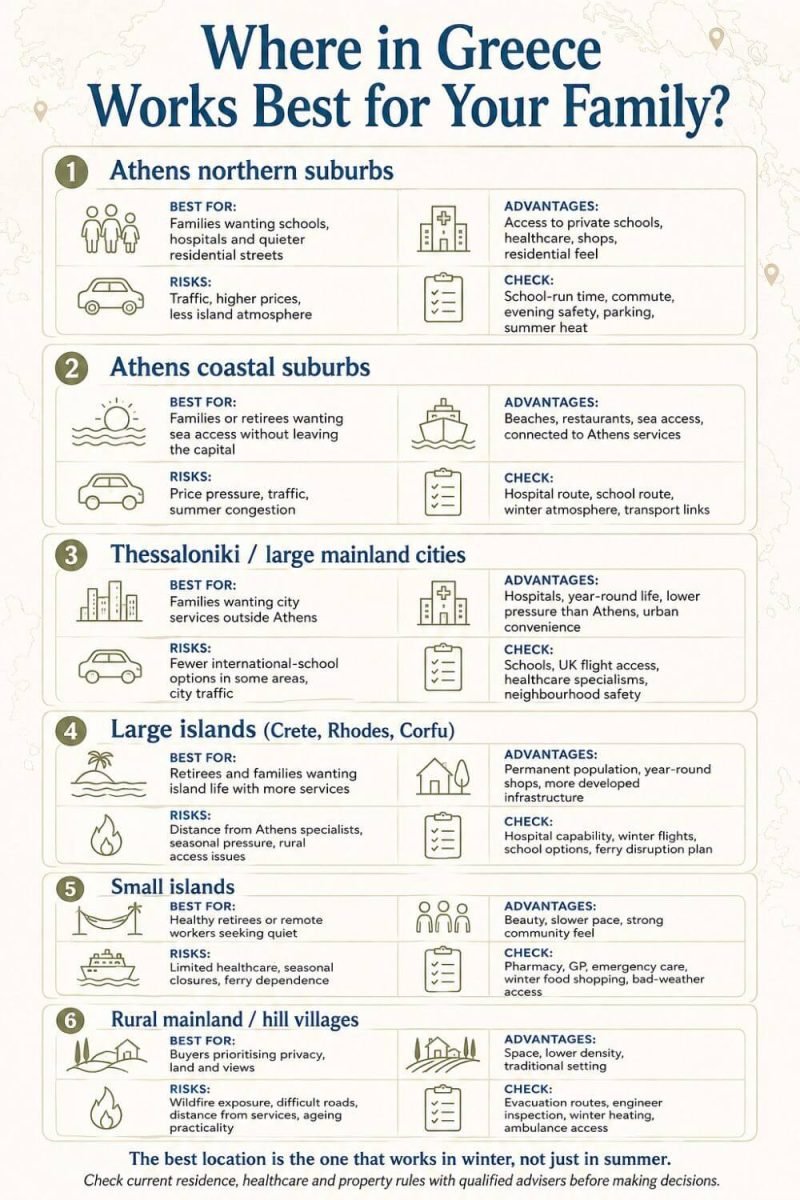
Compare the location types before choosing a home
The biggest relocation mistake is choosing the view before choosing the life around it.
A family in Athens, a retiree in Crete and a couple on a small Cycladic island are not making the same move. They are choosing different healthcare access, school options, road networks, winter services and emergency plans.
| Location type | Works best for | Main advantages | Main risks | Check before committing |
|---|---|---|---|---|
| Athens northern suburbs | Families wanting schools, hospitals and quieter residential streets | Strong access to private schools, healthcare, shops and transport | Traffic, higher prices, less “island lifestyle” | School-run time, commute, evening safety, parking, summer heat |
| Athens coastal suburbs | Families or retirees wanting sea access without leaving the capital | Beaches, restaurants, international feel, access to Athens services | Price pressure, traffic, summer congestion | Hospital route, school route, winter atmosphere, transport links |
| Thessaloniki or other large mainland cities | Families wanting city services outside Athens | Universities, hospitals, year-round life, lower pressure than Athens | Fewer international-school options than Athens in some areas | Schools, flights to the UK, healthcare specialisms, neighbourhood-by-neighbourhood safety |
| Large islands such as Crete, Rhodes or Corfu | Retirees and families wanting island life with more services | Permanent population, year-round shops, larger hospitals than small islands | Distance from Athens specialists, seasonal pressure, some rural access issues | Hospital capability, winter flights, school options, ferry disruption plan |
| Small islands | Healthy retirees or remote workers seeking quiet | Beauty, community, slower pace | Limited healthcare, seasonal closures, ferry dependence | Pharmacy, GP, emergency care, winter food shopping, bad-weather access |
| Rural mainland or hill villages | Buyers prioritising privacy, land and views | Space, lower density, traditional setting | Wildfire exposure, road access, ageing practicality, distance from services | Evacuation routes, engineer inspection, winter heating, ambulance access |
A good location should pass the ordinary Tuesday test. Where is the school? Where is the nearest doctor? Can you buy groceries in January? How hard is the road after dark? What happens if someone needs urgent care?
Work out healthcare before choosing a location
Healthcare access can decide whether a Greek location is practical.
Public healthcare in Greece is run by EOPYY, the Greek National Organisation for Healthcare Services Provision. GOV.UK says people moving to Greece must show proof of healthcare cover before registering as a resident and when applying for a visa. People staying in Greece for more than three months must register as residents.
If you are employed or self-employed in Greece, you must register with the Greek authorities and get a social insurance number. Once you are registered to work and make social insurance contributions, you are entitled to state-run healthcare on the same basis as a Greek citizen. Social insurance is called AMKA, and once you have an AMKA number, you must register with EOPYY.
For retirees, the S1 form can be important. British nationals who are resident in Greece and receive a UK State Pension or certain exportable benefits may be entitled to UK-funded state healthcare through an S1 form. Once the S1 is registered in Greece, the holder and dependants can access state healthcare on the same basis as an insured Greek citizen.
If you are not working and do not have a registered S1, GOV.UK says you will have to take out private health insurance.
This is why location matters. Living near Athens, Thessaloniki, Patras or Heraklion gives far more choice than living on a small island. A beautiful house is less attractive if every specialist appointment requires a ferry, a flight or an overnight stay.
Before choosing a home, map the actual healthcare journey: nearest emergency department, paediatrician, pharmacy, GP, private clinic, EOPYY office and prescription route. For retirees, the standard should be stricter. A location that works at 62 may not work at 78.
Check schools and children’s routines
Families often start with international schools. They should go further.
GOV.UK says all children aged 6 to 15 must attend school in Greece, and points families to Greek government guidance on school enrolment.
The practical questions are about routine. Will your child attend a Greek state school, international school, bilingual school or private school? Is the school run manageable in Athens traffic? Are activities available throughout the year? Can teenagers travel independently? Are you dependent on a car for every journey?
Athens often works well for families because schools, healthcare, shops and activities are concentrated. Coastal suburbs can offer a strong compromise for families wanting sea access without losing the capital’s services. Large islands may also work, but the school and healthcare map needs checking carefully.
A retired couple may happily trade convenience for views. A family with two school-age children may regret the same trade within weeks.
Understand tax before becoming resident
Relocation changes your administrative life.
British nationals living in Greece will usually need a Greek tax identification number, known as AFM. GOV.UK says residents must register for an AFM, submit a yearly tax return and submit an annual declaration of assets, including assets held outside Greece. It also notes that the UK has a double taxation agreement with Greece so the same income is not taxed twice in both countries.
This should be handled before the move, not after the first Greek tax deadline. The position may differ for UK pensions, rental income, remote work, dividends, investments and UK property.
Remote workers should be especially careful. Working for a UK employer while living in Greece can raise immigration, tax, social security and employment-law questions. Speak to a cross-border tax adviser before becoming resident.
Visit the neighbourhood in real life, not holiday mode
Asking whether Greece is safe is useful only up to a point.
Someone living in a quiet Athens suburb will have a different experience from someone renting near a busy transport hub. A family in Crete faces different questions from a retiree on a small island. A village home outside a town requires different planning from an apartment near a tram stop.
The decision should begin at street level. Visit in daylight and after dark. Walk to the shops. Use the transport you would actually use. Drive the school run, the hospital route and the airport route. Ask whether local shops, pharmacies, restaurants and services stay open in winter.
Petty theft is mainly a normal big-city and tourist-area concern, not a reason to reject Greece. FCDO guidance says thefts of passports, wallets and handbags are common on the metro and in crowded tourist places, particularly in central Athens. It also advises keeping valuables out of sight in vehicles and parking in well-lit or secure areas.
For residents, the more useful question is whether the neighbourhood feels manageable every day.
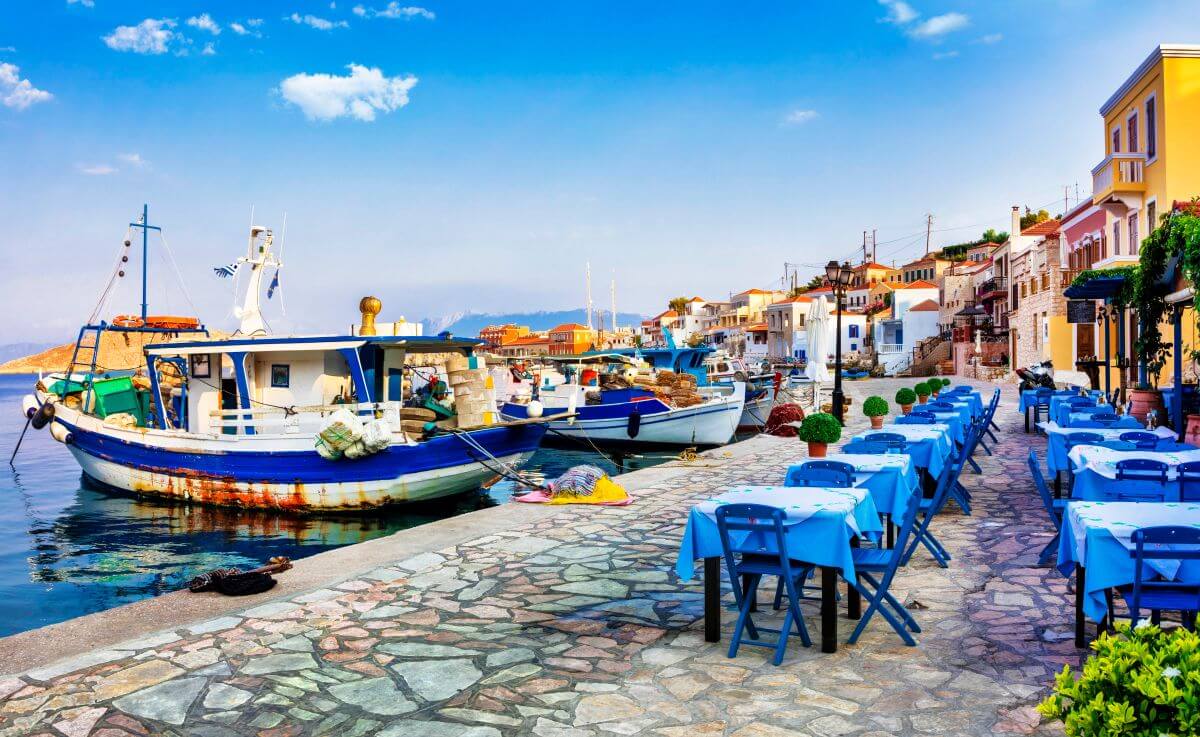
See the place in winter
One of the best tests of a Greek location is to visit when the tourists have gone.
This matters most on islands and in resort towns. A place that feels lively in August can feel very different in February. Restaurants close. Flights reduce. Ferries may be less frequent. Some services depend on seasonal demand.
That may suit a couple seeking a quieter retirement. It may be difficult for a family needing schools, activities, reliable transport and medical appointments.
Before choosing an island or remote location, check winter ferry frequency, winter flights, ambulance access, broadband, heating costs, year-round pharmacies, year-round shops and whether tradespeople are available outside the summer season.
Six months after moving, these questions may matter more than the view.
Treat heat, wildfire and flood risk as property checks
A British buyer can underestimate a Greek summer when they have only experienced it beside a hotel pool.
Heat affects the type of home worth buying. Air conditioning, insulation, shutters, shade, orientation and ventilation are not luxuries. They affect comfort, sleep, running costs and health.
Wildfire risk deserves particular attention in rural, semi-rural and wooded areas. FCDO guidance says Greece has a high wildfire risk during the summer season from April to October, and that wildfires are dangerous, unpredictable and can change quickly. Greece can also experience earthquakes, extreme heat and flash floods, and residents should enable emergency alerts on their phones.
A secluded house surrounded by pine trees may look beautiful in spring. In August, the same setting raises questions about vegetation, road access, water supply, insurance and evacuation routes.
Before buying, ask whether there is more than one practical road out, whether emergency vehicles can reach the house, whether the area has burned before, whether the mobile signal works, and whether buildings insurance covers wildfire, flood, earthquake and temporary accommodation.
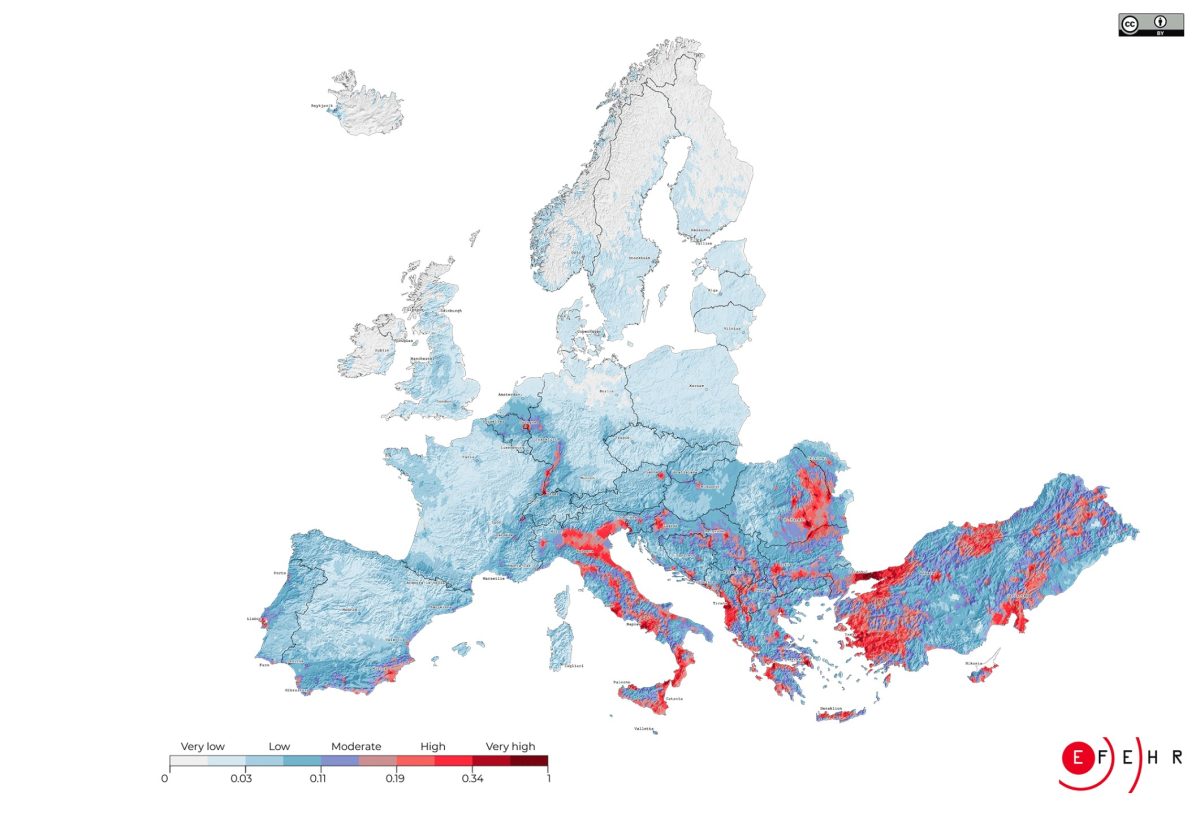
Take earthquakes seriously, but practically
Earthquakes are part of Greek geography, I’ve experienced mild ones in Zante, Keflonia and Kos, and they are more common than most people realise with 21 this century over 6 magnitude, only one was 7 magnitude or over. They should influence property checks rather than create panic, it’s not unique to Greece, it’s just that the UK and Ireland are relatively far away from the fault lines.
FCDO guidance states that there is a risk of earthquakes and earth tremors in Greece and advises people to familiarise themselves with earthquake safety procedures, follow local authority advice and call 112 if in immediate danger. The FCDO also links to mySafetyPlan for emergency assembly points in Greece.
For buyers, the sensible response is structural due diligence. The age, construction, maintenance and alteration history of the building matter. So do extensions, balconies, retaining walls, basement works and heavy renovations.
An independent engineer should inspect older, rural or heavily renovated properties before completion. Legal checks should confirm whether extensions and alterations have been properly recorded and authorised.
A pretty old house can still be a good purchase. It simply needs to be checked as a building, not admired only as a lifestyle.
Test the roads you will actually use
Driving deserves more attention than many relocation plans give it.
FCDO guidance describes traffic in larger Greek cities as busy, fast and chaotic, and notes that local drivers regularly ignore speed limits. It also warns that drivers do not always stop at pedestrian crossings.
For British residents, documents matter too. GOV.UK says you can drive in Greece for up to six months using a UK or Gibraltar driving licence. If you have been resident in Greece for six months or more, you should exchange a UK, Jersey, Guernsey, Isle of Man or Gibraltar licence for a Greek one.
Outside the cities, the challenge changes. Island and mountain roads can be narrow, poorly lit and unforgiving. A hillside villa may lose some of its charm if every supermarket trip involves a difficult road after dark.
Before buying, drive the routes you will actually use. Do it in daylight and at night. For retirees, ask whether the road will still feel reasonable in ten or fifteen years.
Use property to support the move, not lead it
Buying property in Greece can be attractive, but it should come after the relocation strategy.
GOV.UK says foreign nationals can own land and property in Greece, but usually need an AFM. It also recommends contacting an English-speaking lawyer when considering buying property or land in Greece.
That legal advice should be independent. A buyer should understand title, debts, boundaries, building permits, unauthorised works, access rights, planning issues, cadastral records, tax obligations and insurance before completion.
If the purchase is part of an investment-residence strategy, treat the residence process as a legal matter rather than an estate-agent promise. Greek Golden Visa procedures involve specific permit categories, supporting documents, notarial certificates, land registry or cadastral evidence and, for some property routes, technical or insurance requirements.
Property is where many relocation decisions become expensive. Do not use it to solve questions that should have been answered earlier.
Build an emergency plan before you need one
Emergency planning is not alarmist. It is ordinary family planning.
Greece’s 112 emergency communications service can be used to contact emergency services and can also send mass alerts when a natural disaster or dangerous situation may threaten life, health or safety. Civil Protection guidance also lists alternative emergency numbers: Police 100, Fire Service 199, EKAB ambulance 166 and the European Emergency Call Number 112.
Every household should know how to call for help, where important documents are, what medication needs to be carried, who collects children from school and where the family meets if roads close or mobile signal fails.
FCDO guidance suggests preparing a grab bag with essentials such as passports or ID cards, mobile phones and chargers, money and bank cards, insurance documents, important papers, essential medicine and prescription details.
For British families, the practical version is simple: keep digital and paper copies of passports, residence permits, insurance and prescriptions; save local emergency numbers; keep school contacts updated; and know the route to the nearest hospital.
Frequently asked questions
Can British citizens move to Greece permanently?
British citizens can move to Greece, but they need the correct visa and residence route unless they have separate EU rights or rights under the Withdrawal Agreement. GOV.UK says British nationals who want to live in Greece should usually apply for a visa before arrival and then apply for a temporary residence permit after arrival.
Can I stay in Greece for more than 90 days without residency?
For a long-term move, no. GOV.UK says British citizens can travel to Greece without a visa for up to 90 days in any 180-day period for short stays, but for a longer stay they must apply to the Greek authorities for a national visa. The Living in Greece guidance also says new residents must register their address and apply for a temporary residence permit within 90 days of arrival.
How do UK retirees access healthcare in Greece?
Some UK retirees may be entitled to UK-funded state healthcare through an S1 form if they receive a UK State Pension or qualifying exportable benefit. Once the S1 is registered in Greece, they and their dependants can access state healthcare on the same basis as an insured Greek citizen.
Do non-working British residents need private health insurance?
If they are not working in Greece and do not have a registered S1 form, GOV.UK says they will have to take out private health insurance. Healthcare cover is also required before registering as a resident and when applying for a visa.
Are children required to attend school in Greece?
Yes. GOV.UK says all children aged 6 to 15 must attend school in Greece. Families should check enrolment requirements, language, transport, international-school availability and after-school routines before choosing a home.
Is buying a property enough to live in Greece?
No. Property ownership and residence rights are separate issues. Foreign nationals can own land and property in Greece, but buyers usually need an AFM and should take independent legal advice. If the property is part of an investment-residence plan, the residence route needs separate legal checking.
Which Greek locations work best for British families?
Athens and its suburbs usually offer the widest choice of schools, healthcare and services. Large islands such as Crete, Rhodes and Corfu may also work well, especially where there are year-round services. Smaller islands and rural villages can suit some retirees, but families should check winter transport, schools, healthcare and emergency access very carefully.
What should I check before buying an older Greek property?
Use an independent lawyer and an independent engineer. Check title, debts, land registry or cadastral records, building permits, extensions, alterations, access rights, insurance, structural condition, wildfire exposure, earthquake resilience and whether the property works year-round.
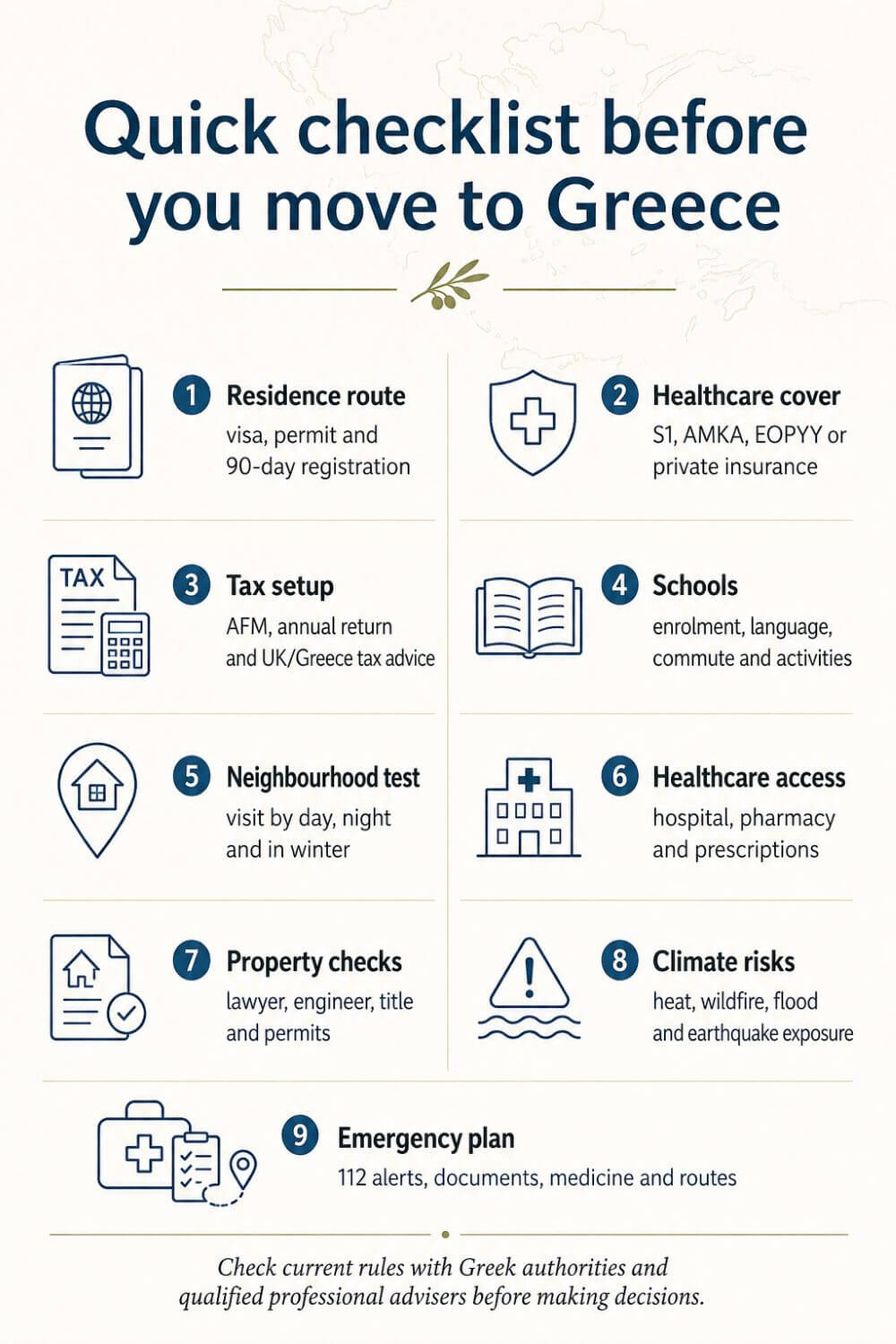
Is Greece a good move for British families?
Greece can offer British families and retirees an exceptional quality of life: climate, food, sea, community, culture and a slower rhythm of living.
But the people most likely to enjoy it long term are those who look beyond the postcard.
Before moving, settle the residence route. Confirm healthcare. Understand tax. Choose schools carefully. Visit in winter. Test the roads. Inspect the property properly. Understand heat, wildfire and earthquake exposure. Know where the nearest hospital is. Make sure the location works for ordinary Tuesdays, not just summer holidays.
Greece is not just a place to buy. It is a place to live. The best decisions are made by people who treat it that way from the beginning.
This article is general information for British nationals considering a move to Greece. It is not immigration, tax, legal, medical or financial advice. Current rules should be checked with the relevant Greek authorities and qualified professional advisers before decisions are made.