Oxfordshire has large acute hospitals, specialist centres, community hospitals, mental-health hospitals, maternity units, minor-injury services and private hospitals. The names can be confusing, because not every building called a hospital has an Emergency Department, and some services are based on the same campus but run by different NHS trusts.
Need medical help now?
Call 999 for a serious or life-threatening emergency. If you need urgent help but it is not life-threatening, use NHS 111 online or call 111. For urgent mental-health support that is not immediately life-threatening, call 111 and select option 2. Opening hours and service arrangements can change, so check NHS 111 or the relevant hospital before travelling
This guide explains what Oxfordshire’s main hospitals do, where to go for emergency or urgent care, and how community hospitals, mental-health services, maternity units and private hospitals fit into the county’s healthcare system.
Oxfordshire hospitals at a glance
| If you need… | Usual service |
|---|---|
| Major emergency care | John Radcliffe Hospital or Horton General Hospital Emergency Department |
| Emergency care for a child | Dedicated Children’s Emergency Department at the John Radcliffe |
| Cancer treatment | Primarily the Churchill Hospital; some care is also provided at the Horton |
| Heart surgery or specialist cardiac care | Oxford Heart Centre at the John Radcliffe |
| Bone, joint or specialist rehabilitation care | Nuffield Orthopaedic Centre |
| Acute hospital care in north Oxfordshire | Horton General Hospital |
| A recent minor injury | Abingdon, Henley or Witney Minor Injury Unit; Bicester or Chipping Norton First Aid Unit may also be appropriate |
| Rehabilitation after acute illness or surgery | Oxford Health community hospital, usually after referral |
| Urgent mental-health support | NHS 111, option 2; call 999 if there is immediate danger |
| Consultant-led maternity care | Women’s Centre at the John Radcliffe |
Emergency, urgent or planned care: which route is right?
| Type of care | Use this route |
|---|---|
| Life-threatening emergency | Call 999 or go to A&E if safe to do so |
| Urgent but not life-threatening | Use NHS 111 online or call 111 |
| Recent minor injury | NHS 111 may direct you to a Minor Injury Unit or First Aid Unit |
| Eye emergency | Call Oxford Eye Hospital telephone triage before attending |
| Dental emergency | Contact your dentist or NHS 111; hospital A&E does not usually treat routine dental emergencies |
| Mental-health crisis | Call NHS 111 and select option 2; call 999 if there is immediate danger |
| Planned specialist care | Usually requires GP or consultant referral |
| Community hospital inpatient care | Usually requires referral from an acute hospital, GP or community healthcare team |
Oxford University Hospitals says the John Radcliffe and Horton General both have Emergency Departments open 24 hours a day, and the John Radcliffe has a dedicated Paediatric Emergency Department open 24 hours a day. OUH also says its Emergency Departments do not treat dental emergencies and patients with dental emergencies should call NHS 111.
Who runs Oxfordshire’s hospitals?
Most NHS hospital services in Oxfordshire are run by two NHS trusts.
Oxford University Hospitals NHS Foundation Trust, usually shortened to OUH, runs the county’s four main acute and specialist hospitals:
- John Radcliffe Hospital
- Churchill Hospital
- Nuffield Orthopaedic Centre
- Horton General Hospital
OUH lists those four hospitals as its main hospital sites and gives a single main switchboard number: 0300 304 7777.
Oxford Health NHS Foundation Trust runs the county’s community hospitals and provides community and mental-health services. Community hospitals commonly support rehabilitation, recovery, palliative care and care closer to home, rather than walk-in emergency treatment. Oxford Health lists community hospitals including Abingdon, Bicester, City Community Hospital, Didcot, Townlands, Wallingford, Wantage and Witney.
Local NHS planning and commissioning sit with NHS Thames Valley Integrated Care Board, which covers Oxfordshire, Buckinghamshire and Berkshire and was established in April 2026.
John Radcliffe Hospital
Address: Headley Way, Headington, Oxford OX3 9DU
Main role: Oxfordshire’s largest acute hospital and principal emergency centre
A&E: Yes, open 24 hours
Known locally as “the JR”, the John Radcliffe is Oxfordshire’s main emergency and specialist hospital. It provides acute medical and surgical care, major trauma services, intensive care and regional specialist services.
The wider John Radcliffe campus includes:
- adult Emergency Department
- dedicated Children’s Emergency Department
- Oxford Children’s Hospital
- Oxford Heart Centre
- Oxford Eye Hospital
- West Wing, including neurosciences
- Women’s Centre
- neonatal intensive and special care
OUH lists the John Radcliffe site as including the Children’s Hospital and West Wing, Oxford Eye Hospital, Oxford Heart Centre and Women’s Centre.
Although names such as Oxford Eye Hospital and Oxford Children’s Hospital sound like separate hospitals, they are part of the wider John Radcliffe site. The campus is large and built on a slope, so visitors should check the correct building, level and entrance on their appointment letter before travelling.
Churchill Hospital
Address: Old Road, Headington, Oxford OX3 7LE
Main role: Cancer, renal, transplant and specialist medical care
A&E: No
The Churchill is a major specialist hospital rather than a general emergency hospital. It is best known for cancer services, but it also provides other specialist medicine and surgery.
Services include:
- cancer medicine, clinical oncology and medical oncology
- clinical haematology
- radiotherapy
- cancer surgery
- renal services
- transplant services
- dermatology
- haemophilia services
- respiratory and chest medicine
- palliative care
- diabetes, endocrinology and metabolic medicine through OCDEM
OUH describes the Churchill as a centre of excellence for cancer services and other specialties including renal services and transplant, clinical and medical oncology, dermatology, haemophilia, chest medicine and palliative care.
The Churchill does not have an Emergency Department. Patients with an emergency should follow NHS 111 or 999 advice rather than travelling to the Churchill simply because they already receive treatment there.
The site can also be organisationally confusing. City Community Hospital and some Oxford Health mental-health services are located in the Fulbrook Centre on the Churchill campus, but they are run by Oxford Health rather than OUH.
Nuffield Orthopaedic Centre
Address: Windmill Road, Headington, Oxford OX3 7HE
Main role: Orthopaedics, rheumatology and specialist rehabilitation
A&E: No
The Nuffield Orthopaedic Centre, often called the NOC, specialises in bones, joints, movement, orthopaedics, rheumatology and rehabilitation.
Services include:
- orthopaedics
- rheumatology
- radiology
- rehabilitation
- OxSport
- metabolic medicine
- therapy services
- hydrotherapy
- day surgery
- treatment for bone infection and bone tumours
- limb reconstruction
- rehabilitation for limb amputation and complex neurological disability
OUH says the Nuffield Orthopaedic Centre has a reputation for orthopaedics, rheumatology and rehabilitation, and undertakes specialist work including bone infection, bone tumours, limb reconstruction and rehabilitation for limb amputation or complex neurological disabilities.
Despite its name, the Nuffield Orthopaedic Centre is an NHS hospital. It should not be confused with Nuffield Health’s private Manor Hospital elsewhere in Headington. The NOC does not have an A&E department.
Horton General Hospital
Address: Oxford Road, Banbury OX16 9AL
Main role: Acute hospital for Banbury and north Oxfordshire
A&E: Yes, open 24 hours
Horton General Hospital is north Oxfordshire’s main acute hospital. It provides emergency, inpatient, outpatient and day-case care for Banbury and the surrounding area.
Services include:
- 24-hour Emergency Department
- emergency admission unit
- acute general medicine
- elective day-case surgery
- trauma
- critical care
- paediatrics
- maternity through a midwifery-led unit
- gynaecology
- Brodey Centre cancer treatment
- diagnostic and therapy services
- outpatient clinics with visiting consultants from Oxford
OUH describes the Horton as an acute general hospital serving north Oxfordshire and lists services including an Emergency Department, acute general medicine, elective day-case surgery, trauma, maternity, gynaecology, paediatrics, critical care and cancer treatment at the Brodey Centre.
The Horton has paediatric services, but Oxfordshire’s dedicated 24-hour Children’s Emergency Department is at the John Radcliffe. The Horton Midwifery-led Unit supports lower-risk births; if obstetric or specialist medical care is required, transfer to the John Radcliffe Women’s Centre may be necessary.
Where to go in an emergency
Oxfordshire has two 24-hour NHS Emergency Departments:
- John Radcliffe Hospital, Oxford
- Horton General Hospital, Banbury
The John Radcliffe also has a dedicated 24-hour Children’s Emergency Department.
Call 999 for a life-threatening illness or injury. For urgent problems that are not life-threatening, or if you are uncertain which service you need, use NHS 111 online or call 111. NHS 111 can direct you to self-care, a pharmacy, an out-of-hours clinician, a Minor Injury Unit, a First Aid Unit or an Emergency Department.
Eye emergencies
Do not arrive at Oxford Eye Hospital without first seeking advice. Oxford Eye Hospital says patients with an eye emergency should not come straightaway and should call its specialist telephone triage number on 01865 234567, option 1 followed by option 1. The service is open Monday to Friday, 8.30am to 4.30pm, and Saturday, Sunday and bank holidays, 8.30am to 3.30pm. Out of hours, contact NHS 111.
Dental emergencies
Hospital A&E departments do not generally treat routine dental emergencies. OUH advises patients with a dental emergency to call NHS 111.
Minor Injury Units and First Aid Units
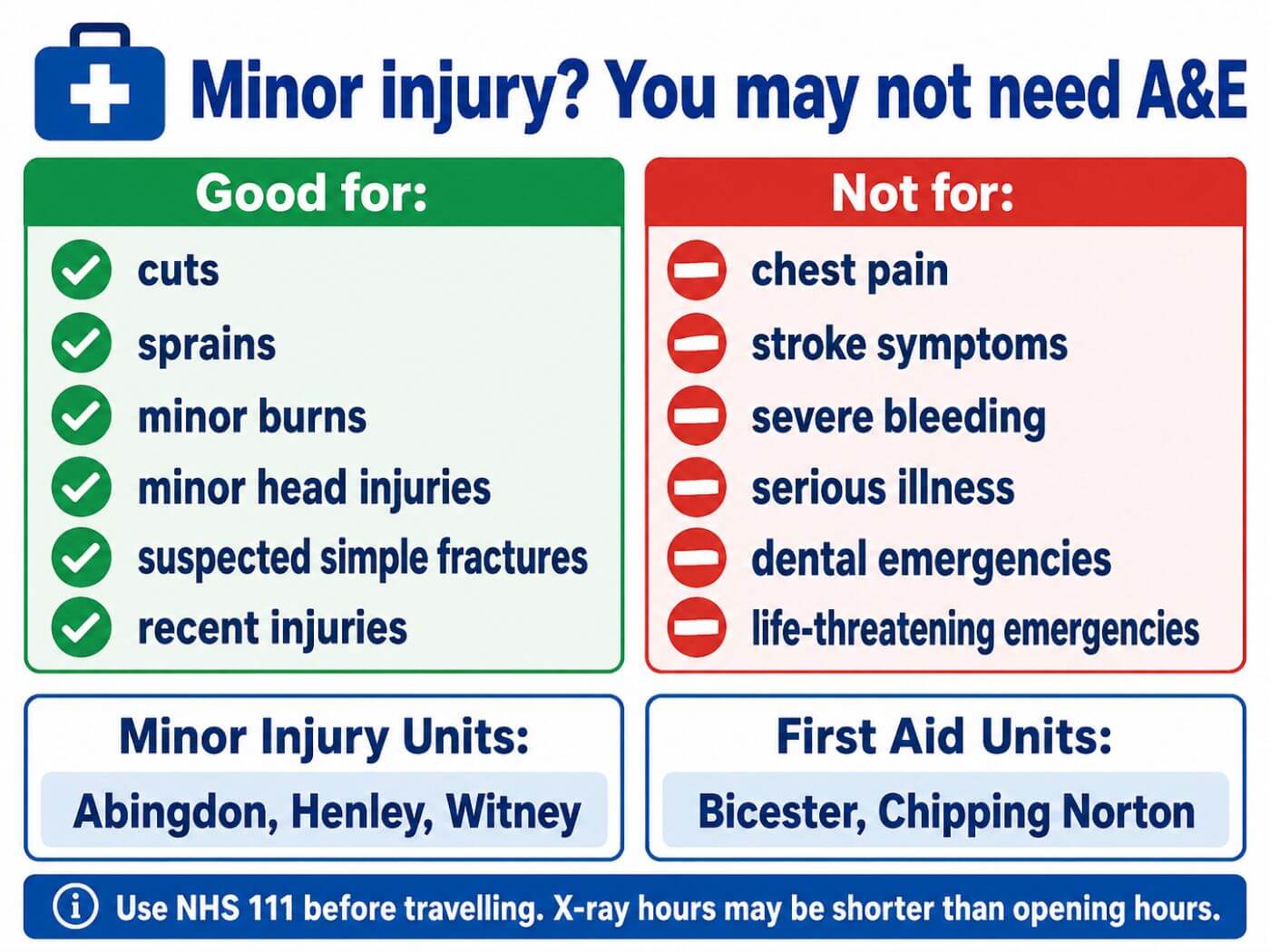
For a recent injury that is not life-threatening, a local Minor Injury Unit may be more appropriate than A&E. Oxford Health says its MIUs treat injuries sustained within the previous seven days and are not intended for general illnesses.
| Facility | Location | Published opening hours at time of writing |
|---|---|---|
| Abingdon Minor Injury Unit | Abingdon Community Hospital | Daily, 10am–10.30pm |
| Henley Minor Injury Unit | Townlands Memorial Hospital | Daily, 9am–9.30pm |
| Witney Minor Injury Unit | Witney Community Hospital | Daily, 10am–10.30pm |
| Bicester First Aid Unit | Bicester Community Hospital | Weekdays 6pm–11pm; weekends 8.30am–11pm |
| Chipping Norton First Aid Unit | Chipping Norton Health Centre / Outpatient Unit | Weekdays 5pm–9pm; weekends and bank holidays 10am–9pm |
Hours can change. Contact NHS 111 and check the latest Oxford Health or NHS service information before setting out. First Aid Units are more limited than MIUs and may not have X-ray facilities. Bicester asks patients to call NHS 111 before attending.
Minor Injury Units can assess problems such as cuts, sprains, minor burns and suspected simple fractures. X-ray departments may have shorter operating hours than the MIU itself.
Oxfordshire’s community hospitals
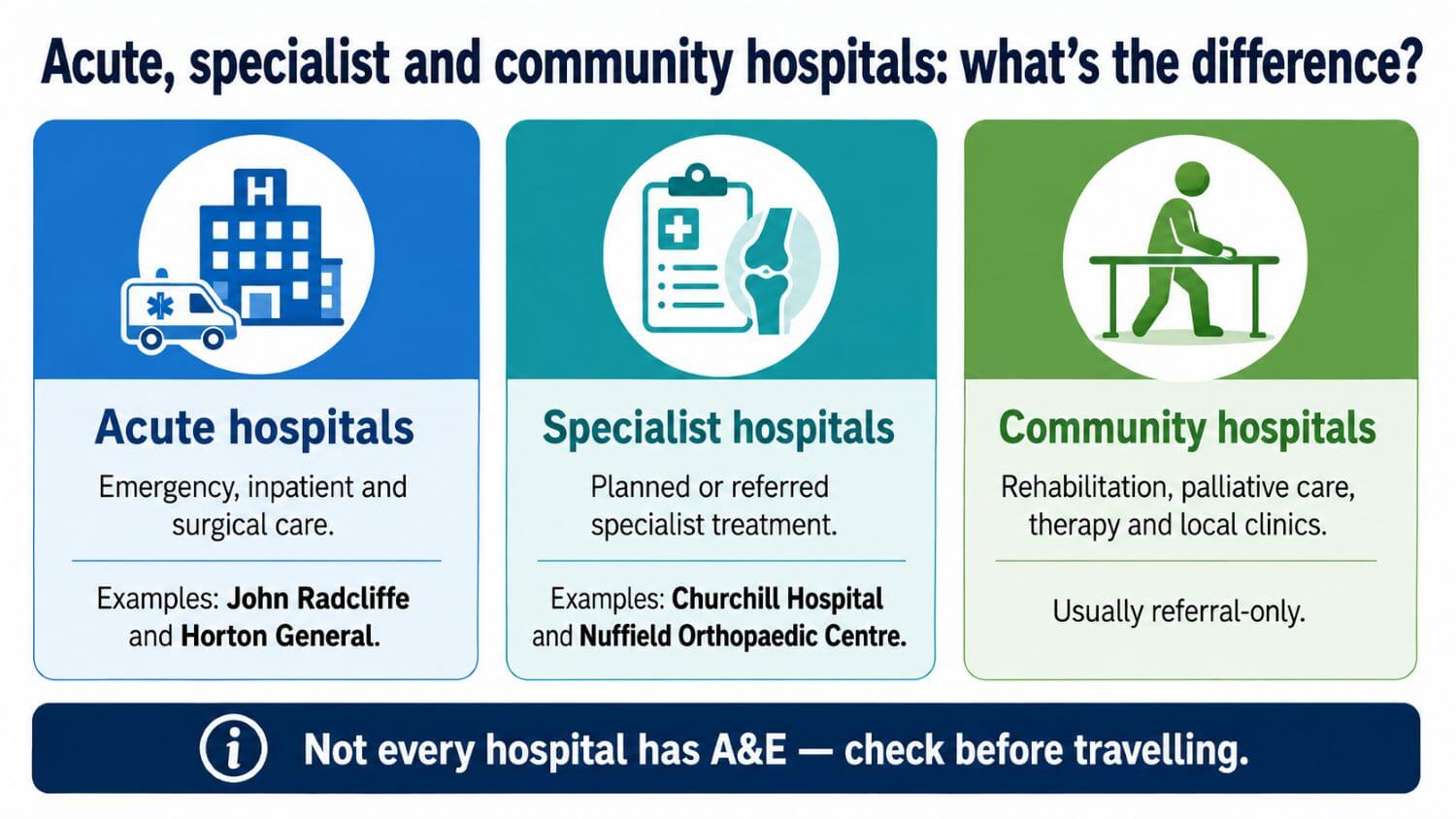
Community hospitals help bridge the gap between a major acute hospital and care at home. They commonly provide inpatient rehabilitation, palliative care, therapy and local outpatient clinics.
They are not walk-in alternatives to the John Radcliffe or Horton. Admission to a community inpatient bed normally follows referral from an acute hospital, GP or community healthcare team.
| Community hospital | Main role |
|---|---|
| Abingdon Community Hospital | Rehabilitation, palliative care, Oxfordshire Stroke Rehabilitation Unit, MIU, EMU, X-ray and outpatient services |
| Bicester Community Hospital | Rehabilitation, palliative care, outpatient services and First Aid Unit |
| City Community Hospital | Rehabilitation and palliative care on the Churchill campus |
| Didcot Community Hospital | Rehabilitation, palliative care and outpatient clinics |
| Townlands Memorial Hospital, Henley | Community inpatient care, Minor Injury Unit, rapid-access care and outpatient services |
| Wallingford Community Hospital | Rehabilitation, palliative care and maternity/birthing services |
| Wantage Community Hospital | Local clinics and community services, including maternity care |
| Witney Community Hospital | Rehabilitation, palliative care, Minor Injury Unit, X-ray, outpatient clinics and EMU |
Oxford Health’s community hospital directory lists Bicester, City Community Hospital, Didcot, Townlands, Wallingford, Wantage and Witney, and its Abingdon page describes rehabilitation, palliative care, a Minor Injury Unit, EMU, X-ray and the Oxfordshire Stroke Rehabilitation Unit.
Emergency Multidisciplinary Units
Emergency Multidisciplinary Units, or EMUs, are not walk-in A&E departments. Oxford Health says EMUs are based within community hospital sites and assess patients after contact with a healthcare provider such as a GP, community nurse or ambulance paramedic.
Mental-health hospitals and crisis support
Oxford Health provides mental-health care in community settings and at inpatient sites.
Important Oxfordshire mental-health sites include:
- Warneford Hospital, Headington
- Littlemore Mental Health Centre, Oxford
- Fulbrook Centre, on the Churchill Hospital campus
These are specialist inpatient or mental-health service sites, not walk-in hospitals. Admission normally follows assessment by a mental-health, crisis or emergency service.
For urgent mental-health support that is not immediately life-threatening, call NHS 111 and select option 2. Oxford Health describes the Buckinghamshire and Oxfordshire 24/7 Mental Health Helpline as available through NHS 111. Call 999 if someone is at immediate risk.
Maternity hospitals and birth centres
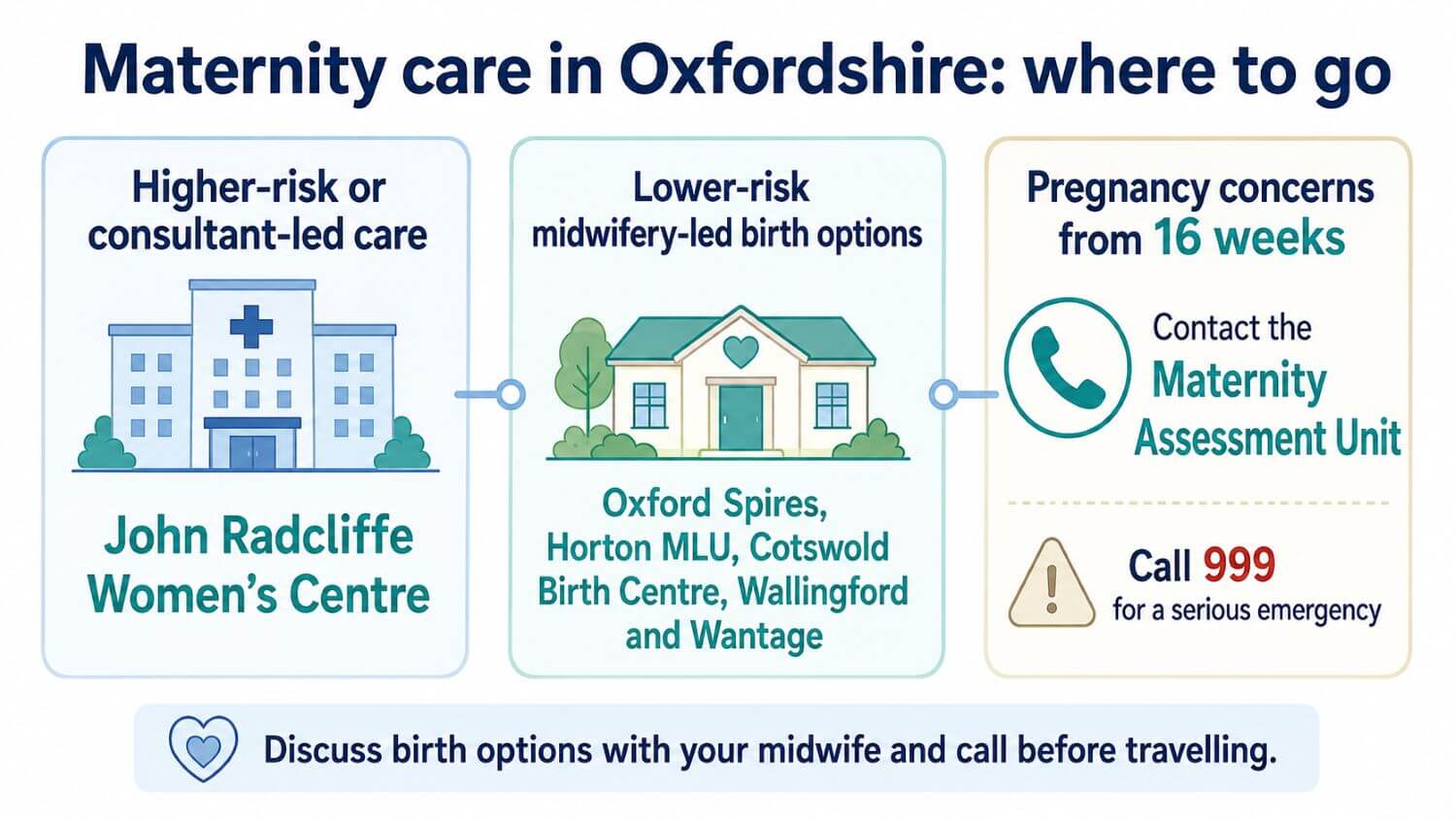
The John Radcliffe Women’s Centre is Oxfordshire’s main consultant-led maternity unit. It provides 24-hour obstetric, anaesthetic and neonatal support and is the main destination for complicated or higher-risk pregnancies.
For eligible lower-risk pregnancies, OUH also offers midwifery-led birth settings, including:
- Oxford Spires Midwifery-led Unit at the John Radcliffe
- Horton Midwifery-led Unit in Banbury
- Cotswold Birth Centre in Chipping Norton
- Wallingford Maternity and Birthing Centre
- Wantage Maternity Unit
OUH lists these birth-place options in its maternity information.
For pregnancy concerns from 16 weeks onward, OUH directs patients to the John Radcliffe Maternity Assessment Unit on 01865 220221. Earlier-pregnancy problems are assessed through the Early Pregnancy Assessment Unit. Call 999 for a pregnancy-related emergency that meets NHS emergency criteria.
Private hospitals in Oxfordshire
Oxfordshire also has independent hospitals. These are planned-care providers and are not substitutes for NHS Emergency Departments.
Nuffield Health, The Manor Hospital
Nuffield Health Oxford, The Manor Hospital, is a private hospital in Headington. Nuffield Health gives its address as Beech Road, Headington, Oxford OX3 7RP. NHS service listings identify it as an independent hospital that provides some free NHS services as well as paid private services.
This is separate from the NHS Nuffield Orthopaedic Centre.
The Cherwell Hospital
The Cherwell Hospital in Banbury is operated by Ramsay Health Care UK. Ramsay describes it as a private hospital providing care for self-pay, insured and NHS patients, and says NHS patients in England may attend for specified procedures through patient choice.
The New Foscote Hospital
The New Foscote Hospital in Banbury is a private hospital. Its website describes it as a private hospital providing consultant-led clinics, diagnostics and surgery. NHS service listings also identify Foscote Court / The New Foscote Hospital as an independent provider that provides some free NHS services as well as paid private services.
Private patients should check insurer authorisation, consultant fees, diagnostic costs and hospital charges before treatment.
Appointments and choosing a hospital
Most non-emergency hospital treatment begins with referral from a GP or another healthcare professional. Many referrals are managed through the NHS e-Referral Service, which allows patients to book or manage a first appointment where patient-choice rules apply.
Being referred to “Oxford University Hospitals” does not necessarily mean attending the John Radcliffe. A service might be based at the Churchill, NOC, Horton or a satellite clinic in a community hospital. Always check the hospital name, department, building and entrance shown on your appointment letter.
Travelling to Oxfordshire’s hospitals
Headington hospitals
The John Radcliffe, Churchill, Nuffield Orthopaedic Centre, Warneford and private Manor Hospital are all in Headington, but they occupy separate sites. Travel time between them can be longer than a map initially suggests.
Parking at the three OUH Headington hospitals is limited and chargeable. OUH says all its sites operate payment on departure, with the first 30 minutes free. Patients and visitors must park in designated patient and visitor car parks.
Hospital bus connections serve the John Radcliffe and Churchill from central Oxford, surrounding towns and several Park & Ride sites. Services change, so check current OUH travel information and bus operator timetables before travelling.
Horton General
Horton General is in Banbury, north Oxfordshire. OUH’s site information places it on Oxford Road, Banbury, OX16 9AL.
Parking concessions and patient transport
OUH says patients or visitors may be entitled to discounted or free parking in certain circumstances. It also says some patients may be entitled to non-emergency patient transport if, for example, they need continuous oxygen, cannot walk more than a few steps, require a stretcher or have a disability or problem that prevents ordinary private or public transport.
The Healthcare Travel Costs Scheme may also help some patients on low incomes with necessary travel costs for NHS treatment. OUH says claims must be made within three months of the appointment.
Visiting and getting help at hospital
Visiting arrangements can differ between hospitals and wards and may change during outbreaks or periods of clinical pressure. Check the relevant ward page or contact the ward before making a special journey.
For questions or concerns about care at Oxford University Hospitals, contact OUH Patient Advice and Liaison Service, known as PALS. OUH says PALS is committed to improving the service it gives to patients.
For community or mental-health services, contact Oxford Health’s patient advice and support routes.
Glossary
A&E / Emergency Department
A hospital department for serious and life-threatening illness or injury. In Oxfordshire, the 24-hour Emergency Departments are at the John Radcliffe and Horton General.
Minor Injury Unit
A service for recent, non-life-threatening injuries such as cuts, sprains, minor burns and suspected simple fractures. MIUs are not for general illnesses.
First Aid Unit
A more limited urgent injury service. First Aid Units may not have X-ray support.
Acute hospital
A hospital providing emergency, inpatient, surgical and specialist medical care.
Specialist hospital
A hospital focused on particular clinical areas, such as cancer, orthopaedics or rehabilitation. It may not have A&E.
Community hospital
A local hospital usually focused on rehabilitation, palliative care, therapy, outpatient clinics and support after acute illness. Inpatient care usually requires referral.
NHS trust
An NHS organisation that runs services. OUH and Oxford Health are the two main NHS trusts running hospital services in Oxfordshire.
ICB
An Integrated Care Board plans and oversees NHS services for a local area. NHS Thames Valley ICB covers Oxfordshire, Buckinghamshire and Berkshire.
PALS
Patient Advice and Liaison Service. PALS helps patients, relatives and carers with questions, concerns and feedback about hospital care.
Frequently asked questions
Which Oxfordshire hospitals have A&E?
The John Radcliffe Hospital in Oxford and Horton General Hospital in Banbury have 24-hour Emergency Departments. The John Radcliffe also has a dedicated 24-hour Children’s Emergency Department.
Which Oxfordshire hospitals do not have A&E?
The Churchill Hospital, Nuffield Orthopaedic Centre and Oxfordshire’s community hospitals do not have A&E departments. Patients with urgent needs should use NHS 111 or 999 depending on the situation.
Is the Nuffield Orthopaedic Centre private?
No. The Nuffield Orthopaedic Centre is an NHS hospital run by Oxford University Hospitals. It is different from Nuffield Health’s private Manor Hospital in Headington.
Can I walk into a community hospital for urgent care?
Usually no. Community hospital inpatient care normally requires referral. Some community hospital sites also host Minor Injury Units or First Aid Units, but those are specific services with their own opening hours and conditions.
What should I do for a minor injury in Oxfordshire?
Use NHS 111 online or call 111. You may be directed to a Minor Injury Unit or First Aid Unit if that is appropriate.
What should I do for urgent mental-health support?
If it is not immediately life-threatening, call NHS 111 and select option 2. If someone is at immediate risk, call 999.
Should I go straight to Oxford Eye Hospital for an eye emergency?
No. Oxford Eye Hospital says patients with an eye emergency should call its specialist telephone triage number first: 01865 234567, option 1 followed by option 1.
Does the Churchill Hospital have A&E?
No. The Churchill is a specialist hospital for cancer and other specialist services. It does not have an Emergency Department.
Where is consultant-led maternity care in Oxfordshire?
Consultant-led maternity care is at the John Radcliffe Women’s Centre. Lower-risk midwifery-led settings are also available at specified OUH maternity sites.
Who do I contact if I have a concern about hospital care?
For Oxford University Hospitals care, contact OUH PALS. For Oxford Health community or mental-health services, use Oxford Health’s patient support routes.
The key things to remember
- Oxfordshire’s 24-hour Emergency Departments are at the John Radcliffe and Horton General.
- The dedicated 24-hour Children’s Emergency Department is at the John Radcliffe.
- The Churchill and Nuffield Orthopaedic Centre do not have A&E departments.
- Minor Injury Units treat recent minor injuries, not general illnesses.
- First Aid Units are more limited than MIUs and may not have X-ray support.
- X-ray hours may be shorter than MIU opening hours.
- Community-hospital inpatient care normally requires referral.
- The NHS Nuffield Orthopaedic Centre and private Nuffield Health Manor Hospital are different institutions.
- Use NHS 111 when care is urgent but not life-threatening and you are unsure which service to use.
- Call 999 for serious or life-threatening emergencies.
Oxfordshire’s hospital network ranges from major specialist centres to smaller community facilities providing care closer to home. Understanding the different roles is the quickest way to reach the right service — and to avoid arriving at a hospital that cannot provide the treatment you need.
Useful official links
Use these links to check current hospital information, urgent-care advice, opening hours, travel details and patient support before travelling.
Emergency and urgent care
NHS 111 online
— urgent help when it is not a life-threatening emergency.
Oxford University Hospitals: Emergency Departments
— information about A&E at the John Radcliffe and Horton General, including children’s emergency care.
Oxford Eye Hospital: eye emergencies
— telephone-triage advice before attending Oxford Eye Hospital.
Oxford Health: Minor Injury Units and First Aid Units
— current MIU and FAU information for Abingdon, Henley, Witney, Bicester and Chipping Norton.
Main NHS hospital trusts
Oxford University Hospitals: hospitals
— John Radcliffe, Churchill, Nuffield Orthopaedic Centre and Horton General.
Oxford Health: community hospitals
— Oxfordshire’s community hospital network.
NHS Thames Valley Integrated Care Board
— NHS planning and commissioning body for Oxfordshire, Buckinghamshire and Berkshire.
Oxford University Hospitals
John Radcliffe Hospital
— Oxfordshire’s largest acute hospital and main emergency centre.
Churchill Hospital
— cancer, renal, transplant and specialist services.
Nuffield Orthopaedic Centre
— orthopaedics, rheumatology and specialist rehabilitation.
Horton General Hospital
— acute hospital and Emergency Department for Banbury and north Oxfordshire.
Community hospitals and local care
Abingdon Community Hospital
Bicester Community Hospital
City Community Hospital
Didcot Community Hospital
Townlands Memorial Hospital, Henley
Wallingford Community Hospital
Wantage Community Hospital
Witney Community Hospital
Mental health and crisis support
Oxfordshire and Buckinghamshire NHS 24/7 Mental Health Helpline
— urgent mental-health support through NHS 111.
Oxford Health: NHS 111
— guidance on using NHS 111 for urgent physical or mental-health problems.
Oxford Health: what to do in an emergency
— emergency and out-of-hours mental-health guidance.
Maternity and pregnancy
OUH maternity: places to give birth
— John Radcliffe Women’s Centre and midwifery-led birth settings.
OUH maternity: emergency information
— advice for pregnancy concerns and maternity assessment.
Appointments, travel and patient support
OUH: NHS e-Referral Service
— booking and managing hospital appointments.
OUH: help with transport and parking costs
— parking concessions, patient transport and travel-cost support.
OUH Patient Advice and Liaison Service
— help with questions, concerns and feedback about OUH care.
Oxford Health PALS
— support and feedback for Oxford Health community and mental-health services.