Local government in Oxfordshire can be confusing because more than one council may serve the same address. A resident might have Oxfordshire County Council, a district or city council, and a town or parish council all involved in different local services.
The quick answer is this:
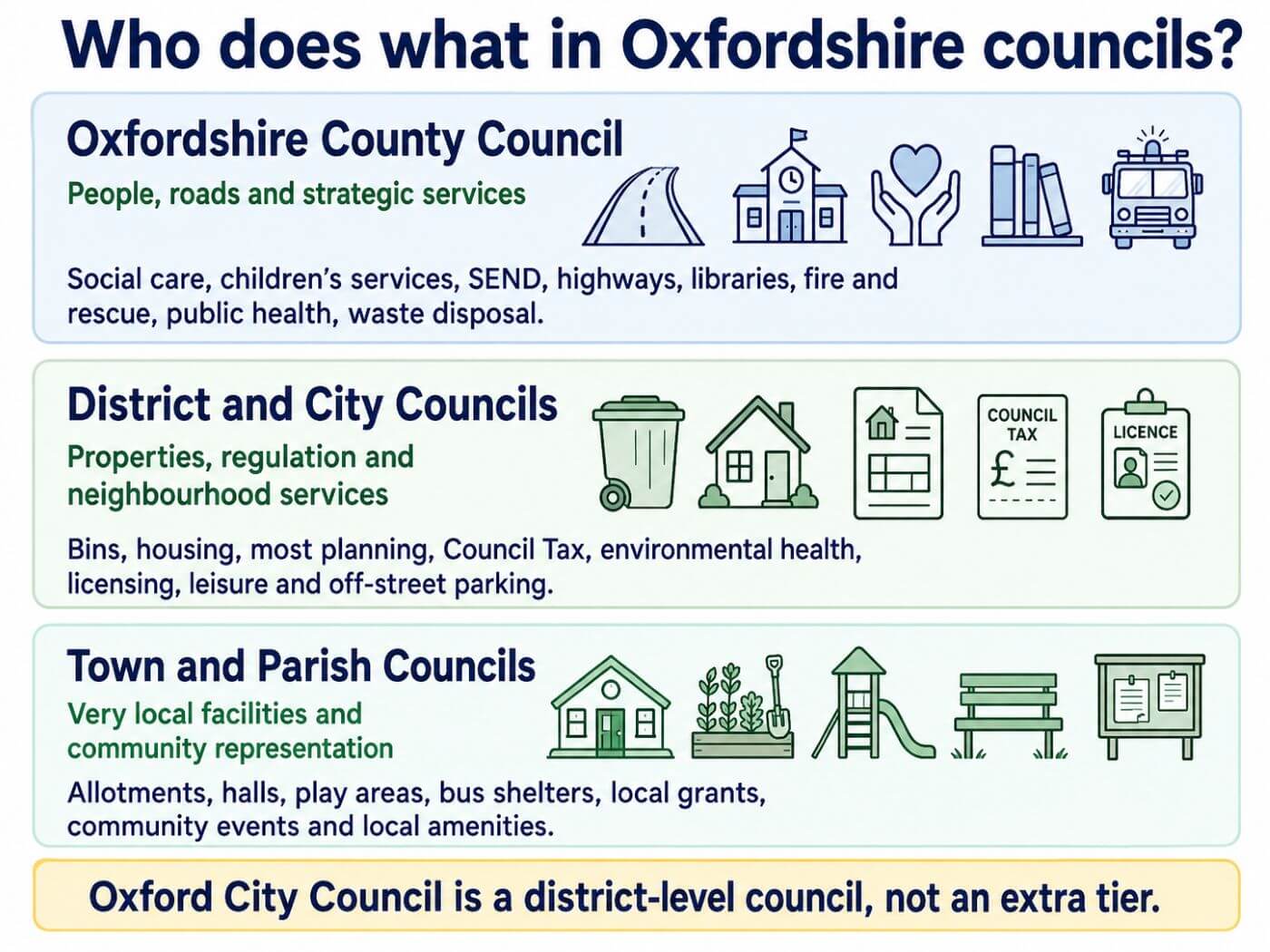
- Oxfordshire County Council handles countywide services such as social care, children’s services, highways, libraries, public health, fire and rescue, waste disposal and transport.
- District and city councils handle local services such as bin collections, housing, Council Tax, most planning, licensing, environmental health, leisure and off-street parking.
- Town and parish councils handle very local facilities such as allotments, village halls, play areas, bus shelters, community events and local grants.
- Oxford City Council is one of Oxfordshire’s five district-level councils. It is not an extra tier above the districts.
- Some services, including policing, hospitals, GP services, motorways and trunk roads, are not run by Oxfordshire’s county, district, city, town or parish councils.
This describes the system operating in August 2026. The government has confirmed a major reorganisation planned for April 2028, explained below. Oxford City Council’s own local-government explainer says Oxfordshire currently has one county council and five district councils: Oxford City, Cherwell, South Oxfordshire, Vale of White Horse and West Oxfordshire.
Oxfordshire’s current council structure
| Level | Authorities | Main responsibilities |
|---|---|---|
| County | Oxfordshire County Council | Adult social care, children’s services, SEND, school admissions, highways, public transport, libraries, public health, fire and rescue, household waste recycling centres and waste disposal |
| District / city | Cherwell District Council, Oxford City Council, South Oxfordshire District Council, Vale of White Horse District Council, West Oxfordshire District Council | Bin collections, most planning applications, housing, homelessness, Council Tax collection, environmental health, licensing, leisure, elections and off-street public car parks |
| Town / parish | Local town and parish councils across the county | Allotments, halls, play areas, burial grounds, bus shelters, benches, local grants, community events and representing local views |
| Parish meeting | Very small civil parishes without a full parish council | A limited form of local governance involving the parish’s electors |
Oxfordshire has more than 300 town councils, parish councils and parish meetings. Oxfordshire County Council lists 236 parish councils, 15 town councils and 68 parish meetings, and says all parts of the county except certain parts of Oxford are parished.
What Oxfordshire County Council does
Oxfordshire County Council is the countywide authority. Its services usually cover large areas, involve strategic infrastructure, or support people with significant care, education or safeguarding needs.
Social care and support for vulnerable residents
The county council is responsible for adult social care and children’s social care. This includes assessing adults who may need care or support, arranging eligible care services, safeguarding adults at risk, children’s safeguarding and support for children and families.
It also has major responsibilities for children with special educational needs and disabilities, known as SEND.
Schools, admissions and education planning
The county council coordinates school admissions, plans for sufficient school places and manages home-to-school transport. It also has statutory duties around SEND and safeguarding.
However, this does not mean Oxfordshire County Council directly runs every individual school. Many schools are academies operated by academy trusts, so complaints about a school’s day-to-day decisions may need to go through the school or trust first.
Roads, transport and parking
Oxfordshire County Council is the highway authority for most local roads in the county. It deals with issues such as potholes, pavements, traffic lights, streetlights, road markings, traffic regulation orders, speed limits, bus lanes, traffic filters, roadworks coordination and on-street parking controls.
The county council also deals with concessionary bus passes, Blue Badges and transport strategy.
The main exception is the strategic road network. The A34, A43 and M40 are managed by National Highways rather than Oxfordshire County Council. Oxfordshire transport policy material specifically identifies the A34, M40 and A43 as National Highways roads.
Waste disposal and recycling centres
The county council is responsible for the disposal and treatment of household waste collected by the district and city councils. It also runs or commissions household waste recycling centres, often called “the tip”.
The simple rule is:
- missed bin or household collection: district or city council
- recycling centre or waste disposal: Oxfordshire County Council
Oxfordshire County Council explains that district councils are responsible for household waste collection, while the county council is responsible for waste disposal and recycling centres.
Other county services
Oxfordshire County Council is also responsible for libraries, registration of births, deaths and marriages, coroner services, Oxfordshire Fire and Rescue Service, public health, emergency planning, Trading Standards, surface-water flood-risk management, minerals and waste planning, and some planning applications connected to county services.
Fire and rescue is part of Oxfordshire County Council rather than a separate Oxfordshire fire authority.
What district and city councils do
Oxfordshire has five district-level authorities:
- Cherwell District Council
- Oxford City Council
- South Oxfordshire District Council
- Vale of White Horse District Council
- West Oxfordshire District Council
Oxford City Council has city status, a Lord Mayor and civic traditions, but for local-government structure it is a district council. Oxford City Council says it delivers district-level services in Oxford, while Oxfordshire County Council provides county-level services.
Bin collections and street cleaning
District and city councils collect household rubbish and recycling. They usually handle missed-bin reports, food waste collections, garden-waste schemes, bulky-waste collections, street cleaning and litter enforcement.
This is one of the most common points of confusion. If your bin has not been collected, contact your district or city council, not Oxfordshire County Council.
Planning and development
District and city councils decide most ordinary planning applications. That includes house extensions, residential development, commercial development, listed-building consent and conservation-area matters.
They also prepare Local Plans, investigate alleged planning breaches and carry out planning enforcement.
Oxfordshire County Council is often consulted on the highways impact of a planning application, but it does not usually decide an ordinary householder extension. Minerals, quarries and waste-facility applications are generally county council matters.
Town and parish councils can comment on planning applications in their area, but they do not normally make the final decision.
Housing and homelessness
District and city councils deal with homelessness prevention, emergency housing assistance, housing registers, affordable-housing policy, private rented-housing enforcement, houses in multiple occupation and housing grants or adaptations.
Some councils own housing stock; others work with housing associations. Housing associations are separate organisations, even when a resident was nominated for a property through a council housing register.
Council Tax and benefits
District and city councils issue and collect Council Tax bills. They also administer Council Tax Reduction and remaining Housing Benefit claims.
However, the full Council Tax bill does not simply go to the collecting district or city council. Oxfordshire County Council says Council Tax bills include charges for Oxfordshire County Council, the Police and Crime Commissioner for the Thames Valley, city or district councils, and parish or town councils in some areas. Council Tax is collected by the district council rather than Oxfordshire County Council.
Environmental health and licensing
District and city councils normally handle food hygiene inspections, noise nuisance, pest-control services, air-quality monitoring, contaminated land, private-housing conditions, taxi and private-hire licensing, alcohol and premises licensing, gambling premises and some event licences.
Local facilities
Depending on the area, district and city councils may also provide leisure centres, parks, open spaces, public toilets, cemeteries, markets, community grants, economic-development work and council-operated off-street public car parks.
Ownership matters. A park, play area, toilet, hall or car park may belong to a district council, city council, town council, parish council or another organisation.
What town and parish councils do
Town and parish councils are the most local tier of elected local government. They are civil councils, not church bodies.
A town council and a parish council are essentially the same legal tier. A parish council may choose to call itself a town council, and a town mayor is usually the civic chair of that town council. This is not the same as an executive mayor running a large city.
Depending on local budgets, assets and priorities, a town or parish council may provide or maintain:
- allotments
- play areas and playing fields
- village halls or community halls
- burial grounds
- bus shelters
- benches
- noticeboards
- public clocks
- war memorials
- Christmas lights
- local events
- local markets
- community grants
- small areas of land
- some public toilets
- some local footpath or open-space maintenance
Many of these are powers rather than duties. That means one parish council may provide many services, while another may provide very little.
Town and parish councils usually raise money through a precept, which is added to the Council Tax bill and collected by the district or city council on their behalf.
What parish councils do in planning
Town and parish councils are usually consulted on planning applications in their area. They may support an application, object to it, or suggest conditions.
They do not normally decide the application. That decision usually rests with the relevant district or city planning authority.
Town and parish councils can also lead neighbourhood plans. Once a neighbourhood plan is examined, approved by referendum and formally adopted, it becomes part of the statutory development plan. That means it must be considered when planning decisions are made.
What happens inside Oxford itself?
Most of Oxford is not covered by a parish council. Oxford City Council therefore provides district-level services across the city and may also carry out some local functions that parish councils perform elsewhere.
There are four civil parish councils within Oxford:
- Blackbird Leys Parish Council
- Littlemore Parish Council
- Old Marston Parish Council
- Risinghurst and Sandhills Parish Council
Oxford City Council lists those four parish councils on its parish council contact pages.
Residents in those areas may see an additional parish precept on their Council Tax bill.
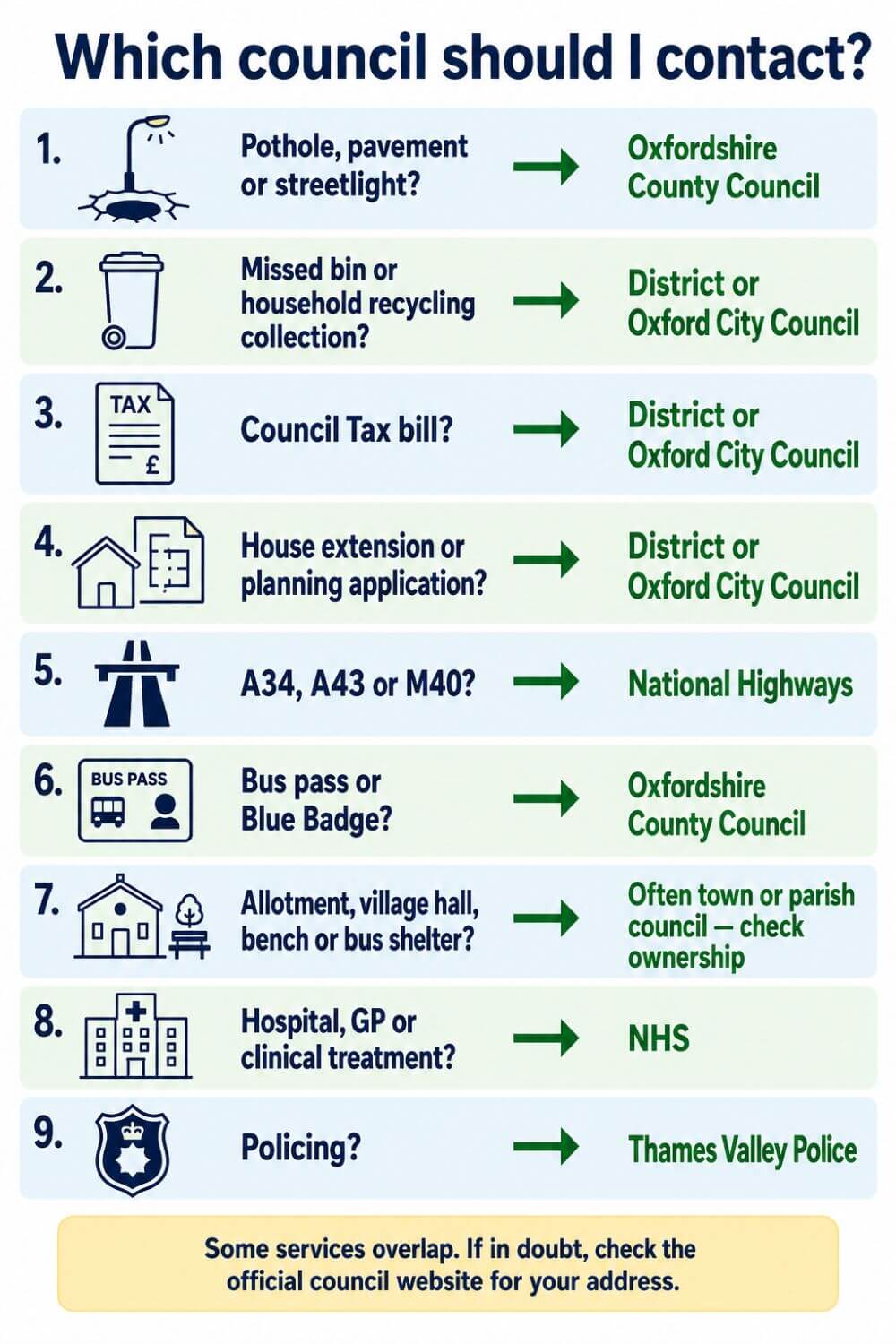
Which council should you contact?
| Issue | Usual organisation |
|---|---|
| Adult social care | Oxfordshire County Council |
| Children’s social care | Oxfordshire County Council |
| SEND, school admissions or school transport | Oxfordshire County Council |
| Pothole, pavement, traffic light or streetlight | Oxfordshire County Council |
| A34, A43 or M40 | National Highways |
| Bus pass or Blue Badge | Oxfordshire County Council |
| On-street parking or residents’ parking zone | Oxfordshire County Council |
| Council-operated off-street car park | District or Oxford City Council |
| Missed bin or household recycling collection | District or Oxford City Council |
| Household waste recycling centre | Oxfordshire County Council |
| House extension or ordinary planning application | District or Oxford City Council |
| Quarry, minerals or waste-facility planning application | Oxfordshire County Council |
| Homelessness or housing register | District or Oxford City Council |
| Council Tax bill | District or Oxford City Council |
| Council Tax Reduction or remaining Housing Benefit claims | District or Oxford City Council |
| Noise, food hygiene or taxi licensing | District or Oxford City Council |
| Allotment, local hall, bench or bus shelter | Often town or parish council, but check ownership |
| Policing | Thames Valley Police |
| Hospital, GP or clinical treatment | NHS |
| Water supply or sewer flooding | Thames Water |
| Main-river flooding | Environment Agency |
| Surface-water flooding | Oxfordshire County Council as lead local flood authority |
Common mistakes
“My bin was missed — should I contact Oxfordshire County Council?”
Usually no. Household bin collections are handled by your district or city council. Oxfordshire County Council deals with waste disposal and household waste recycling centres.
“There is a pothole — should I contact the district council?”
Usually no. Potholes and most local-road defects are Oxfordshire County Council responsibilities. The exception is strategic roads such as the A34, A43 and M40, which are National Highways roads.
“I live in Oxford — is Oxford City Council above the districts?”
No. Oxford City Council is a district-level authority with city status. It is one of Oxfordshire’s five district-level councils.
“Does my parish council decide planning applications?”
Usually no. Parish and town councils can comment on planning applications, but the district or city planning authority normally makes the decision.
“Does all my Council Tax go to the district council?”
No. The district or city council collects the bill, but the bill includes amounts for several bodies, including Oxfordshire County Council, the Police and Crime Commissioner, the district or city council, and in some areas a town or parish council.
Why responsibilities sometimes overlap
The split between councils is not always obvious.
A district council may maintain land owned by another body. A town council may take over a facility that used to be run by a district council. County and district planning teams may both be involved in a major development. Some councils also share services or use private contractors.
The best question is not always “Which tier usually does this?” but “Which organisation owns this asset or has the legal responsibility in this particular case?”
Councillors at different levels
Many residents have several elected councillors:
- a county councillor
- one or more district or city councillors
- town or parish councillors, if the area is parished
These are separate elected offices. The same person can sometimes serve on more than one council.
Council officers are employees who run services, process applications and give professional advice. Councillors are elected representatives who set policy, agree budgets, scrutinise decisions and represent residents.
In Oxford, the Lord Mayor is a civic and ceremonial role. Day-to-day political leadership is provided through the council’s leader and executive arrangements.
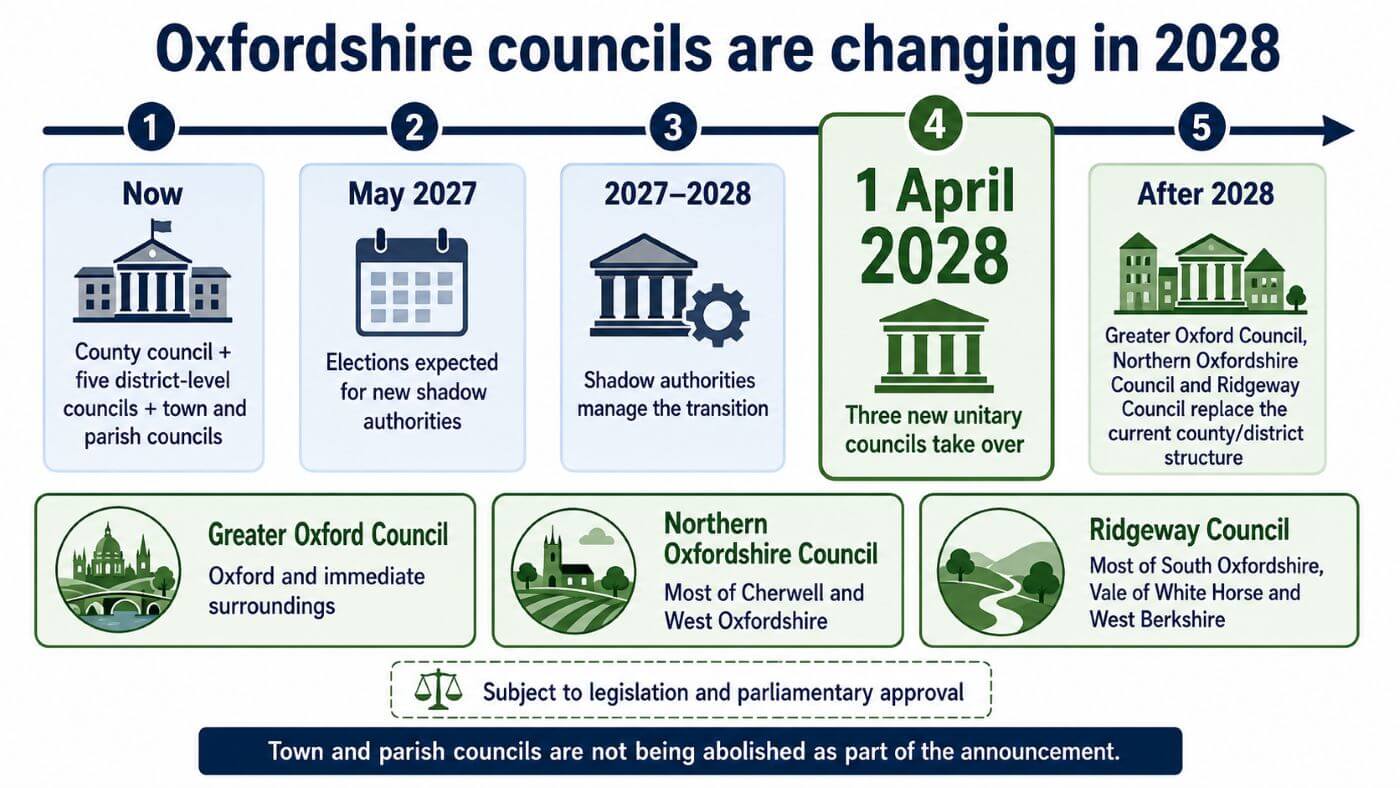
What changes in April 2028?
The present system is due to change substantially.
In July 2026, the government confirmed that three new unitary councils will be created for Oxfordshire and West Berkshire from 1 April 2028. The plan will replace Oxfordshire County Council, Oxfordshire’s five district-level councils and West Berkshire Council with three new unitary councils.
The three planned councils are:
- Greater Oxford Council – covering Oxford and its immediate surroundings
- Northern Oxfordshire Council – covering most of Cherwell and West Oxfordshire
- Ridgeway Council – covering most of South Oxfordshire and Vale of White Horse, combined with West Berkshire
The government consultation outcome says the Secretary of State has decided to implement the proposal for three unitary councils, subject to Parliamentary approval. It also says new unitary councils are expected to take on full council roles from April 2028, with transitional arrangements in 2027–28.
A unitary council combines county and district functions. In practical terms, from April 2028 residents should no longer have one council for social care and potholes and another for bins, planning and Council Tax. The new unitary authority for their area would handle both sets of responsibilities.
Town and parish councils are not being abolished as part of the announcement. They will remain the community-level tier, although local boundaries, service arrangements and devolved responsibilities may evolve.
Until the new unitary councils take over, the current county, district, city, town and parish responsibilities remain in place.
Glossary
County council
A countywide council responsible for large-scale services such as social care, highways, children’s services, libraries and fire and rescue.
District council
A local council responsible for services such as bin collections, most planning, housing, licensing, environmental health and Council Tax collection.
City council
In Oxfordshire, Oxford City Council is a district-level authority with city status. It is not a separate tier above the districts.
Town council
A parish-level council that has chosen to use the title “town council”. It may provide local amenities and civic functions.
Parish council
The most local tier of elected local government, serving a civil parish. It may provide or maintain local facilities such as allotments, halls, play areas, benches and community grants.
Parish meeting
A limited form of local governance for a very small civil parish without a full parish council.
Unitary council
A single council that combines county and district functions for its area.
Frequently asked questions
Which council collects bins in Oxfordshire?
Your district or city council usually collects household bins, recycling and food waste. Oxfordshire County Council deals with waste disposal and household waste recycling centres.
Who fixes potholes in Oxfordshire?
Oxfordshire County Council is responsible for most local roads, including potholes and pavements. National Highways manages strategic roads such as the A34, A43 and M40.
Is Oxford City Council a district council?
Yes. Oxford City Council is one of Oxfordshire’s five district-level authorities. It has city status but is not an extra tier above the district councils.
What does Oxfordshire County Council do?
Oxfordshire County Council handles countywide services including adult social care, children’s services, SEND, school admissions, highways, public health, libraries, fire and rescue, waste disposal, bus passes and Blue Badges.
What do parish councils do?
Town and parish councils provide or support very local services. These may include allotments, halls, play areas, benches, bus shelters, burial grounds, local grants and community events. Services vary between parishes.
Who do I contact about Council Tax?
Council Tax is collected by your district or city council. The bill includes amounts for several bodies, including Oxfordshire County Council, the district or city council, Thames Valley Police and any town or parish council in your area.
What changes in 2028?
The government has confirmed plans for three new unitary councils for Oxfordshire and West Berkshire from April 2028, subject to the required legislation and parliamentary approval. These councils would replace the current county and district structure.
The simplest way to remember it
Under the current system:
- County: people, roads and strategic infrastructure.
- District or city: properties, regulation and neighbourhood services.
- Town or parish: highly local facilities and community representation.
The words city and town describe status and identity more than an extra layer of government. Oxford City Council operates at district level. A town council operates at parish level.
Useful official links
Oxfordshire County Council
Oxford City Council: local government structure and service responsibilities
Oxfordshire County Council: town and parish councils
Oxfordshire County Council: waste management responsibilities
Oxfordshire County Council: Council Tax, funding and spending
GOV.UK: Oxfordshire local government reorganisation
Oxfordshire County Council: reorganisation and devolution
National Highways
Thames Valley Police
NHS
Thames Water
Environment Agency