Cotswold Wildlife Park is celebrating its most successful white stork season after 49 young birds were reared for release into the wild as part of a project restoring the species to Britain’s skies.
At a glance
| 2026 result | 49 juvenile white storks successfully reared at Cotswold Wildlife Park and released at Knepp in West Sussex |
| Chicks originally hatched | The park reported 54 hatchings earlier in the breeding season |
| Project | The White Stork Project |
| Cotswold Wildlife Park involvement | Nine consecutive breeding seasons since joining the project in 2016 |
| Park’s stated cumulative total | 280 white storks bred for the project |
| Long-term aim | At least 50 breeding pairs across southern England by 2030 |
| Where visitors can see storks | The walk-through area beside the Children’s Farmyard |
| Report a wild sighting | Use the White Stork Project sighting form |
A record group of 49 young white storks bred at Cotswold Wildlife Park has been released into the wild, marking the Oxfordshire attraction’s strongest season since joining a national restoration project.
The birds hatched at the park near Burford in May and were cared for by its specialist husbandry team until they were fully fledged and ready to move to Sussex.
Cotswold Wildlife Park reported earlier in the summer that 54 chicks had hatched from 25 adult pairings. The White Stork Project has since confirmed that 49 park-bred juveniles were released at the Knepp Estate in West Sussex.
The result exceeds the park’s previous record of 48 young birds released in 2025.
The park says it has now bred 280 white storks for the project, making the Oxfordshire collection one of the central breeding partners in the effort to restore a self-sustaining wild population.
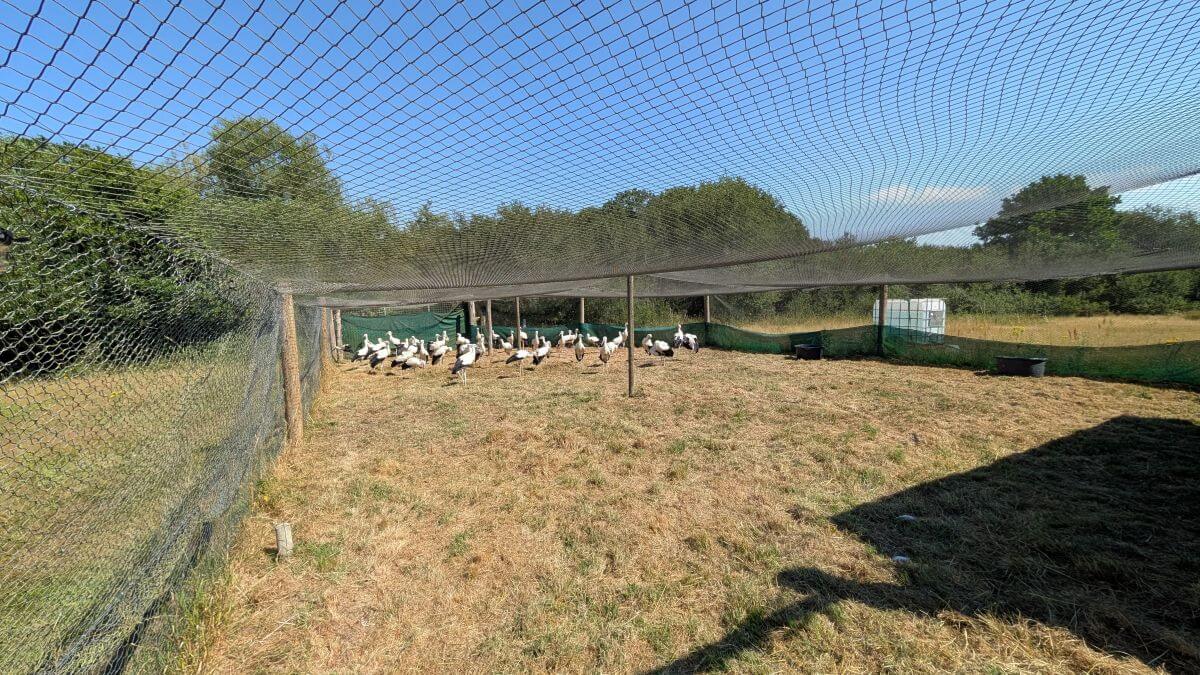
How the young storks are prepared for release
Successful release begins well before the chicks hatch.
White storks begin displaying pairing and nesting behaviour during late winter. Keepers provide large quantities of sticks and other nesting material, monitor the birds as they build and check that each nest is stable and complete.
Eggs take approximately 35 days to hatch. The adult storks feed their own chicks, but the park’s keepers also provide finely chopped fish and insects directly at the nests.
This additional food is intended to give each youngster the best chance of survival while reducing the demands placed on adults raising larger clutches.
Jamie Craig, Curator and Managing Director of Cotswold Wildlife Park, described the team as acting like a “fairy godmother” to the chicks and their parents.
He said: “Although the adults will bring a good supply of food to the nest for the young, the keepers also assist feed, visiting each nest daily with quantities of finely chopped feed items, usually fish and insects.
“The young birds grow rapidly and by around two months of age, the birds will fledge the nest and become independent.”
Once the juveniles have left their nests, they are separated from the adults, examined, sexed and fitted with identification rings.
After a further settling period of around two weeks, during which keepers make sure the birds are strong and healthy, they are transported to a release pen in Sussex.
What happens when the storks reach Knepp?
The young birds spend a short period inside the release pen at Knepp before being allowed to fly free.
This gives them time to become familiar with the location and is intended to encourage them to recognise the area as a future breeding site.
After release, some remain in southern England while others begin travelling through Europe. Previous birds from the project have reached France, Spain and Morocco.
White storks usually do not breed until they are around four or five years old. The project hopes released birds will eventually return to southern England, form new pairs and attract naturally arriving wild storks.
Jamie said: “Watching our young storks hatch, grow at the park and then be transferred to Knepp is always a proud moment.
“When they are finally released and take to the air to soar the thermals, it’s a sight that always inspires us for the future. It is the pinnacle of what we do and something I never tire of.”
The 2026 juveniles are expected to begin their first southward migration from late August, although individual birds may leave considerably later. In previous years, some have remained in Britain until October.
Why white storks are being restored to Britain
White storks were once a breeding species in Britain but disappeared during the medieval period.
The last definitive record of a pair successfully raising chicks is generally given as 1416, when storks nested at St Giles’ Cathedral in Edinburgh.
Habitat loss and hunting are thought to have contributed to their disappearance, although wild birds have continued to visit Britain from continental Europe.
The White Stork Project was established in 2016 by partners including Cotswold Wildlife Park, the Roy Dennis Wildlife Foundation, Knepp Castle Estate and landowners in Sussex.
Its aim is to establish at least 50 breeding pairs across southern England by 2030.
Founding birds came from Poland after being rehabilitated from injuries caused by incidents including power-line and road collisions. Some could no longer survive independently in the wild and were used to establish managed breeding groups.
Their flying offspring are then released, helping create the larger colony that visiting wild storks are thought to need before they will settle and breed.
In 2020, four wild chicks fledged at Knepp, becoming the first white storks successfully raised in the British countryside for around 600 years.
Wild breeding is now increasing
The project’s 2026 results extend beyond the 49 birds raised in Oxfordshire.
At Knepp, 42 wild chicks fledged from 16 nests. A further three chicks fledged from two nests at Wadhurst Park in East Sussex.
More than ten project birds that had previously migrated were also confirmed back at Knepp, with some going on to breed.
The project says storks have now begun gathering and building a nest away from the principal colony for the first time, at a location near Guildford. The nest had not yet been used for breeding.
These developments are important because the eventual goal is a population capable of maintaining and expanding itself, rather than one that continues to depend indefinitely on birds bred for release.
Cotswold Wildlife Park says two birds bred at its collection have already migrated, returned to Knepp and attempted to breed.
Beth Peacock, Conservation Officer at the park, said: “It is especially encouraging that two birds bred here have migrated, returned to Knepp and attempted to breed, showing just how important these releases are in helping restore white storks to the landscape.”
New tracking technology follows more birds
The 2026 season has also introduced new technology for monitoring the storks after release.
Project birds have traditionally been followed using backpack-style satellite trackers alongside their coloured identification rings.
This year, the project also fitted lightweight electronic rings, known as e-rings, to a larger number of birds.
Across the project, 20 satellite trackers and 44 e-rings were deployed during 2026. The aim is to collect more information about movement, survival and behaviour while following a greater proportion of released birds.
The park says every young bird in its release cohort carried either a satellite tracker or one of the new electronic rings.
Beth said: “For the first time, every bird is carrying either a satellite tracker or one of the new e-ring nanotags, which will help us build a much clearer picture of their movements, survival and behaviour after release.”
A sample of chicks at Cotswold Wildlife Park was also weighed weekly, with wing and beak measurements recorded from hatching until the birds were ready for release.
The park says this information is contributing to research with the University of East Anglia and should improve understanding of white stork chick development.
The White Stork Project is working on an updated 2026 flight map. Birds fitted with satellite transmitters can meanwhile be viewed through the Animal Tracker app.
Previous and current tracking information is available through the project’s interactive flight map.
What to do if you spot a white stork
Members of the public play an important role in monitoring released birds, particularly those that do not carry live satellite trackers.
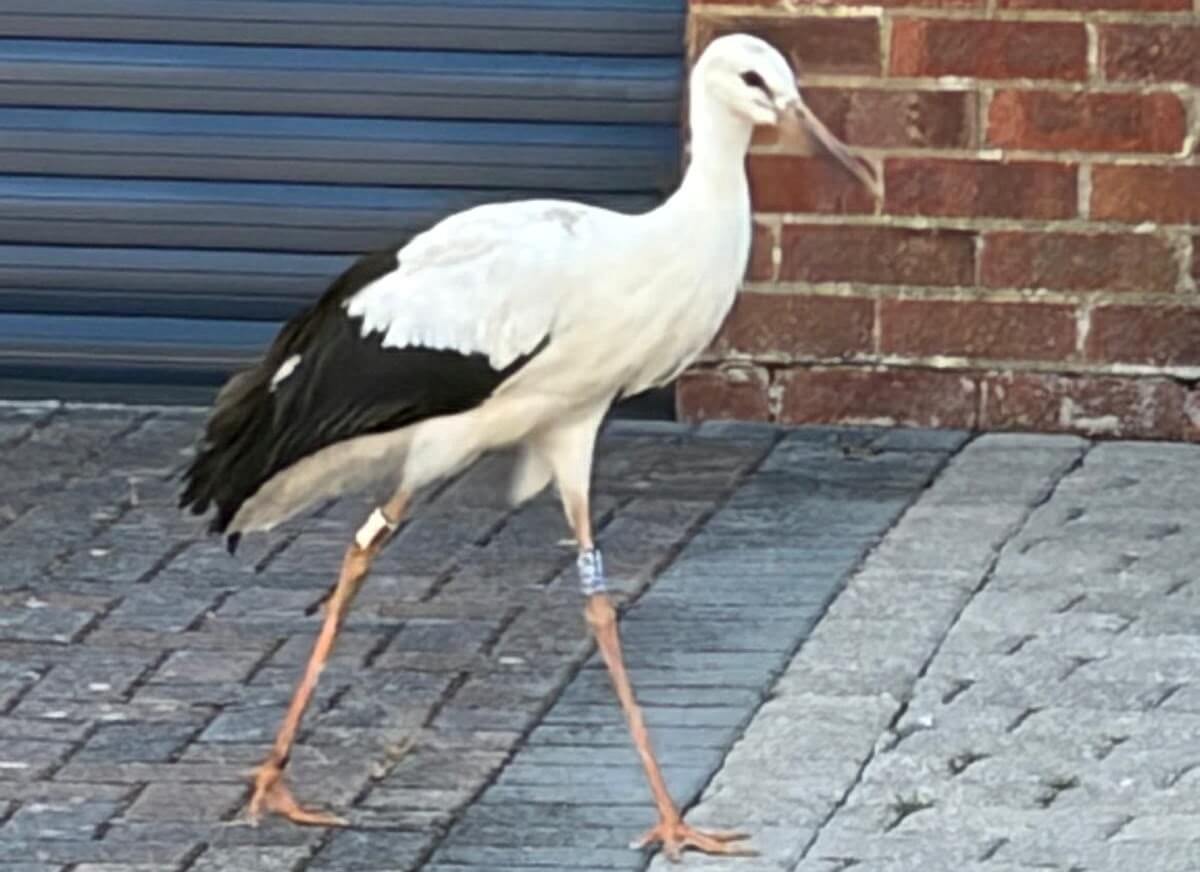
Every stork involved in the project has an identifying ring. The main project ring is blue, is worn on the left leg and carries an individual code beginning with the letters GB.
A smaller metal British Trust for Ornithology ring is fitted to the other leg.
Anyone who sees a white stork is asked to record the date, time and precise location. A visible ring code is particularly valuable, but sightings can still be submitted when the observer cannot read the ring.
Photographs can be emailed to whitestorksgb@gmail.com.
Reporting a stork sighting
| Record | The date, time and exact location |
| Check from a distance | Look for a blue ring and note the code if it can be read safely |
| Take a photograph | A clear image of the bird and ring can help confirm its identity |
| Do not disturb it | Keep a respectful distance and keep dogs under control |
| Submit the record | Use the White Stork Project form |
See the breeding storks at Cotswold Wildlife Park
The adult breeding group remains on view at Cotswold Wildlife Park in the walk-through area beside the Children’s Farmyard.
The park is near Burford on the A361, around 20 miles west of Oxford.
During British Summer Time it is open every day from 10am until 6pm, with last admission at 4pm. The park recommends allowing at least four hours for a visit.
Advance e-tickets currently cost £17.50 for adults and £12.50 for children aged three to 16 and visitors aged 65 or over. Children under three enter free. Gate prices are higher, and advance booking is strongly recommended during school holidays because the park can sell out.
Planning your visit
| Venue | Cotswold Wildlife Park and Gardens |
| Address | Bradwell Grove, Burford, Oxfordshire, OX18 4JP |
| Sat-nav postcode | OX18 4JJ |
| Summer hours | 10am to 6pm daily, with last admission at 4pm |
| Current advance prices | Adults £17.50; children aged 3–16 and visitors aged 65+ £12.50; under-threes free |
| Parking | Free visitor parking is available |
| Public transport | The nearest bus stop is in Burford, two miles away. The park advises against walking along the A361 because there is no footpath. |
| Accessibility | The site is largely flat with wide paths, accessible toilets and a Changing Places facility. Wheelchairs and mobility scooters can be reserved in advance. |
| Tickets | View current prices and book |
Dogs are permitted on leads in some parts of the park but cannot enter indoor spaces, the Children’s Farmyard or areas containing free-ranging animals. Visitors bringing a dog should check whether they will be able to enter the stork walk-through area.
Detailed access information and wheelchair or mobility-scooter booking arrangements are available through the park’s accessibility page.
FAQs
How many white storks did Cotswold Wildlife Park breed in 2026?
The park reported 54 chicks hatching earlier in the season. The White Stork Project confirms that a record 49 Cotswold-bred juveniles were successfully reared and released at Knepp.
Where were the young birds released?
They were transferred to the Knepp Estate in West Sussex, where they spent time in a release pen before being allowed to fly free.
Why are white storks being released?
The White Stork Project aims to establish a self-sustaining wild breeding population across southern England, with at least 50 breeding pairs by 2030.
When did white storks disappear from Britain?
They disappeared as a regular breeding species during the medieval period. The last definitive historical record of a pair raising chicks is from 1416.
Have white storks bred successfully in the wild again?
Yes. Four chicks fledged at Knepp in 2020, the first successful wild breeding in Britain for around 600 years. In 2026, 42 chicks fledged from 16 Knepp nests and three from two nests at Wadhurst.
Do all the released storks migrate?
No. Some travel through Europe and into North Africa, while others remain in Britain for longer or overwinter near the release colonies.
How are the storks tracked?
Project birds carry identification rings, while selected birds have satellite trackers or new electronic e-rings that provide information about their movements and survival.
How can I report a sighting?
Use the White Stork Project sighting form. Include the location, date, time, ring code and a photograph where possible.
Can visitors see white storks at Cotswold Wildlife Park?
Yes. The breeding group is on show in the walk-through area beside the Children’s Farmyard.