A warm spring has raised hopes of a colourful summer for butterflies, but conservationists say sightings from gardens, parks and green spaces across Oxfordshire are needed to reveal the full picture.
At a glance
| What is happening? | Butterfly Conservation is asking people to take part in the Big Butterfly Count 2026. |
| When? | Friday 17 July to Sunday 9 August 2026. |
| How long does it take? | 15 minutes in a sunny outdoor space. |
| Where can people count? | Gardens, parks, balconies, allotments, school grounds, churchyards, nature reserves and countryside walks. |
| Oxfordshire in 2025 | 1,391 people took part locally, recording 18,040 butterflies and day-flying moths. |
| Species to look for | Peacock, Holly Blue, Red Admiral, Brimstone, Small Copper, Large White, Gatekeeper and others. |
| Take part | Visit the Big Butterfly Count website |
Oxfordshire could be heading for a brighter butterfly season after a warm spring gave some familiar species a promising start to the year.
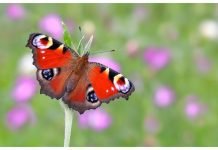
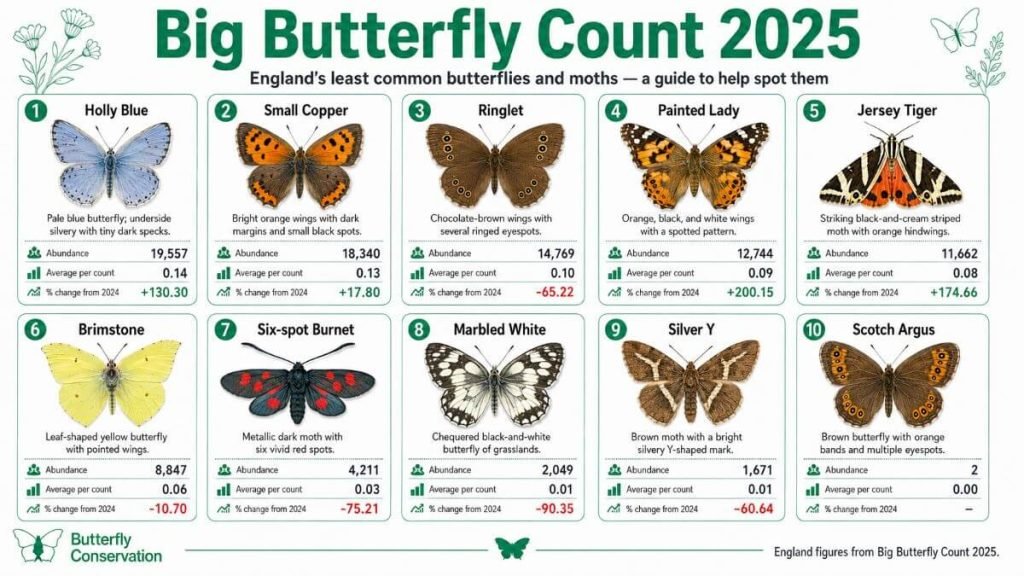
Wildlife charity Butterfly Conservation says Small Copper and Holly Blue butterflies have been seen in strong numbers this spring, while Peacock, Red Admiral and Brimstone also appear to have made an encouraging start.
But conservationists are warning that a good spring does not guarantee a bumper summer. They are asking people across Oxfordshire to take part in this year’s Big Butterfly Count so scientists can understand how common butterflies and day-flying moths are really faring.
The annual count runs from Friday 17 July to Sunday 9 August and asks people to spend 15 minutes in a sunny outdoor space, count what they see and submit the results online or through the free app.
Why this year’s count matters
The count comes after two contrasting years for butterflies.
In 2024, Butterfly Conservation declared a national “Butterfly Emergency” after the Big Butterfly Count recorded the lowest average number of butterflies in the survey’s history.
Last year looked better. Across the UK, more than 125,000 people took part in the 2025 count, recording 1.7 million butterflies and day-flying moths. The average rose to 10.3 butterflies per 15-minute count, up from 7.2 in 2024.
However, Butterfly Conservation warned that 2025 was still only broadly average by modern standards, despite the UK experiencing a hot and sunny summer.
That makes this year’s count especially important. Spring 2026 was the warmest on record for England and Wales, according to the Met Office, and conservationists now need to know whether that warmth has translated into healthier butterfly numbers through summer.
Kate Merry, Head of Engagement at Butterfly Conservation, said: “After the colourful spring with seemingly lots of beautiful butterflies appearing across the UK, it’s tempting to assume we’re heading for a bumper summer, and we’d love nothing more as most of our butterfly species have undergone long-term declines.
“But a bright spring is only ever part of the story, which is why we need people out there taking part in the Big Butterfly Count this summer.
“We genuinely don’t yet know how this year will unfold, and the only way to find out is for people to tell us what they’re seeing in their own gardens and green spaces.”
What happened in Oxfordshire last year?
Last year’s Big Butterfly Count showed why local records matter.
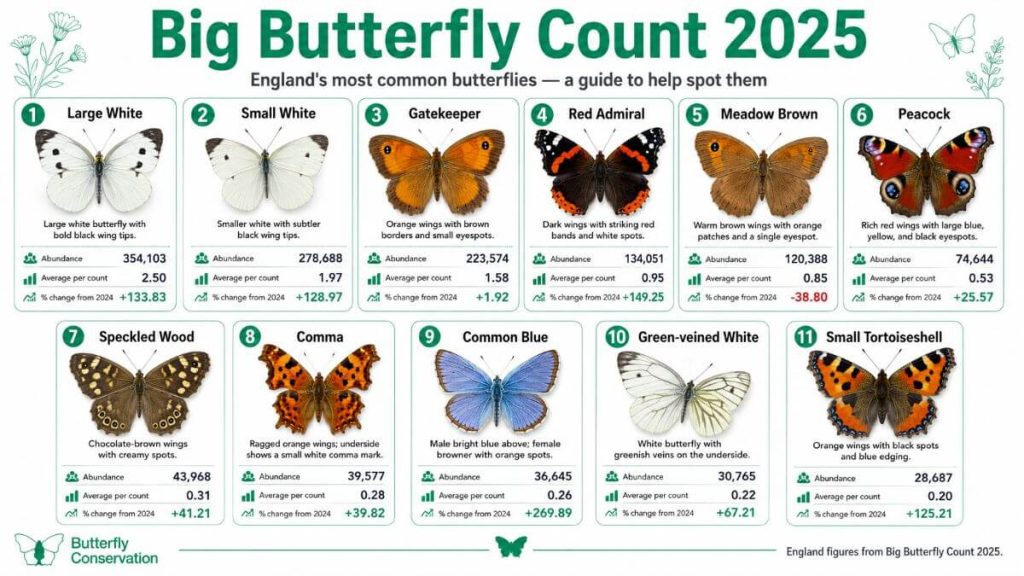
In Oxfordshire, 1,391 people took part in the 2025 count, recording 18,040 butterflies and day-flying moths. The county average was 9.7 butterflies or moths per 15-minute count, up from the record lows seen in 2024.
The Large White was the most frequently recorded butterfly in Oxfordshire, reflecting a strong year nationally for the species.
Those figures were encouraging after the 2024 slump, but they also showed how much more there is to learn. If more residents take part this year, the county’s picture will become clearer, from urban gardens in Oxford to village lanes, allotments, parks and chalk grassland across the wider county.
From 2024 to 2026: why the count matters
| 2024 | Butterfly Conservation declared a Butterfly Emergency after the lowest Big Butterfly Count results in the survey’s history. |
| 2025 | Numbers improved, but Butterfly Conservation said the UK result was still only broadly average by modern standards. |
| Oxfordshire in 2025 | Local counters recorded 18,040 butterflies and day-flying moths, with Large White the most frequently spotted species. |
| 2026 | A warm spring has raised hopes of a colourful summer, but conservationists need fresh sightings to see whether that promise has been fulfilled. |
Why butterflies matter
Butterflies are more than a welcome flash of colour in gardens and parks.
They are pollinators, a food source for other wildlife and useful indicators of the health of the wider environment.
As they feed on nectar, butterflies can help move pollen between plants. They are not usually as efficient as bees, but they still play a role in supporting wildflowers, garden plants and wider plant diversity.
Butterflies and their caterpillars are also part of the food chain, providing food for birds, bats, spiders and other insects.
When butterfly numbers fall, it can point to wider problems affecting habitats, weather patterns, pesticide use and the availability of food plants.
Butterfly Conservation says 80% of UK butterfly species have declined in abundance, distribution or both since the 1970s. That makes every local count useful, including counts where no butterflies are seen.
Which butterflies should people look for?
The Big Butterfly Count focuses on 20 common butterflies and day-flying moths. People do not need to be experts to take part, as the free app and website include an identification guide.
Several familiar species may be seen in Oxfordshire gardens, parks, meadows and hedgerows this summer.
| Species | When to look | Where to look | How to recognise it |
|---|---|---|---|
| Gatekeeper | July to August | Hedgerows, brambles, woodland edges and gardens | Orange wings with darker edges and small eye-spots. |
| Large White | Spring to autumn | Gardens, allotments, parks and vegetable patches | Large white wings with black tips. |
| Red Admiral | Spring to autumn | Gardens, orchards, parks and sunny sheltered places | Black wings with bold red bands and white markings. |
| Holly Blue | Spring and summer | Gardens, hedges, churchyards and woodland edges | A small, delicate blue butterfly often seen around shrubs. |
| Peacock | Spring to autumn | Gardens, meadows, hedgerows and nettle patches | Large red butterfly with dramatic eye-spots. |
| Small Copper | Spring to autumn | Meadows, grassland, commons and sunny open ground | Small and fast-moving, with bright copper-orange forewings. |
| Speckled Wood | April to October | Woodland paths, shaded gardens and sunny clearings | Brown wings with cream spots, often basking in dappled light. |
| Brimstone | Spring to autumn | Woodland edges, hedgerows, gardens and parks | Males are bright yellow; females are pale greenish-white. |
| Meadow Brown | June to September | Grassland, meadows, field edges and verges | Brown wings with orange patches and a small black eye-spot. |
| Common Blue | May to October | Meadows, grassy paths, verges and sunny open areas | Males are bright blue; females are brown with orange markings. |
Oxfordshire’s butterfly landscape
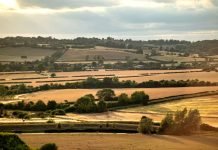
Oxfordshire has a mix of habitats that can be important for butterflies, from city gardens and river corridors to chalk grassland, woodland rides, meadows, farmland margins and Cotswold slopes.
Butterfly Conservation’s Upper Thames Branch covers Berkshire, Buckinghamshire and Oxfordshire. It says the area includes the Chilterns, Oxfordshire and Berkshire Downs, the Oxford and Aylesbury clay vales, the Bernwood Forest complex and the edge of the Cotswolds.
The branch says the region is home to rare butterflies and moths including Black Hairstreak, Duke of Burgundy, Adonis Blue, Silver-spotted Skipper and Striped Lychnis.
Although the Big Butterfly Count focuses on common and widespread species, records from everyday gardens and green spaces still help scientists understand what is happening across the wider landscape.
Where to count in Oxfordshire
People do not need to visit a nature reserve to take part. A count from a small garden, balcony, school field or local park is still useful.
In Oxford, counts can be made in gardens, allotments, churchyards, community green spaces, riverside paths and parks. Oxford City Council’s Biodiversity Report highlights the importance of the city’s green and blue network, including trees, woodland, hedgerows, rivers, wetlands, recreational areas and allotments.
Elsewhere in the county, people could count during a walk near the Thames, in village meadows, on chalk downland, in a park in Banbury, Bicester, Witney or Abingdon, or from a quiet spot in a garden.
The important thing is to choose one place, count for 15 minutes in suitable weather and submit the results.
How to spot butterflies like a pro
Butterflies are easiest to see on warm, bright days with little wind. They need warmth to fly, so a sunny, sheltered spot is usually better than an exposed or shaded area.
Butterfly spotting tips
| Choose the right weather | Pick a sunny, still day if possible. Butterflies are less active in cold, wet or windy conditions. |
| Look near flowers | Nectar-rich flowers, brambles, buddleia, thistles and wildflower patches can attract adult butterflies. |
| Check hedgerows and edges | Many butterflies use warm field edges, woodland rides, hedgerows and paths. |
| Stand still | Butterflies can be wary of sudden movement, so patience helps. |
| Use the app | The Big Butterfly Count app includes an identification guide and lets you submit sightings quickly. |
| Count even if you see none | A zero count is still useful because it shows where butterflies were not seen. |
How to help butterflies in your garden or local green space
Taking part in the Big Butterfly Count is one way to help, but residents can also make gardens, balconies, school grounds and community spaces more useful for butterflies throughout the year.
The most important step is to provide food for both adult butterflies and caterpillars. Adult butterflies feed on nectar, so a mix of flowers from spring through to autumn will give them a longer season of support.
Caterpillars need food plants too. That means leaving some wild plants in place, rather than making every corner of a garden neat. Nettles, for example, are important for species including Peacock, Red Admiral and Small Tortoiseshell.
How to help butterflies in your garden or local green space
Taking part in the Big Butterfly Count is one way to help, but residents can also make gardens, balconies, school grounds and community spaces more useful for butterflies throughout the year.
The most important step is to provide food for both adult butterflies and caterpillars. Adult butterflies feed on nectar, so a mix of flowers from spring through to autumn will give them a longer season of support.
Caterpillars need food plants too. That means leaving some wild plants in place, rather than making every corner of a garden neat. Nettles, for example, are important for species including Peacock, Red Admiral and Small Tortoiseshell, while longer grass can provide shelter and food for other species.
| What to do | Why it helps |
|---|---|
| Plant nectar-rich flowers | Adult butterflies need nectar for energy. Choose a range of plants that flower at different times of year. |
| Choose sunny, sheltered spots | Butterflies need warmth to fly and feed, so flowers in sunny, wind-protected areas are especially useful. |
| Leave a patch of nettles | Nettles are caterpillar food plants for several familiar butterflies, including the Peacock. |
| Mow less often | Longer grass and flowering lawn plants can provide shelter, nectar and food for caterpillars. |
| Avoid pesticides | Insecticides can kill butterflies and caterpillars, while herbicides can remove the wild plants they depend on. |
| Leave fallen fruit in late summer | Butterflies such as Red Admirals and Painted Ladies may feed on the juices of overripe apples, pears and plums. |
| Add a shallow water source | A shallow dish with pebbles can help pollinators drink safely, provided the water is changed regularly. |
| Use pots if space is limited | Balconies, patios and window boxes can still provide nectar if planted with pollinator-friendly flowers. |
Good butterfly plants do not need to be complicated. Open, single flowers are often easier for pollinators to use than highly bred double blooms. Herbs such as thyme, marjoram, chives and lavender can help, while buddleia, verbena, scabious, knapweed, hebe, ivy and late-flowering plants can extend the nectar season.
For families, schools and community groups, a small “wild corner” can be just as valuable as a formal flower bed. A sunny patch with long grass, nettles and a few nectar plants can support butterflies at several life stages, from egg and caterpillar to adult.
Anyone planning changes can use the RHS Plants for Pollinators lists and Butterfly Conservation’s gardening for butterflies guidance to choose plants that support butterflies, moths and other pollinators.
| What to do | Why it helps |
|---|---|
| Plant nectar-rich flowers | Adult butterflies need nectar for energy. Choose a range of plants that flower at different times of year. |
| Choose sunny, sheltered spots | Butterflies need warmth to fly and feed, so flowers in sunny, wind-protected areas are especially useful. |
| Leave a patch of nettles | Nettles are caterpillar food plants for several familiar butterflies, including the Peacock. |
| Mow less often | Longer grass and flowering lawn plants can provide shelter, nectar and food for caterpillars. |
| Avoid pesticides | Insecticides can kill butterflies and caterpillars, while herbicides can remove the wild plants they depend on. |
| Leave fallen fruit in late summer | Butterflies such as Red Admirals and Painted Ladies may feed on the juices of overripe apples, pears and plums. |
| Use pots if space is limited | Balconies, patios and window boxes can still provide nectar if planted with pollinator-friendly flowers. |
Good butterfly plants do not need to be complicated. Open, single flowers are often easier for pollinators to use than highly bred double blooms. Herbs such as thyme, marjoram, chives and lavender can help, while buddleia, verbena, scabious, knapweed, hebe, ivy and late-flowering plants can extend the nectar season.
For families, schools and community groups, a small “wild corner” can be just as valuable as a formal flower bed. A sunny patch with long grass, nettles and a few nectar plants can support butterflies at several life stages, from egg and caterpillar to adult.
How to take part in the Big Butterfly Count
Big Butterfly Count 2026
| Step 1 | Download the free Big Butterfly Count app or visit bigbutterflycount.org. |
| Step 2 | Between Friday 17 July and Sunday 9 August, choose a sunny outdoor space. |
| Step 3 | Spend 15 minutes counting the butterflies and day-flying moths you see. |
| Step 4 | Use the app or website ID guide if you are not sure what you have seen. |
| Step 5 | Submit your sightings, even if you see no butterflies. |
Kate Merry said: “Butterflies are icons of summer and, more importantly, key indicators of the UK’s biodiversity and environmental health.
“Every single person that takes part in the Big Butterfly Count and submits their sightings is helping us to see how these pollinators are doing, which in turn helps conservationists build a wider picture of how all insects are faring.
“It’s easy, fun for all the family, and a great excuse to get outside and experience the simple joy of spotting butterflies.
“You’ll also be helping to protect butterflies for future generations, and if that doesn’t give you the feel-good factor I don’t know what will.”
Butterfly facts for younger counters
| Butterflies taste with their feet | This helps them find the right plants for feeding or laying eggs. |
| Their wings are covered in tiny scales | Those scales help create the colours and patterns we see. |
| They need warmth to fly | That is why they are often seen basking in sunny places. |
| Some travel huge distances | The Painted Lady can migrate thousands of miles between North Africa, Europe and the UK. |
What happens after the count?
Butterfly Conservation uses the results to build an interactive picture of butterfly abundance and distribution across the UK.
That helps scientists see where butterflies are doing well, where numbers appear low, and whether species are shifting their ranges in response to climate change, habitat loss or habitat restoration.
The results are especially valuable because they come from many different places, not only nature reserves or professional monitoring sites.
This year, after a spring that has raised hopes but not answered the bigger questions, Oxfordshire residents are being asked to add their 15 minutes to the national picture.
FAQs
When is the Big Butterfly Count 2026?
The Big Butterfly Count runs from Friday 17 July to Sunday 9 August 2026.
How long does the count take?
Each count takes 15 minutes.
Where can I do the count?
You can count in any sunny outdoor space, including gardens, balconies, parks, allotments, school grounds, churchyards, nature reserves or countryside paths.
Do I need to know butterfly names?
No. The free app and website include an identification guide to help you work out what you have seen.
Should I submit a count if I see no butterflies?
Yes. Zero counts are still useful because they help scientists understand where butterflies are not being seen.
Which butterflies might I see in Oxfordshire?
Common species could include Peacock, Red Admiral, Brimstone, Holly Blue, Large White, Small White, Meadow Brown, Gatekeeper, Comma and Speckled Wood, depending on the location and weather.
Why are nettles important?
Nettles are caterpillar food plants for several butterflies, including Peacock, Red Admiral and Small Tortoiseshell. Leaving a small patch in a quiet, sunny corner can help.
Why are butterflies important?
Butterflies are pollinators, part of the food chain and indicators of environmental health. Changes in their numbers can reflect wider pressures on habitats, climate and insect life.
Where can I take part?
You can download the free app or submit sightings through bigbutterflycount.org.