Oxfordshire has been placed under drought conditions as part of a wider Thames Valley alert after weeks of exceptionally dry and hot weather left rivers low, wildlife under pressure and millions of households under water restrictions.
At a glance
| What has happened? | The Environment Agency has declared drought across half of England, including the Thames Valley. |
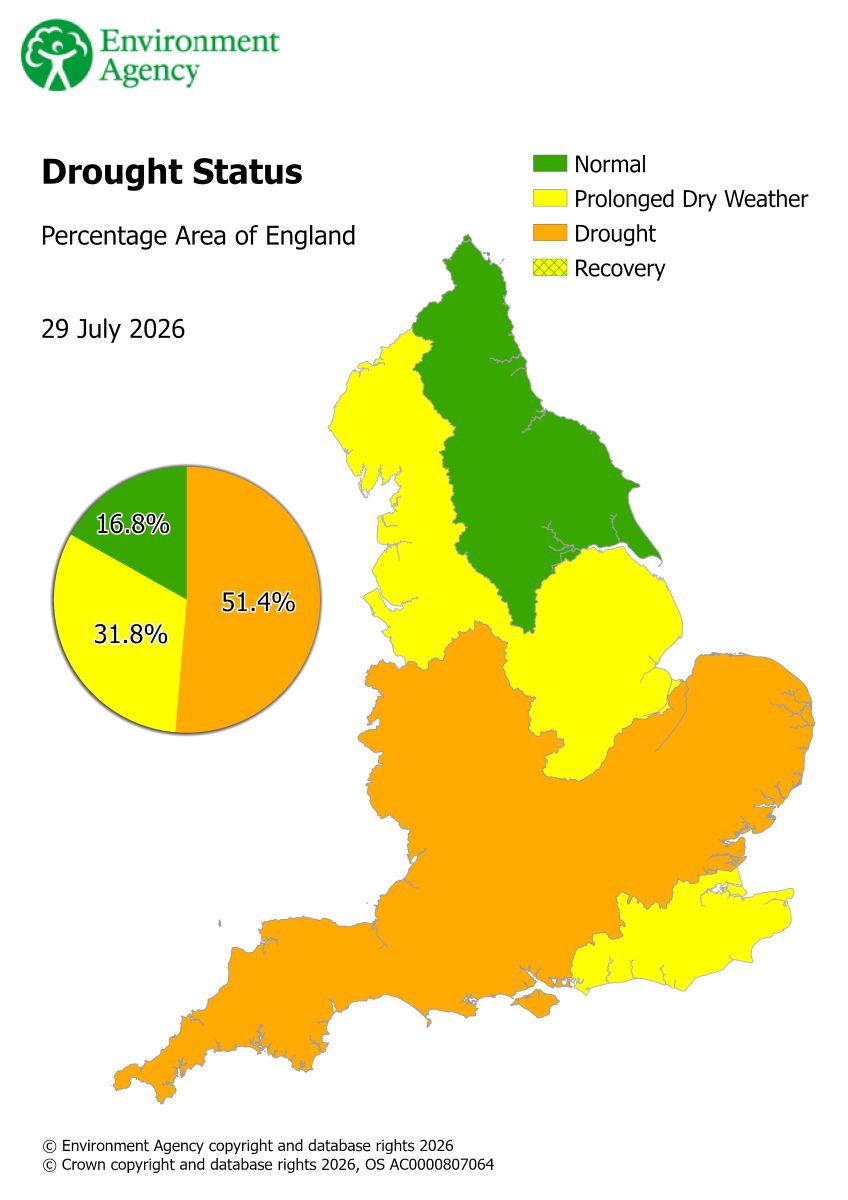
| Areas in drought | East Anglia, Hertfordshire and London, Thames Valley, Hampshire and the Isle of Wight, Devon and Cornwall, the West Midlands and Wessex. |
| Why? | Exceptionally low rainfall, repeated heatwaves and high water demand. |
| Rainfall | July has so far seen 7% of expected rainfall nationally, falling to 1% across southern England. |
| River levels | Some 78% of England’s rivers are now below normal or lower, with a sixth classed as exceptionally low for the time of year. |
| Water restrictions | Seven water companies have introduced Temporary Use Bans, affecting around 23 million customers. |
| Local issue | Thames Water customers in its drinking water supply area are under a hosepipe ban. |
Oxfordshire residents are being urged to use water carefully after the Environment Agency declared drought across the Thames Valley and several other parts of England.
The agency said a large swathe of central, eastern and southern England is now experiencing a “flash drought”, a rapidly developing drought caused by very low rainfall and high temperatures.
Rivers are running low, farmers are harvesting some crops early, wildfire risk is rising and millions of people are now living under restrictions on water use.
The drought declaration follows a sharp change in weather during 2026. A very wet winter helped replenish reservoirs and groundwater, but the summer has remained exceptionally hot and dry.
Why has drought been declared?
The Environment Agency says July has so far seen just 7% of expected rainfall across England, falling to 1% across southern England.
The dry weather has come alongside three heatwaves and 12 consecutive days of temperatures above 30C. A fourth heatwave is now under way, with amber heat-health alerts issued for parts of England including London and the South East.
Helen Wakeham, Director of Water at the Environment Agency and Chair of the National Drought Group, said: “The hot and dry weather means we are currently using water faster than nature can replenish it.
“A second consecutive summer drought is an exceptionally serious situation and one that will have long-lasting impacts on our environment, wildlife, and the economy.
“We want everyone to stay safe and hydrated during the hot weather but every drop we can save is a drop more for nature and agriculture.”
What it means for Oxfordshire
The Thames Valley is one of the areas now officially in drought, bringing Oxfordshire into the centre of the Environment Agency’s response.
For households, the most immediate impact is the Thames Water hosepipe ban for customers whose drinking water is supplied by the company.
For the environment, the concern is low river flows, stressed fish, falling oxygen levels in ponds and streams, and reduced water available for wildlife, agriculture and navigation.
The Environment Agency said some rivers are tracking their lowest flows on record for this time of year, including the River Thames at Reading.
Locally, the agency said chemical aeration was used at Tuckers Pond in Faringdon to save fish after algae, which had flourished in the hot and dry weather, caused oxygen levels to crash.
Thames Water hosepipe ban still in force
Thames Water introduced a Temporary Use Ban, commonly known as a hosepipe ban, from 00.01am on Thursday 23 July.
The restrictions apply to customers whose drinking water is supplied by Thames Water. They do not apply to wastewater-only customers, although those residents should check their own drinking water supplier for any separate restrictions.
Under the ban, hosepipes, sprinklers and pressure washers must not be used for non-essential activities.
| Activity | Is a hosepipe allowed? |
|---|---|
| Watering gardens, lawns or flowerbeds | No, unless a specific exemption applies. |
| Cleaning private cars | No. A bucket and sponge can still be used. |
| Filling paddling pools, swimming pools or hot tubs | No for general domestic recreation. |
| Cleaning patios, paths, driveways or windows | No, unless needed for health and safety or another exemption applies. |
| Using sprinklers connected to mains water | No. |
| Watering with a watering can or bucket | Yes. |
| Using water from a water butt | Yes. |
Thames Water says it will keep the ban under review and remove it when prolonged and significant rainfall has restored water levels.
Who may be exempt from the hosepipe ban?
There are exemptions, but residents should check Thames Water’s legal notice before relying on one.
Possible exemptions include health and safety needs, animal welfare, fishponds, some medical needs, severe mobility problems, certain Priority Services customers, approved drip or trickle irrigation systems, agricultural use, and some newly planted trees or hedges.
Food crops at domestic premises or private allotments may also be watered with a hosepipe where this cannot reasonably be done with a watering can.
Businesses providing services to customers, such as professional window cleaning or car washing, may also be treated differently from household use. However, businesses cannot use hosepipes for non-essential watering of gardens or green spaces outside their premises unless an exemption applies.
Full details are available through Thames Water’s hosepipe ban FAQs and legal notice.
Rivers, locks and wildlife under pressure
The drought is affecting waterways as well as household water use.
The Environment Agency said 78% of England’s rivers are now below normal or lower, with a sixth classed as exceptionally low for the time of year.
Low river flows have led to 1,506 abstraction licence restrictions, while irrigation demand remains high and farm storage reservoirs are falling rapidly.
Along the Thames, the Environment Agency said lock usage is being limited during the day between St John’s Lock and Osney Lock, with closures between 6pm and 9.30am to preserve water.
The agency has also completed work at Old Windsor weir to reduce leakage and support Thames Water’s abstraction downstream for London drinking water.
Members of the public who see fish in distress can report it to the Environment Agency’s incident hotline on 0800 80 70 60.
Farmers and food production affected
The drought is creating significant challenges for agriculture.
The Environment Agency said farmers are facing early cereal harvesting, reduced yields for some crops and increased field fires.
Low river flows are also limiting water abstraction, which affects irrigation when demand is high.
The National Drought Group, which includes the Met Office, government, regulators, water companies, farmers, the Canal & River Trust, anglers and conservation experts, has reviewed drought impacts and response plans with Water Minister Emma Hardy.
Water companies have been told to prioritise fixing leaks, and the Government says it is working with key groups to secure water supplies into the autumn.
Water Minister says droughts are the ‘new normal’
Water Minister Emma Hardy said climate change means droughts are becoming increasingly common.
She said: “Our climate is changing, droughts are becoming increasingly common, and we need to be prepared for this new normal.
“We’re delivering long-term change in the water industry and driving record investments in infrastructure, including nine new reservoirs.
“We expect water companies to follow their drought plans, to go further and faster to reduce leaks, and to ensure supplies are not disrupted even in the driest of weather.”
The current drought means England has now seen three drought years in the past five years: 2022, 2025 and 2026.
Will rain in August help?
Some unsettled weather may arrive during the first part of August, but the Met Office has warned there is currently little sign of the widespread, sustained rainfall needed to make a significant difference to the worst-affected areas.
Met Office Chief Meteorologist Will Lang said the warm and exceptionally dry conditions across much of England are continuing to have a significant impact.
He said many areas had received very little or no rainfall during July, extending a period of below-average rainfall that has persisted since spring.
That means restrictions and drought response measures are likely to remain in place until prolonged rain restores river flows, soil moisture, groundwater and reservoir levels.
How residents can save water
The Environment Agency is asking people to use a little less water while restrictions remain in place.
Small changes can help reduce pressure on supplies, especially during hot weather when demand rises.
Water-saving tips
| Use a watering can | If you are in a hosepipe ban area, watering cans and buckets can still be used for gardens. |
| Take shorter showers | Reducing shower time can save a significant amount of water over a week. |
| Fit a low-flow shower head | The Environment Agency says low-flow shower heads can use around 6 litres per minute, compared with 10 to 15 litres for a standard shower head. |
| Turn off taps | Turn taps off while brushing teeth or shaving. |
| Fill washing machines properly | Run washing machines with full recommended loads where possible. |
| Do not pre-rinse dishes | Scrape plates before using the dishwasher rather than rinsing them under running water. |
| Use a washing-up bowl | This can reduce water waste when washing items by hand. |
| Install a water butt | Stored rainwater can be used in the garden when rain returns. |
| Fix leaking toilets | The Environment Agency says leaky loos can waste 200 to 400 litres a day. |
What gardeners can still do
Gardeners in areas covered by the Thames Water hosepipe ban can still use watering cans, buckets, grey water and rainwater from water butts.
The best approach is to prioritise plants most at risk, such as pots, hanging baskets, vegetables, newly planted shrubs and young trees.
Lawns can usually be left to go brown during dry weather and often recover when rain returns.
Watering early in the morning or later in the evening reduces evaporation, while mulching after watering can help soil hold moisture for longer.
What happens next?
The Environment Agency says it has stepped up its operational response, including enhanced monitoring and tighter control of how much water can be taken from rivers and groundwater.
It is also carrying out more compliance checks on water abstractors to make sure water is used fairly.
The agency says current reserves should be enough for the coming months if people follow restrictions and use a little less water, but the position will depend on sustained rainfall returning.
The wider challenge is long term. The Environment Agency says England will need to find an additional 5 billion litres of water a day by 2055 to meet public water supply demand.
That is why water companies, regulators and government are looking at new reservoirs, water recycling, desalination, leakage reduction, efficiency measures and ways to hold more water in the landscape.
FAQs
Is Oxfordshire officially in drought?
Yes. The Environment Agency has declared drought across the Thames Valley, which includes Oxfordshire, after exceptionally low rainfall and high temperatures.
What is a flash drought?
A flash drought develops quickly when very low rainfall combines with high temperatures and high evaporation, causing soils, rivers and water supplies to dry rapidly.
Does the Thames Water hosepipe ban apply to all Oxfordshire residents?
No. It applies to customers whose drinking water is supplied by Thames Water. Wastewater-only customers should check their own drinking water supplier.
Can I water my garden?
You can use a watering can or bucket. You cannot use a hosepipe connected to mains water unless a specific exemption applies.
Can I wash my car?
You cannot use a hosepipe or pressure washer to clean a private car. A bucket and sponge can still be used.
Can I fill a paddling pool?
No, not for general domestic recreation. Thames Water lists limited exemptions for medical, veterinary, construction and religious uses.
Can I water food crops on an allotment?
A hosepipe can be used to water food crops at domestic premises or private allotments where this cannot reasonably be done with a watering can.
What should I do if I see fish in distress?
Report fish in distress to the Environment Agency incident hotline on 0800 80 70 60.
How long will the hosepipe ban last?
Thames Water has not given an end date. The ban will remain until water levels recover enough for restrictions to be lifted.
Will customers get compensation?
Thames Water says compensation does not apply during a hosepipe ban. It only applies during an Emergency Drought Order, which is not the case here.