Families in Oxfordshire who receive Universal Credit will be entitled to free school meals from September 2026, even if their household earnings were previously too high to qualify under the old income threshold.
The change applies across England, including Oxfordshire. It means children in households receiving Universal Credit will qualify for a free school meal from the start of the 2026/27 academic year, regardless of household earnings. Oxfordshire County Council says all children whose parent or carer receives Universal Credit will be entitled to free school meals from September 2026.
The Department for Education says the national expansion applies from the start of the 2026 to 2027 academic year and covers all children from households receiving Universal Credit.
You can check eligibility for free school meals on the GOV website.
This article applies to Oxfordshire and England. Free school meal rules differ in Wales, Scotland and Northern Ireland.
What is changing?
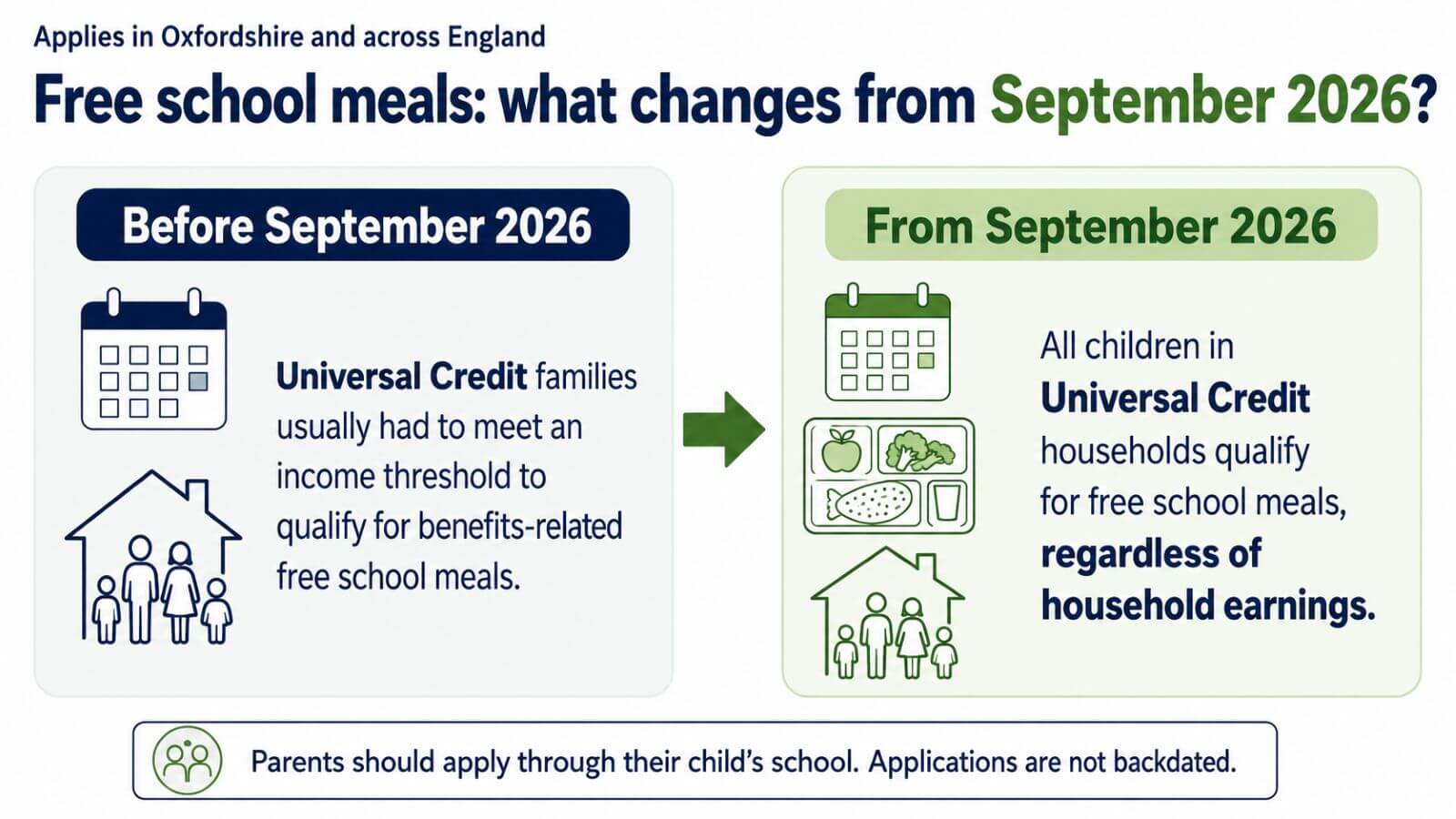
Until now, many families on Universal Credit only qualified for benefits-related free school meals if their annual household earnings were below the national threshold. From September 2026, that changes.
Children in households receiving Universal Credit will be entitled to free school meals regardless of household earnings. GOV.UK says that from the start of the 2026 to 2027 academic year, a child will qualify for free school meals if their family gets Universal Credit, regardless of household income.
That does not mean every related support scheme expands in the same way. The new system separates free school meal entitlement into different categories.
What this means for Oxfordshire families
The change is a national initiative aimed at improving access to school food, supporting child nutrition and helping families with the cost of living.
| If this applies to you | What it means |
|---|---|
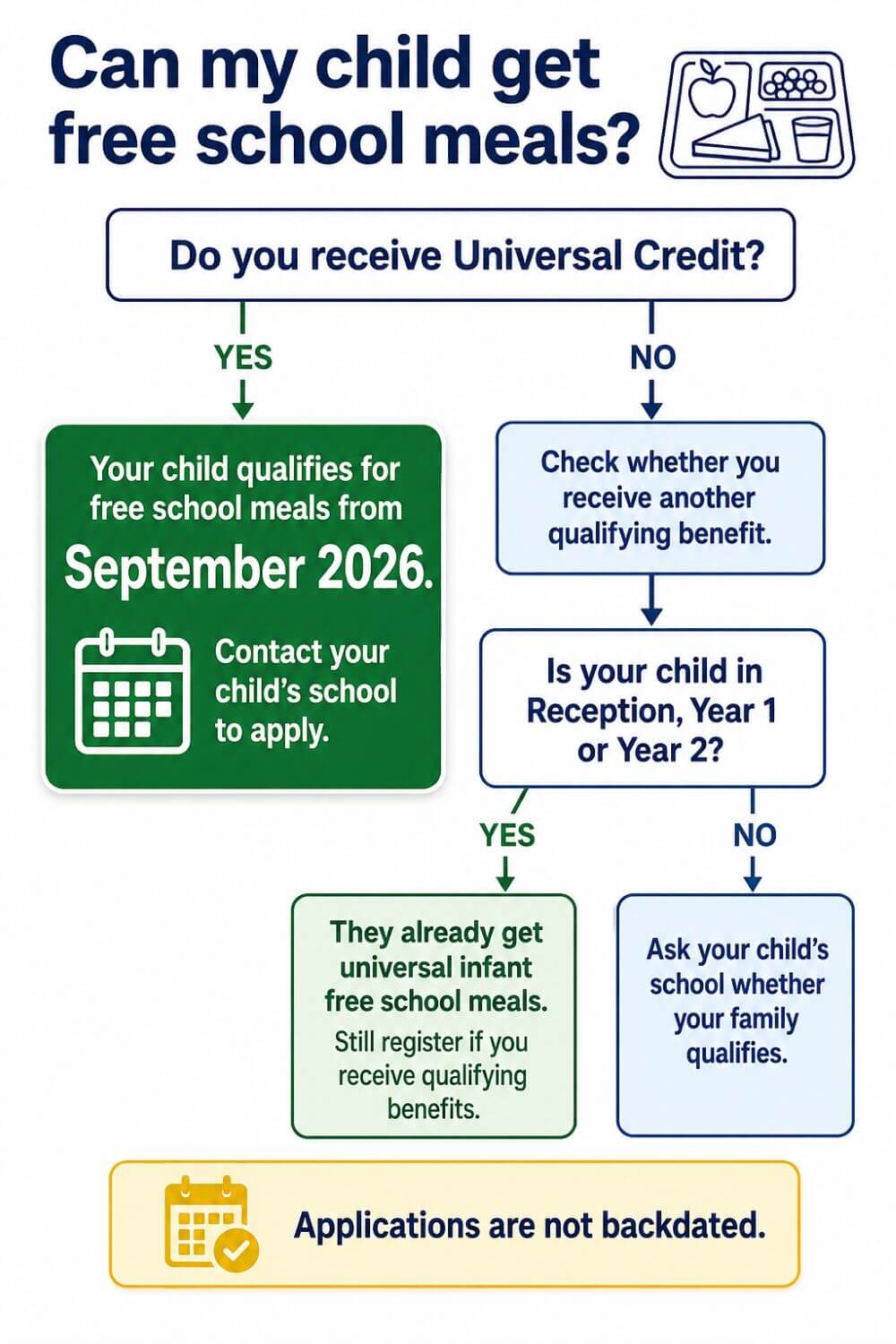
| You receive Universal Credit | Your child will be entitled to free school meals from September 2026. |
| Your child already gets free school meals | Existing transitional protections continue until July 2026; from September 2026, the new national rules apply. |
| Your child is in Reception, Year 1 or Year 2 | They already get universal infant free school meals, but you should still apply if you receive a qualifying benefit. |
| Your child is in primary school but older than Year 2 | The Universal Credit expansion may be especially relevant, because universal infant meals no longer apply after Year 2. |
| Your child is in nursery | Some children in eligible early years provision may also qualify, depending on age, attendance pattern and eligibility. |
| Your child qualifies through expanded FSM only | They get the meal, but this does not automatically attract pupil premium funding. |
The key information for parents is simple: if you receive Universal Credit, contact your child’s school and ask for the latest free school meals application details. Oxfordshire County Council says applications are not backdated, so families should apply as soon as they become eligible.
Targeted FSM, expanded FSM and infant free meals explained
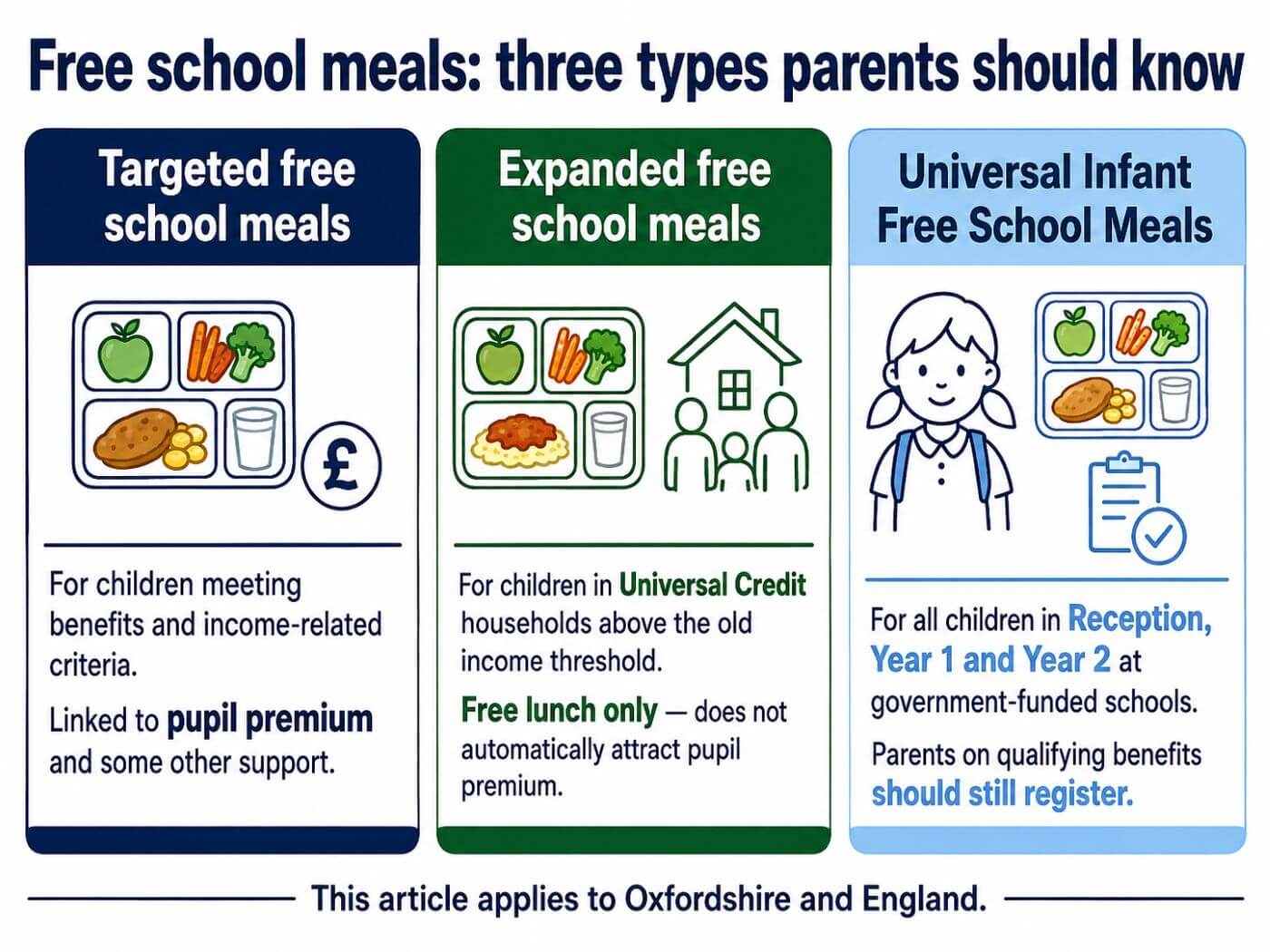
From September 2026, there are three main types of free school meal entitlement for families to understand.
| Type of free school meal | Who it covers | What else it affects |
|---|---|---|
| Targeted free school meals | Children whose parent or carer receives certain qualifying benefits and meets income-related criteria | This is the category linked to pupil premium and some other support. |
| Expanded free school meals | Children in Universal Credit households who do not meet the targeted FSM income threshold | This is meals-only and does not automatically attract pupil premium. |
| Universal Infant Free School Meals | All children in Reception, Year 1 and Year 2 at government-funded schools | This gives the meal regardless of family income, but benefit-eligible families should still register. |
The Department for Education says children in Universal Credit households with annual household earnings of £7,400 or less will be eligible for targeted FSM, which attracts pupil premium and other disadvantage funding. Children in Universal Credit households above that earnings threshold will be entitled to expanded FSM, which applies to meals only.
GOV.UK’s pupil premium guidance also says pupils who become eligible for free school meals for the first time through the new expanded FSM category will not attract pupil premium funding.
Why parents should still apply if their child already gets infant free meals
All children in Reception, Year 1 and Year 2 at government-funded schools in England already get free school meals through Universal Infant Free School Meals.
However, parents should still tell the local authority or school if they receive qualifying benefits, because the school may be able to receive extra funding if the child qualifies under the targeted free school meals criteria. GOV.UK makes this point directly for infant free meals, and Oxfordshire County Council says children may still qualify for targeted FSM in addition to universal infant free meals.
In simple terms: your child may already be getting the lunch, but the school may miss out on extra support funding if your family’s eligibility is not registered.
What if you receive Housing Benefit or Council Tax Support?
Families who receive Housing Benefit, Council Tax Support or another form of welfare support should not assume that those benefits alone automatically qualify a child for free school meals.
Instead, parents should check whether they also receive Universal Credit or one of the other qualifying benefits listed by Oxfordshire County Council and GOV.UK. If you are unsure, ask your child’s school for the free school meals application form or contact the relevant school meals service for advice.
This distinction matters because free school meal eligibility, pupil premium, holiday support and other linked services do not always use the same criteria.
Who qualifies in Oxfordshire?
From September 2026, children in Oxfordshire will qualify for free school meals if their parent or carer receives Universal Credit.
Oxfordshire County Council also lists other routes to eligibility, including support under Part VI of the Immigration and Asylum Act 1999, income-related Employment and Support Allowance, the guarantee element of Pension Credit, and some families with no recourse to public funds who meet separate criteria.
Children who receive qualifying benefits directly, instead of through a parent or guardian, can also get free school meals.
How do parents apply in Oxfordshire?
If a child is already enrolled at school, Oxfordshire County Council says the school is responsible for assessing eligibility.
Parents should contact their child’s school and request an application form. The school may ask for evidence of the parent or carer’s benefit. A child is only eligible where a claim has been made and the child’s eligibility has been verified by the school or local authority.
The Department for Education says schools and local authorities should begin accepting new applications as soon as possible and prepare to process applications from 1 June, so eligible pupils can receive meals from the start of the 2026/27 academic year.
What happens to families already receiving free school meals?
Transitional protections were introduced in 2018 so that children who became eligible for free school meals continued to receive them even if family circumstances later changed.
Oxfordshire County Council says those protections remain in place until the end of the 2025/26 academic year, in July 2026. From September 2026, the new national eligibility rules apply.
Oxfordshire Schools has also told schools that children who became eligible on or after 1 April 2018 continue receiving free school meals until July 2026, even if household circumstances have changed. From September 2026, transitional protections end and all pupils receiving free school meals will need eligibility confirmed through regular annual checks.
What about nursery children?
Some nursery children may also qualify.
Oxfordshire County Council says a child attending a maintained nursery, including academies, may be eligible for free school meals if they attend for a full day (before and after lunch) and their parent or carer receives a qualifying benefit.
Oxfordshire Schools says that from September 2026, eligibility expands to all children in households receiving Universal Credit, including children attending eligible early years provision in school-based nurseries and maintained nursery schools.
What support is linked to free school meals?
Free school meals can reduce the cost of school lunches, but families should understand which support is linked to which type of eligibility.
Targeted FSM remains important because the Department for Education says pupil premium, the Holiday Activities and Food programme and the extended rights element of school travel assistance continue to be based on targeted FSM, not expanded FSM.
| Support | What parents should know |
|---|---|
| Free lunch at school | Expanded to all children in Universal Credit households from September 2026. |
| Pupil premium | Continues to be based on targeted FSM, not meals-only expanded FSM. |
| Holiday Activities and Food programme | Continues to be linked to targeted or benefits-related FSM criteria. |
| Home-to-school transport | Separate scheme; free school meals do not automatically mean free transport. |
Oxfordshire County Council says free school meals and home-to-school transport are separate schemes with different eligibility criteria, although children eligible for targeted FSM can be considered for additional travel support under extended rights criteria.
Is holiday food support included?
Free school meals cover meals during the school day. Holiday support is separate.
Oxfordshire’s Holiday Activities and Food programme offers free sessions to families whose children are still eligible for benefits-related free school meals. Oxfordshire Schools also says there is a 15% vulnerability allowance, which means some children who are not on FSM but are considered vulnerable may be referred for free sessions.
Parents should not assume that free school meal eligibility automatically means holiday vouchers or holiday food support. Oxfordshire County Council’s school meals page treats school meals, HAF and transport as related but separate areas of support.
Why applying matters
For families, free school meals mean a healthy lunch at no cost.
Oxfordshire County Council’s free school meals auto-enrolment page says families could save up to £450 per year per child, and that children get access to nutritious meals that can support concentration, attendance and academic performance.
For schools, registering eligible pupils can also matter. Targeted free school meal eligibility helps determine additional pupil premium funding, while the national expansion also brings separate free school meals expansion funding to help schools meet the cost of providing more meals.
What parents should do now
Parents in Oxfordshire should contact their child’s school if they receive Universal Credit or another qualifying benefit.
This is especially important for:
- families receiving Universal Credit who previously earned too much to qualify
- parents of children moving from Year 2 to Year 3
- parents whose child already receives universal infant free meals
- families with children in eligible nursery provision
- families who previously relied on transitional protections
- families who may qualify for targeted FSM and linked support
Parents should apply as soon as they start receiving a qualifying benefit, because Oxfordshire County Council says applications are not backdated.
Why applying matters for nutrition, learning and inclusion
For families, free school meals can reduce the pressure on weekly food budgets and help make sure children have access to a regular, balanced school lunch.
For children, a reliable meal during the school day can support concentration, learning and inclusion. Good nutrition is not just about diet; it can affect whether pupils are ready to take part in lessons, activities and school life.
For schools, registration matters because targeted free school meal status can help identify pupils who may need extra support. That can affect pupil premium and other funding awards linked to disadvantage. Expanded FSM is different: it provides the meal, but it does not automatically bring the same linked funding.
The policy is also part of a wider conversation about poverty, hunger and equity. Families may be eligible for school meals, holiday food support, local food services or emergency help, but those schemes are not all the same and may have different application rules.
Where can Oxfordshire families get extra help with food?
Families who are struggling with food costs do not have to wait until the September 2026 free school meals expansion. Oxfordshire has local services, charities and community groups that may be able to help people with food, welfare advice and short-term support.
The Good Food Oxfordshire food map can help families find nearby foodbanks, community larders, community fridges and low-cost food projects. Oxford Food Hub signposts individuals to local food support, while SOFEA runs community larders in Oxfordshire and the Thames Valley.
Families in immediate food crisis may need a foodbank referral. Oxfordshire County Council says most foodbanks require a referral from an organisation such as a doctor, housing association, local council, charity or another support service.
During the main school holidays, Oxfordshire’s Holiday Activities and Food programme provides free holiday activities and meals for eligible children in Reception to Year 11 who receive benefits-related free school meals. Some vulnerable children may also be able to attend if referred by a school, family help practitioner or social worker.
Information for schools, charities and parent groups
Schools, charities, community groups and local organisations may want to share this information through newsletters, website content, parent emails, WhatsApp groups or LinkedIn updates.
A simple statement to share is:
From September 2026, children in Oxfordshire households receiving Universal Credit will be entitled to free school meals. Parents should contact their child’s school to apply, because applications are not backdated.
When sharing the details, it is important to explain that expanded free school meals and targeted free school meals are not identical. Expanded FSM gives the child a meal. Targeted FSM remains the category linked to pupil premium and some other support.
Frequently asked questions
Will all Universal Credit families in Oxfordshire get free school meals?
Yes. From September 2026, children whose parent or carer receives Universal Credit will be entitled to free school meals, regardless of household earnings.
Does expanded FSM include pupil premium?
No. Expanded FSM gives the child a free meal, but it does not automatically attract pupil premium. Pupil premium continues to be linked to targeted FSM.
Do I need to apply if my child is in Reception, Year 1 or Year 2?
Yes, if you receive a qualifying benefit. Your child already gets a free meal through Universal Infant Free School Meals, but registering targeted eligibility may help the school receive additional funding.
Are free school meal applications backdated in Oxfordshire?
No. Oxfordshire County Council says applications are not backdated, so parents should apply as soon as they start receiving a qualifying benefit.
Who do parents apply to?
If the child is already enrolled at school, Oxfordshire County Council says the school is responsible for assessing eligibility. Parents should contact the school and ask for an application form.
What if my family has no recourse to public funds?
GOV.UK says children may still be eligible for free school meals if the family does not qualify for most benefits because of no recourse to public funds. Parents should ask the school or local authority whether their child is eligible.
Does Housing Benefit or Council Tax Support mean my child automatically gets free school meals?
Not necessarily. Families receiving Housing Benefit, Council Tax Support or other welfare support should check whether they also receive Universal Credit or another qualifying benefit. The safest step is to ask the child’s school for the latest Oxfordshire free school meals application details.
Why does the type of free school meal matter?
The type matters because targeted FSM and expanded FSM are treated differently. Expanded FSM provides the meal. Targeted FSM can also link to pupil premium, the Holiday Activities and Food programme and some other support.
Does free school meals help children’s learning?
A regular school lunch can support nutrition, concentration and inclusion. Free school meals can also reduce pressure on family food budgets and help schools identify pupils who may need additional support.
The bottom line
More children in Oxfordshire will be entitled to free school meals from September 2026.
The biggest change is that children in households receiving Universal Credit will qualify regardless of household earnings. But parents should not assume the school will automatically know: if your child is already enrolled, Oxfordshire County Council says the school is responsible for assessing eligibility, and applications are not backdated.
For families, the change can reduce lunch costs. For schools, registering eligible pupils also helps make sure children are properly recorded for meals, funding and linked support where the targeted criteria apply.
Where can Oxfordshire families get extra help with food?
Families who are struggling with food costs do not have to wait until the September 2026 free school meals expansion. Oxfordshire has several local charities, foodbanks, community larders and council-backed support schemes that may be able to help.
Support can vary by area, and some services require a referral. Parents should check the latest local information before visiting or applying.
Food support in Oxfordshire at a glance
| Support | Who it may help | Where to start |
|---|---|---|
| Good Food Oxfordshire food map | Families looking for nearby foodbanks, community larders, community fridges or low-cost food projects. | Search the Good Food Oxfordshire map |
| Oxford Food Hub | People looking for signposting to local food services and community food support. | Oxford Food Hub: support for individuals |
| SOFEA community larders | Households looking for regular lower-cost food support through local community larders. | Find a SOFEA community larder |
| Local foodbanks | Families in immediate food crisis. Many foodbanks need a referral from a support organisation. | Oxfordshire County Council: help with rising living costs |
| Holiday Activities and Food programme | Eligible children in Reception to Year 11 who receive benefits-related free school meals, plus some referred vulnerable children. | Oxfordshire HAF programme |
| Oxfordshire Residents Support Scheme | Residents in short-term financial crisis who need help with basic living costs such as food or energy prepayment credit. | Oxfordshire Residents Support Scheme |
Good Food Oxfordshire food map
Good Food Oxfordshire has a food map that helps residents search for local foodbanks, community larders, community fridges and other food support. This is a useful first step for families who want to find help close to home.
Oxford Food Hub
Oxford Food Hub signposts individuals and families to organisations that can provide food support. It is a helpful route for people who are not sure which local service is most appropriate.
SOFEA community larders
SOFEA runs community larders in Oxfordshire and the Thames Valley. Community larders can help families access regular lower-cost food support, usually through a membership model.
Foodbanks and referrals
Families in immediate food crisis may need a foodbank referral. Oxfordshire County Council says most foodbanks need a referral to access them, which can come from organisations such as a doctor, housing association, local council, charity or other support service.
Holiday food support
During the main school holidays, Oxfordshire’s Holiday Activities and Food programme provides free holiday activities and food for eligible children in Reception to Year 11 who receive benefits-related free school meals. Some vulnerable children may also be able to attend if referred by a school, family help practitioner or social worker.
The programme runs during the longer school holidays, but Oxfordshire County Council says it does not run during half-term holidays.
Emergency financial help
Families facing short-term financial crisis can also check the Oxfordshire Residents Support Scheme. The scheme can help with short-term basic living costs, including food and credit for gas or electricity prepayment meters.
Free school meals, foodbanks, community larders, holiday food support and emergency hardship help are separate forms of support. Families may be able to use more than one route depending on their circumstances.
Information correct on 21st August 2026.